
Introduction
Tax compliance for software companies is genuinely complicated — and getting more so. SaaS products are taxed inconsistently across states, remote hiring creates multi-state obligations almost immediately, and compliance requirements keep expanding. According to Anrok, SaaS is now taxable in some form across 25 US jurisdictions, up from roughly 20 states just a few years ago.
That raises a practical question most founders and CFOs eventually face: when is the right time to outsource?
Outsource too early and you're paying for infrastructure a $200K-ARR startup doesn't need. Wait too long and you're looking at back taxes, state notices, and potential deal complications during your next fundraising round. This article breaks down the specific triggers, warning signs, and timing strategies that help software companies make this call correctly.
Key Takeaways
- Outsource when your obligations multiply: multi-state nexus thresholds, remote hires across state lines, or an upcoming funding round are all clear triggers
- SaaS taxability rules vary dramatically by state, making DIY compliance far more error-prone than in most other industries
- Early-stage, single-state companies may not yet need outsourced compliance; the cost isn't justified until obligations multiply
- The right partner offers multi-jurisdiction expertise, integrates with your billing systems, and scales as your business grows
Why Timing Matters for Tax Compliance in Software Companies
Software companies face a compliance profile unlike most other industries. Subscription billing pushes revenue across economic nexus thresholds in multiple states almost simultaneously. Remote hiring creates physical nexus before sales thresholds are even approached.
A 20-person SaaS company can carry tax obligations spanning a dozen states without anyone on the team realizing it — a situation no brick-and-mortar retailer faces.
The Cost Asymmetry Is Real
The price of outsourcing compliance is predictable — a monthly retainer or per-filing fee. The cost of non-compliance is not. Late sales tax penalties range from 10% in California and Texas to as high as 30% in New York, before interest compounds on top. For a company that's been non-compliant across five states for two years, those numbers add up fast.
Investors and acquirers have noticed. According to BDO's SaaS compliance research, sales tax exposure is a priority consideration during due diligence for strategic deals. Plante Moran notes that identified liabilities can lead buyers to seek seller remediation, escrows, or indemnities — sometimes holding back 10–20% of deal proceeds until exposure is resolved.
The Post-Wayfair Compliance Baseline
Those financial stakes trace back to a single regulatory shift. Since the South Dakota v. Wayfair (2018) Supreme Court ruling, every US state with a sales tax now enforces economic nexus requirements. The most common threshold — $100,000 in annual sales or 200 transactions — catches software companies faster than expected, especially those with monthly subscription billing generating hundreds of small transactions. Notable exceptions exist: California and Texas set their threshold at $500,000, while New York applies $500,000 plus more than 100 sales.
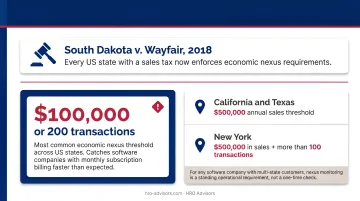
For any software company with multi-state customers, nexus monitoring is now a standing operational requirement — not a one-time check.
Scenarios That Signal It's Time to Outsource Tax Compliance
There's no single universal trigger. The right moment depends on your revenue volume, team structure, product mix, and growth trajectory. That said, a few scenarios consistently push companies past the point where internal management makes sense.
When Revenue Growth Crosses Nexus Thresholds
When your sales volume in states beyond your home state approaches $100,000 annually, you're entering a new tier of compliance obligation. For SaaS companies, this happens faster than founders expect — subscription billing generates both revenue and transaction counts simultaneously.
The compounding problem: a SaaS company can cross nexus thresholds in 10–15 states at roughly the same time, particularly if it's been growing steadily for 12–18 months without tracking state-level sales. One quarter you're a two-state compliance problem; the next you have 15 filing obligations. At that scale, internal teams are typically equipped for one or two states — not fifteen simultaneous registrations, filings, and rate lookups.
When Team Expansion Crosses State Lines
Hiring a remote engineer in Colorado or a sales rep in Georgia can create physical nexus in those states — even if you have zero customers there. This is one of the most common blind spots for fast-growing software startups that recruit nationally without thinking through the tax implications.
Physical nexus from remote employees doesn't just affect sales tax — it triggers payroll tax registration requirements as well. In California, employers must register with the EDD within 15 days of paying more than $100 in wages in a calendar quarter.
For software companies scaling headcount across states quickly, handling payroll tax compliance through a PEO is often the most practical option. HRO Advisors matches technology companies with PEO providers experienced in multi-state payroll obligations, at no cost to the business.
When Products or Business Models Change
Adding professional services to a SaaS product, bundling hardware with software, or launching a new product line can change your taxability profile overnight. States where you had a sales presence but no prior filing obligation may suddenly require registration. Most finance teams catch this months after the fact, well into a period where unfiled obligations have already accrued.
Before a Funding Round or Acquisition
Series A investors and acquirers expect clean books. Unresolved tax liabilities discovered during due diligence don't just create paperwork; they can delay closings, reduce valuations, or result in escrow holdbacks. Getting compliance current before a fundraising process starts is far cheaper than negotiating around liabilities after a term sheet is on the table.
Signs Your Software Company Is Ready to Outsource Tax Compliance Now
If your team recognizes three or more of the following, it's time to act — not plan to act.
Operational signals:
- Finance or accounting staff spend significant hours each month manually tracking state filing deadlines
- The company has received nexus questionnaires or notices from state tax authorities
- Filings have been submitted late, estimated rather than precisely calculated, or skipped entirely
These operational gaps tend to surface gradually — until a notice from a state authority makes them urgent. The compliance capability gaps below often explain why.
Compliance capability signals:
- Your billing platform (Stripe, Chargebee, etc.) doesn't automatically calculate tax across all applicable jurisdictions
- No one on the team can confidently classify whether your specific SaaS product is taxable in a given state — and the answer actually varies
- You're relying on QuickBooks' automated tax feature for multi-state compliance without verifying its jurisdictional coverage
Forward-looking signals:
- You're planning a geographic expansion, new product launch, or hiring push into new states within the next two quarters
- A funding round is on the horizon and compliance records haven't been formally reviewed
- The company crossed $1M in ARR and has customers in 10+ states
Outsourcing before a notice arrives typically costs a fraction of what remediation, back-filing, and penalties run after one does.
When to Hold Off on Outsourcing Tax Compliance
Outsourcing isn't the right move at every stage. If you're pre-revenue or generating less than $250K annually with customers in one or two states and no remote employees outside your home state, a managed multi-state compliance service will likely cost more than it saves.
At this stage, a well-configured accounting platform combined with a fractional CFO who understands SaaS tax can handle the basics. QuickBooks or Stripe Tax can cover single-jurisdiction calculations reasonably well, provided someone is monitoring your nexus exposure as you grow.
Set clear internal benchmarks that trigger a reassessment:
- Entering a third state through sales or hiring
- Hiring a fifth remote employee outside your headquarters state
- Crossing $250,000 in annual sales in any single state
- Receiving your first state tax notice or nexus questionnaire
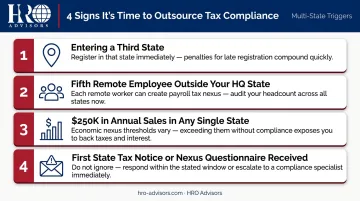
When any of these occur, the complexity of your exposure outpaces what internal tools can reliably manage. That's the point to start evaluating outside compliance support.
What Happens When You Get the Timing Wrong
The Compliance Debt Problem
When a software company has been non-compliant for two or three years before engaging an outsourcing partner, that partner can't just start filing going forward. They have to remediate first — identifying which states require back-filing, calculating what's owed, and navigating voluntary disclosure programs where available. This is expensive, time-consuming work that delays any forward-looking compliance posture.
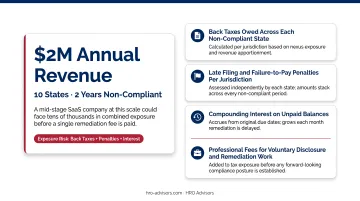
The math on penalties isn't abstract. A mid-stage SaaS company with $2M in annual revenue spread across 10 states, non-compliant for two years, could face tens of thousands of dollars in combined exposure. That number includes back taxes, penalties, and interest — before professional remediation fees enter the picture.
The cost components stack quickly:
- Back taxes owed across each non-compliant state
- Late filing and failure-to-pay penalties per jurisdiction
- Compounding interest on unpaid balances
- Professional fees for voluntary disclosure and remediation work
Strategic and Reputational Consequences
The M&A and fundraising risk is underappreciated. Tax liabilities discovered during due diligence rarely kill deals outright, but they do complicate them. Common outcomes include:
- Escrow holdbacks equal to the estimated liability
- Purchase price adjustments to account for discovered exposure
- Extended closing timelines while liabilities are resolved
- Indemnification provisions that follow founders after the deal closes
None of these outcomes are hypothetical. They're documented patterns in SaaS acquisition processes, consistently flagged by tax advisors and M&A counsel who work these deals.
Best Practices for Timing Tax Compliance Outsourcing Correctly
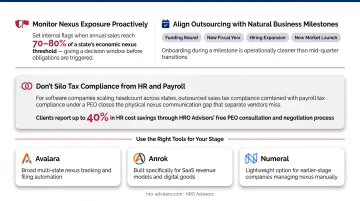
Monitor nexus exposure proactively. Set internal flags when annual sales to customers in any state reach 70–80% of that state's economic nexus threshold. This gives you a decision window before obligations are triggered.
Align outsourcing with natural business milestones. Closing a funding round, starting a new fiscal year, completing a hiring expansion, or launching into a new market all create natural transition points. Onboarding a compliance partner during a milestone is operationally cleaner than mid-quarter transitions.
Don't silo tax compliance from HR and payroll decisions. For software companies scaling headcount across states, the most efficient compliance posture combines outsourced sales tax compliance with payroll tax compliance under a PEO. Handling these separately creates gaps — most obviously when a new remote hire creates physical nexus that neither your sales tax vendor nor your payroll provider communicates to the other. HRO Advisors helps tech companies navigate exactly this gap — their free consultation compares PEO providers based on your specific workforce footprint and state exposure, with clients frequently reporting up to 40% in HR cost savings through the negotiation process.
Use the right tools for your stage. The platforms most commonly used by outsourcing partners for SaaS taxability and multi-jurisdiction monitoring include:
- Avalara — broad multi-state nexus tracking and filing automation
- Anrok — built specifically for SaaS revenue models and digital goods
- Numeral — lightweight option for earlier-stage companies managing nexus manually
Understanding these tools is worthwhile even before you're ready to engage a partner directly.
Frequently Asked Questions
When should software companies outsource tax compliance?
The right time is typically when the company begins crossing economic nexus thresholds in multiple states, hires remote employees across state lines, or is preparing for a funding round — whichever comes first. If two or more of these apply simultaneously, act immediately.
What is tax outsourcing for software companies?
Tax outsourcing means delegating compliance functions — nexus tracking, tax calculation, filing, and remittance — to external specialists or automated platforms with multi-jurisdiction expertise and dedicated SaaS compliance knowledge.
What are best practices for tax compliance for software companies?
Monitor nexus exposure before thresholds are crossed, align compliance decisions with business milestones, and outsource before complexity exceeds internal capacity. Using integrated billing and tax tools — with payroll and sales tax compliance coordinated under the same partners — reduces filing gaps.
What is tax compliance software for software companies?
Platforms like Avalara, Numeral, and Anrok automate nexus tracking, tax rate calculation, and filing across jurisdictions. These tools are designed specifically for SaaS taxability rules and are typically the core infrastructure used by outsourcing partners serving subscription businesses.
What are the signs that a software company needs to outsource tax compliance?
Key signals include receiving state tax notices, spending excessive internal hours on filings, operating in five or more states, or lacking internal expertise to determine product taxability in a given state. Any one of these warrants a serious reassessment.
How does hiring remote employees affect tax compliance for software companies?
Each state where a remote employee works can create physical nexus, triggering payroll tax registration and potentially sales tax filing obligations — regardless of whether the company has an office or customers there. These are separate legal requirements that must be managed in parallel.