
Introduction
A basic health plan and a few PTO days no longer cut it. Today's employees expect mental health coverage, student loan repayment, caregiving support, and flexible work arrangements — and according to SHRM's 2024 Employee Benefits Survey, 60% say benefits are a major factor in whether they stay with an employer.
The pressure on HR leaders heading into 2026 is real. Healthcare costs keep climbing, talent competition remains fierce, and a multi-generational workforce means no single benefits package satisfies everyone. Getting this right matters more than ever.
This guide gives HR teams a practical roadmap for 2026: what benefits to offer, how to structure them, and how smaller businesses can access Fortune 500-level packages through PEO partnerships — without the Fortune 500 budget.
Key Takeaways
- 83% of workers say retirement benefits are a major factor in their final job decision — benefits directly drive hiring outcomes
- Employee benefits fall into two categories: statutory (legally required) and voluntary (employer-elected) — understanding both shapes every compliant, competitive benefits strategy
- 2026 HR best practices hinge on needs assessments, competitive benchmarking, consistent communication, and ROI tracking
- Benefits represent 30.1% of total private-sector compensation costs — most employees dramatically underestimate this value
- PEO partnerships give small and mid-sized businesses access to enterprise-level benefits at group rates — typically at no added cost
What Are Employee Benefits in Human Resource Management?
Employee benefits are non-wage compensation an employer provides beyond base salary: health insurance, retirement plans, paid leave, wellness programs, and other structured non-cash offerings. Managing these programs is a core HR function, not a back-office task.
Benefits as a Strategic Tool
Benefits aren't just compliance checkboxes. They reflect company culture, signal organizational values, and directly influence whether people join, stay, or leave.
EBRI's 2025 Workplace Wellness Survey found that 72% of workers cited health insurance as the top benefit when deciding whether to stay at or leave a job — retirement savings plans followed at 62%. That's not a soft metric. That's a retention lever HR controls.
Total Compensation vs. Base Salary
Most employees dramatically underestimate what their benefits cost. BLS data from March 2026 shows private-industry employers averaged $14.01 per hour in benefits costs alongside $32.60 in wages and salaries — meaning benefits represent 30.1% of total compensation.
Yet EBRI found workers believe benefits make up only 16% of their total compensation. That 14-point gap doesn't reflect a weak benefits program — it reflects a communication gap HR can close through total compensation statements that translate benefit value into real dollar terms.
Benefits vs. Perks
The distinction matters practically:
- Benefits — structured, ongoing programs: health insurance, 401(k), PTO, disability coverage
- Perks — discretionary extras: gym subsidies, free lunches, pet-friendly offices
Both contribute to your employee value proposition. Employees notice when one is used to mask the absence of the other.
The HRIS Connection
Managing benefits across a multi-generational workforce without technology creates errors and blind spots. Human Resource Information Systems (HRIS) increasingly handle enrollment, carrier connections, utilization tracking, and compliance reporting, making them essential infrastructure for any benefits program operating at scale.
The Main Types of Employee Benefits
Health and Wellness Benefits
Health coverage remains the anchor of any competitive benefits package. For employers with 50 or more full-time equivalent employees, the ACA's employer shared responsibility provision requires offering affordable minimum essential coverage to at least 95% of full-time employees and their dependents — or risk IRS penalties.
Common plan types and how they differ:
| Plan Type | Key Feature | Best For |
|---|---|---|
| HMO | Requires in-network providers; lower premiums | Cost-conscious employees with predictable care needs |
| PPO | Flexible in/out-of-network access; no referrals needed | Employees who value provider choice |
| HDHP | Higher deductibles; HSA-eligible | Younger, healthier employees building savings |
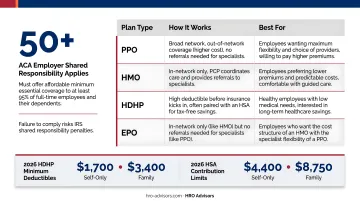
For 2026, IRS sets HDHP minimum deductibles at $1,700 self-only / $3,400 family, with HSA contribution limits of $4,400 self-only / $8,750 family.
Retirement and Financial Security Benefits
Transamerica's 2025 report found 83% of workers consider retirement benefits a major factor in job decisions. For 2026, the 401(k) employee deferral limit rises to $24,500, with a $8,000 catch-up for those 50+ and $11,250 for those ages 60-63.
Beyond 401(k), the financial security umbrella includes:
- 403(b) plans for nonprofits and educational institutions
- Pension plans (increasingly rare in private sector)
- FSAs and HSAs for tax-advantaged healthcare spending
- Life and disability insurance
- Student loan repayment matched through 401(k) contributions (SECURE 2.0, effective 2024)
Paid Time Off and Leave Benefits
PTO structures range from traditional accrual systems to unlimited policies. Legally, FMLA applies to employers with 50+ employees and guarantees eligible workers up to 12 weeks of unpaid, job-protected leave annually for qualifying family and medical events.
Paid parental leave, while not federally mandated, is spreading fast. SHRM reported in 2026 that 46% of employers now offer paid parental leave — up 7 percentage points from 2025.
Work-Life Balance and Flexibility Benefits
Flexibility has become a retention factor in its own right. Gallup data shows that among remote-capable workers, 6 in 10 prefer hybrid arrangements and fewer than 10% prefer fully on-site work. For most knowledge workers, schedule flexibility is no longer a perk — it's a deciding factor when evaluating offers.
This category includes:
- Flexible scheduling and remote/hybrid options
- Childcare assistance and backup care
- Eldercare resources
- Employee Assistance Programs (EAPs)
Supplemental and Emerging Benefits
Beyond core coverage, a growing set of benefits is reshaping what competitive employers offer — particularly in tight labor markets where candidates weigh total compensation carefully:
- Student loan repayment assistance
- Mental health coverage beyond basic EAPs
- Fertility and family-building benefits
- Pet insurance
- Financial wellness programs and coaching
Statutory vs. Voluntary Employee Benefits: What HR Must Know
Statutory (Mandatory) Benefits
These are non-negotiable — legally required regardless of employer preference:
- Social Security and Medicare (FICA) — employer and employee contributions required by IRS
- Unemployment insurance — joint state-federal program administered by each state
- Workers' compensation — governed by state workers' compensation boards for private-sector employees
- FMLA-protected leave — applies to employers with 50+ employees
Requirements vary by employer size and state. What's mandatory in Delaware may differ from requirements in Texas — and that gap keeps growing.
Voluntary (Fringe) Benefits
Offered at employer discretion, yet increasingly treated as standard:
- Health insurance (required only for ALEs under ACA)
- 401(k) and retirement plans
- PTO beyond legally mandated sick leave
- Dental and vision coverage
- Wellness programs and supplemental perks
Candidates now benchmark voluntary benefits against industry norms before accepting offers — what was once a differentiator is quickly becoming the baseline.
The Compliance Landscape
HR must navigate several overlapping frameworks:
- ERISA — sets minimum standards for retirement and health benefit plans
- ACA — employer shared responsibility for applicable large employers (50+ FTEs)
- ADA — reasonable accommodation requirements that can extend to benefit offerings
State-level complexity is accelerating. Delaware's Paid Leave program became fully effective January 1, 2026, covering most businesses with 10+ employees. Minnesota's state Paid Leave program is also active in 2026. NCSL maintains a state-by-state tracker of enacted programs — worth bookmarking for any HR team managing multi-state workforces.
Keeping up with that tracker is one thing; acting on it across multiple jurisdictions is another. That operational burden is a common reason businesses bring in PEO partners with dedicated multi-state compliance expertise.
HR Best Practices for Employee Benefits Administration in 2026
Conduct Regular Benefits Needs Assessments
Effective benefits programs start with listening. Annual or semi-annual surveys, exit interviews, and utilization data reveal what employees actually use — and what they don't.
Generational differences matter here. Mercer research shows:
- Gen Z prioritizes digital tools and mental health support
- Millennials often need family-building and caregiving benefits
- Gen X values financial wellness and caregiving resources
- Boomers focus on health management and chronic-condition support
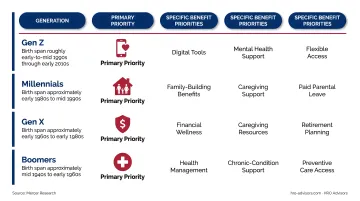
Knowing which segments are underserved — before open enrollment, not after — is where benefits strategy actually begins.
Benchmark Against Industry and Market Standards
Without external reference points, it's impossible to know whether your benefits package is competitive or simply average. The strongest practice is annual or biannual benchmarking against industry peers and regional competitors.
Use a combination of:
- SHRM's annual benefits survey data
- Mercer and other compensation data platforms
- Broker insights from partners with broad market visibility
Benchmarking also surfaces coverage gaps that internal data alone won't catch.
Improve Benefits Communication and Education
Great benefits go to waste when employees don't understand them. SHRM reported that 46% of workers regret open enrollment decisions — a number that reflects a communication gap, not a benefits gap.
Best practices that move the needle:
- Communicate year-round, not just during open enrollment season
- Use multiple channels: email, intranet, short-form video, manager talking points
- Provide decision-support tools that help employees model plan options against their own situation
- Offer one-on-one benefits consultations during enrollment periods
Ensure Compliance and Track Legislative Changes
Build a compliance calendar that tracks:
- IRS limit updates — 401(k) and HSA limits change annually
- ACA reporting deadlines — Forms 1094-C and 1095-C
- State-level paid leave expansions — new programs are launching regularly
- ERISA fiduciary obligations for plan sponsors
Annual reviews with legal counsel or a benefits advisor are standard practice for any HR team carrying real plan liability — and skipping them creates exposure that's rarely worth the time saved.
Measure Benefits ROI and Utilization
HR should track metrics that tie benefits investment to business outcomes. SHRM's well-being ROI framework identifies four core metrics to track:
- Healthcare cost trends over time
- Absenteeism rates correlated with wellness program participation
- Turnover rates among employees with high vs. low benefits satisfaction
- Productivity indicators tied to mental health and EAP utilization
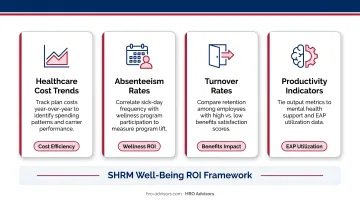
These numbers tell you what's working, what's being ignored, and where the next dollar in benefits spend will have the most impact.
Emerging Employee Benefits Trends for 2026
Mental Health Has Moved to the Core
Mental health coverage is no longer a differentiator — it's a baseline expectation. SHRM found that workers aware of mental health resources were 10 percentage points more likely to say they wouldn't leave their current job for one with better mental health benefits.
Yet the gap between expectation and reality persists: 59% of U.S. workers say their organization provides too few mental health resources. And among large employers, only 46% characterized their mental health and substance-use network as "very broad" — compared to 68% for medical services overall.
Strong mental health benefits in 2026 include therapy coverage with adequate network depth, EAPs with dedicated mental health components, and digital mental health platforms that reduce access friction.
Personalization and Flexible Benefits
Employees increasingly resist one-size-fits-all packages. Lifestyle Spending Accounts (LSAs) let employees allocate benefit dollars toward what they actually value. Mercer data shows roughly 70% of employers were considering adding an LSA as of its last major survey, with typical annual funding ranging from $500 to $2,000.
Two approaches helping employers expand perceived value without dramatically increasing cost:
- LSAs — employee-directed spending on fitness, childcare, education, or pet care
- Voluntary benefits menus — curated supplemental options employees choose from based on personal priorities
Caregiving Support Is Expanding
The numbers are significant: AARP's 2025 report found that approximately 63 million Americans — nearly 1 in 4 adults — are family caregivers. Of those, 7 in 10 are employed, and 29% are sandwich-generation caregivers supporting both children and aging parents simultaneously.
Yet only 25% of working caregivers are offered paid leave designated for adult caregiving. Employers who close that gap — through backup care, flexible scheduling, and expanded family leave — gain a direct retention advantage in a workforce where caregiving conflicts are one of the top reasons employees reduce hours or exit entirely.
Streamlining Benefits Administration: Tools and Approaches
The Administrative Challenge
Benefits administration is among the most time-intensive functions HR manages. Open enrollment, carrier connections, compliance reporting, employee communication, and data management all compound during peak periods. Manual processes amplify the risk: ADP notes that manual benefits administration often requires entering identical employee data into multiple systems, creating exposure to coverage errors and compliance gaps.
What Good Benefits Technology Does
Modern HRIS and dedicated benefits platforms handle the heavy lifting:
- Automate enrollment workflows and eligibility tracking
- Connect directly to carriers via EDI, eliminating manual re-keying
- Provide employee self-service portals for plan selection and life event changes
- Generate ACA and ERISA compliance reports
- Track utilization by benefit type and employee segment
When evaluating platforms, HR leaders should prioritize:
- Guided open enrollment with built-in decision-support tools
- Single-database architecture that eliminates duplicate data entry
- Carrier connectivity to 100+ insurance partners
- Role-based access controls and data security standards
The PEO Option for Small and Mid-Sized Businesses
Technology platforms solve the workflow problem, but they don't solve the buying-power problem. For businesses without the employee count to negotiate competitive group rates independently, a Professional Employer Organization (PEO) partnership changes the math.
PEOs pool employees across many companies — giving SMBs access to health plans, retirement options, and ancillary coverage typically reserved for large employers.
NAPEO data shows businesses using a PEO grow twice as fast, experience 12% lower employee turnover, and are 50% less likely to go out of business than comparable non-PEO companies. The average ROI from PEO engagement has been measured at 27.2%, with cost savings averaging $1,775 per employee per year.
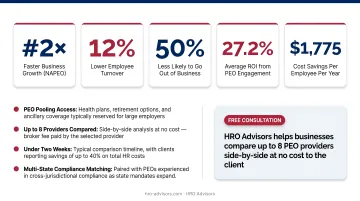
HRO Advisors helps businesses compare up to 8 PEO providers side-by-side at no cost to the client. The broker fee is paid by the selected provider and doesn't increase what the client pays. Most comparisons wrap up in under two weeks, with clients reporting savings of up to 40% on total HR costs. For multi-state businesses, HRO Advisors specifically matches companies with PEOs experienced in cross-jurisdictional compliance — an increasingly relevant factor as state-level benefits mandates continue to expand.
Frequently Asked Questions
What are employee benefits in human resource management?
Employee benefits are non-wage compensation provided beyond base salary — including health insurance, retirement plans, paid leave, and wellness programs. Administering and optimizing these benefits is a core HR function that directly affects recruitment, retention, and compliance.
What are the main types of employee benefits?
Benefits generally fall into four categories: health and wellness (medical, dental, vision), financial security (401(k), life and disability insurance), time-off and leave (PTO, FMLA, parental leave), and supplemental benefits such as FSAs, HSAs, student loan assistance, mental health programs, and flexible work arrangements.
What are the benefits of HRIS?
HRIS platforms simplify benefits administration by automating enrollment, centralizing employee data, and connecting directly to insurance carriers. Employees can manage their own selections through self-service portals, while HR teams get compliance and utilization reports — cutting manual errors and freeing up administrative time.
What HR best practices should companies follow for employee benefits in 2026?
Key practices include:
- Survey employees regularly to identify what benefits they actually value
- Benchmark offerings against industry peers annually
- Communicate benefits year-round, not just during open enrollment
- Track utilization data to cut underused programs and reinvest elsewhere
- Consider PEO or technology partnerships to reduce administrative burden
How can small businesses offer competitive employee benefit packages?
Partnering with a PEO gives small businesses access to group health insurance rates and benefit packages typically available only to large employers. PEOs pool employees across many companies, lowering per-employee costs while expanding coverage options — often resulting in better benefits than businesses could secure independently.
How often should HR review and update the employee benefits program?
At minimum annually, ideally before open enrollment. Each review should cover utilization data, market benchmarks, employee feedback, and any regulatory changes — then adjust offerings accordingly.