Introduction
Running a hotel means managing a workforce that never clocks out. Housekeepers start at dawn, front desk staff work overnight shifts, and maintenance responds around the clock.
Each department carries different pay structures, scheduling needs, and compliance obligations — and that's before factoring in tipped employees, seasonal hiring surges, and multi-state labor laws.
That compliance complexity falls hardest on hotel management companies, where HR errors translate directly into guest experience failures and legal exposure.
According to the American Hotel & Lodging Association, 65% of hotels reported staffing shortages as of early 2025, with 71% unable to fill open positions despite active recruiting. A Professional Employer Organization (PEO) addresses that gap directly, handling payroll, benefits, compliance, and risk management so hotel operators can refocus on occupancy, revenue, and the guest experience.
Key Takeaways:
- PEOs handle payroll, compliance, and benefits — hotels keep full operational control
- Tipped wages, multi-state filings, and seasonal headcount are manageable through the right PEO
- Small hotel companies can access Fortune 500-level benefits via PEO group purchasing
- NAPEO research shows PEO clients save an average of $1,775 per employee annually
- HRO Advisors compares 3–8 PEO providers side-by-side for hotel companies — at no cost
What Is a PEO for Hotel Management Companies?
Hotel management companies juggle staffing across departments, properties, and sometimes multiple states — all while trying to keep labor costs from eating into margins. A PEO (Professional Employer Organization) addresses that directly by entering into a co-employment relationship with your company. Your hotel retains full operational control, while the PEO becomes the employer of record for payroll processing, tax filings, benefits administration, and HR compliance.
What Co-Employment Actually Means
Many hotel operators hear "co-employment" and immediately worry about losing control of their staff. That concern makes sense — but it's misplaced.
Your hotel still:
- Hires, fires, and promotes employees
- Sets schedules and directs day-to-day work
- Manages performance and workplace culture
- Makes all operational decisions
The PEO handles:
- Payroll processing and tax withholdings
- W-2 preparation and multi-state tax filings
- Benefits enrollment and administration
- HR compliance documentation and policy management
- Workers' compensation coverage and claims
PEO vs. Payroll Provider vs. Staffing Agency
Once hotel operators understand co-employment, the next question is usually: "How is this different from what we're already using?" The answer matters — because payroll providers and staffing agencies are often considered substitutes for a PEO, but they cover very different ground:
| Model | What It Covers | Who Employs Workers |
|---|---|---|
| PEO | Full HR suite — payroll, benefits, compliance, risk | Shared (co-employment) |
| Payroll provider | Paycheck processing only | Hotel |
| Staffing/leasing agency | Supplies temporary workers | Staffing agency |
A payroll-only provider won't touch your compliance exposure or benefits costs. A staffing agency supplies workers who belong to that agency — not your culture or operation. A PEO covers all three areas simultaneously, and your employees remain yours throughout.
Why Hotel Management Companies Face Unique HR Challenges
Hotels don't face ordinary HR complexity. They face several overlapping challenges simultaneously — each one capable of generating real financial and legal risk.
High Turnover and Its Compounding Cost
The accommodation and food services sector recorded a 5.6% monthly total separations rate in April 2026, according to BLS Job Openings and Labor Turnover data. Annualized, that pace represents one of the highest workforce churn rates of any industry.
That churn has a price. SHRM reports the average cost per hire is nearly $4,700, and total replacement costs — including lost productivity from inexperienced new hires — can reach three to four times a position's annual salary when soft costs are included. Multiply that across housekeeping, front desk, and food service roles at multiple properties, and the numbers compound quickly.
Payroll Complexity Unique to Hotels
Hotel payrolls are genuinely complicated. A single property may employ:
- Tipped workers (servers, bartenders, valet staff) — subject to FLSA tip credit rules allowing as little as $2.13/hour in direct wages
- Hourly shift workers — requiring overtime calculations, break compliance, and shift differential pay
- Salaried managers — with different exemption classifications
- Seasonal part-timers — cycling in and out across peak periods
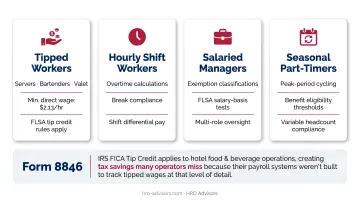
The IRS FICA tip credit (Form 8846) also applies to hotel food and beverage operations, creating potential tax savings that many operators miss entirely because their payroll systems weren't built to track tipped wages at that level of detail.
Multi-State and Seasonal Complexity
Hotel management companies overseeing properties across state lines face a compliance tangle that grows with every new jurisdiction. NCSL data shows 34 states, territories, and districts have minimum wages above the federal floor. At least 21 states have paid sick leave mandates, plus dozens of local ordinances governing predictive scheduling in cities like Chicago, New York, Los Angeles, and Seattle.
Seasonal staffing sharpens that pressure. Headcount swells during summer and holiday peaks, then contracts sharply in off-season months — forcing rapid onboarding and offboarding cycles that can overwhelm a lean HR team.
The Benefits Gap Hurts Recruiting
Independent hotel management companies rarely offer the benefits packages that large hotel chains or other industries can provide. The KFF 2025 Employer Health Benefits Survey found that only 59% of small firms offered health benefits at all, versus 97% of large firms. That gap shows up directly in recruiting — and with housekeeping and front desk roles topping AHLA's list of hardest positions to fill, a weak benefits package often ends the conversation before it starts.
Core Services a Hotel PEO Provides
A hotel PEO doesn't just process paychecks. It delivers an integrated HR infrastructure built for the operational realities of hotel management.
Payroll Processing and Tax Administration
PEOs automate payroll for every employee classification in your workforce — tipped, hourly, salaried, and seasonal. That includes:
- Tip reporting and FLSA tip credit calculations
- FICA and federal/state tax withholdings
- Multi-state tax filings across all properties
- W-2 preparation and year-end compliance
- Shift differentials and overtime calculations
For hotel management companies operating across multiple states, this alone eliminates one of the most error-prone and time-consuming administrative functions.
Benefits Administration and Access
This is where PEOs deliver some of their most tangible value for hotel operators. PEOs pool employees across their entire client base — potentially tens of thousands of workers — to negotiate group health, dental, vision, life, and 401(k) plans at rates typically reserved for large corporations.
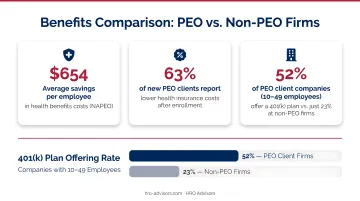
NAPEO research shows PEO clients saved an average of $654 per employee in health benefits costs, with 63% of new PEO clients reporting lower health insurance costs after enrollment. On retirement benefits, PEO client companies with 10–49 employees offered 401(k) plans at a 52% rate versus just 23% for comparable non-PEO firms — a meaningful recruiting advantage against larger competitors.
HR Management and Employee Relations
PEOs provide onboarding tools, employee handbook development, performance management frameworks, and support for workplace dispute resolution. For hotel environments, where employee relations directly affect the guest experience, having consistent HR policies and documentation isn't optional — it's operational infrastructure.
Workers' Compensation and Safety Programs
Hotel roles carry real physical injury risk — housekeeping faces musculoskeletal strain, kitchen staff work near heat and sharp equipment, and maintenance teams handle chemicals daily. A PEO manages workers' comp coverage, processes claims, and provides safety training programs tailored to these environments, including:
- Ergonomics and injury prevention for housekeeping
- Slip-and-fall safety across guest and service areas
- Food service safety protocols for kitchen staff
Time, Attendance, and Scheduling Integration
Most PEOs offer or integrate with scheduling and time-tracking systems that handle rotating shifts, overtime thresholds, and break compliance across multiple properties. This reduces manual timekeeping errors and lightens the manager workload — especially useful when running properties across different time zones or under varying local scheduling mandates.
How a PEO Manages Compliance and Reduces Legal Risk for Hotels
Compliance failure isn't theoretical for hotel operators. The DOL Wage and Hour Division recovered more than $259 million in back wages for nearly 177,000 employees in FY2025 — the highest recovery since 2019. Hotels are a frequent enforcement target.
Federal Labor Law Compliance
PEOs monitor and enforce FLSA compliance, covering minimum wage, overtime calculations, and tip credit rules. One DOL enforcement initiative in Georgia's hotel industry alone recovered more than $283,000 in back wages from more than 140 investigations, plus over $27,000 in civil money penalties for repeat violations.
A PEO builds the payroll accuracy and documentation systems that keep hotels off that list.
State and Local Regulation Tracking
For multi-property hotel management companies, staying current with jurisdiction-specific laws is a constant moving target. A hospitality-experienced PEO tracks:
- State minimum wage changes (active across 34+ jurisdictions)
- Paid sick leave mandates (21+ states, dozens of localities)
- Predictive scheduling requirements (Oregon statewide, plus Chicago, New York City, Seattle, Los Angeles, and others)
- Background check restrictions and ban-the-box laws
When laws change, the PEO updates policies before the effective date, so hotels aren't scrambling to catch up after enforcement begins.
OSHA Workplace Safety Compliance
PEOs develop and maintain safety protocols tailored to hotel operations — areas that OSHA inspectors scrutinize closely. Coverage typically includes:
- Chemical handling procedures for housekeeping staff
- Ergonomics programs for employees doing repetitive physical tasks
- Incident reporting systems that meet OSHA recordkeeping requirements
Employment Practices Liability
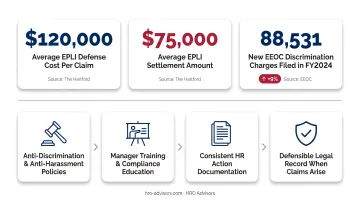
Safety protocols reduce physical injury risk, but employment practices liability is a separate exposure — and an equally costly one. Employment claims are expensive regardless of merit. The Hartford reports that average EPLI defense costs run approximately $120,000 per claim, with average settlements around $75,000. EEOC data shows 88,531 new discrimination charges were filed in FY2024 — a more than 9% increase over the prior year.
PEOs help hotels implement anti-discrimination and anti-harassment policies, conduct manager training, and document HR actions consistently. That documentation — dated records of warnings, performance reviews, and corrective actions — gives legal counsel something to work with when a claim does surface.
What to Look for When Choosing a PEO for Your Hotel Management Company
Not every PEO is equipped to handle the operational complexity of hotel management. Choosing the wrong provider can create new problems rather than solving existing ones.
Hospitality Industry Experience
Ask directly: does this PEO serve hotel management companies? Can they provide references or client examples from the hospitality sector?
A hospitality-experienced PEO already understands:
- Tip reporting workflows and FICA tip credit mechanics
- Seasonal staffing cycles and headcount fluctuations
- Multi-property payroll structures across locations
That existing knowledge means faster implementation and fewer costly missteps during setup.
Scalability for Seasonal and Multi-Property Operations
Your PEO must handle headcount fluctuations without penalizing you for off-peak reductions. Before signing, clarify:
- Per-employee vs. percentage-of-payroll pricing — per-employee models may be more cost-effective during low seasons when headcount drops
- Multi-state filing capabilities — confirm the PEO operates in every state where you manage properties
- Onboarding speed — how quickly can they activate new seasonal employees during peak hiring periods
Transparent Pricing, Technology, and Dedicated Support
Three practical criteria matter most during evaluation:
- Pricing clarity — all fees disclosed upfront, no hidden administrative charges
- Technology integration — the PEO's HR platform should connect with your property management or scheduling systems, not require parallel manual processes
- Dedicated account support — hotel operators need a consistent contact who understands their portfolio, not a rotating call center
Once you've identified what matters most for your portfolio, evaluating several PEOs side-by-side against these criteria — rather than one at a time — gives you the clearest picture of where each provider actually stands.
How HRO Advisors Helps Hotel Companies Find the Right PEO Partner
HRO Advisors is a PEO broker — meaning the firm works for you, not for any PEO provider.
Using a network of more than 500 PEO providers, HRO Advisors collects your HR data and identifies providers with hospitality industry experience and multi-state capabilities. You receive side-by-side comparisons of 3–8 PEOs covering pricing, services, technology, and benefits quality — typically within two weeks of your initial consultation.
No Cost, No Obligation, No Bias
HRO Advisors' service is free to hotel management companies. The firm is compensated by the PEO you ultimately select, and that compensation doesn't increase your cost. The business model is built around finding the right long-term fit — not steering clients toward a single provider.
That same independence applies when things aren't working. If your current PEO relationship has run its course, HRO Advisors provides switching support — managing the transition across health benefits, payroll, workers' comp, and HR administration to minimize disruption.
What Hotel Companies Can Realistically Achieve
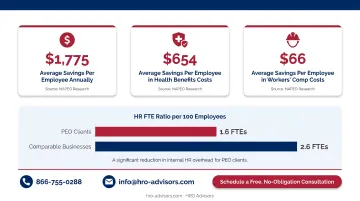
NAPEO research on PEO outcomes across small and mid-sized businesses shows:
- $1,775 average savings per employee annually
- $654 average savings per employee in health benefits costs
- $66 average savings per employee in workers' comp costs
- 1.6 HR FTEs per 100 employees for PEO clients versus 2.6 for comparable businesses — a significant reduction in internal HR overhead
To find out what's achievable for your specific operation, contact HRO Advisors directly:
- Phone: 866-755-0288
- Email: info@hro-advisors.com
- Schedule a free, no-obligation consultation to receive your side-by-side PEO comparison
Frequently Asked Questions
What does a PEO for hotels include?
A hotel PEO typically covers payroll processing and tax filing, benefits administration, workers' comp coverage, HR compliance support, employee onboarding tools, and risk management services — all delivered under a co-employment model where the hotel retains full operational control.
How does a PEO differ from a payroll provider or employee leasing?
A payroll provider only processes paychecks, while a PEO delivers the full suite of HR, compliance, and benefits services. Employee leasing means a staffing agency supplies workers it owns; with a PEO, your existing employees stay with your hotel under a shared administrative structure.
Who should use a PEO for hotels?
Any hotel management company — boutique or multi-location — is a strong candidate. The fit is especially clear when dealing with high turnover, multi-state compliance, limited in-house HR capacity, or trouble offering competitive benefits.
Can a PEO handle seasonal and part-time hotel staff?
Yes. PEOs handle variable staffing directly, supporting rapid onboarding and offboarding during peak and off-peak seasons while keeping payroll and compliance accurate regardless of headcount changes.
How much can a hotel management company save with a PEO?
NAPEO data shows average savings of $1,775 per employee annually across PEO clients, with additional reductions in health benefits and workers' comp costs. Actual hotel savings depend on property size, current inefficiencies, and how well the PEO matches your operation.
Will I lose control of my employees if I use a PEO?
No. Operational control — hiring decisions, scheduling, performance management, and daily supervision — stays entirely with your hotel management company. The PEO only assumes employer-of-record responsibilities for tax, payroll, and benefits administration.