Introduction
Every pay period, the same cycle repeats. Timesheets get collected, wages get calculated, deductions get applied, taxes get filed — and somewhere in the middle of all that, the business owner or office manager who's handling it looks up and realizes half their day is gone.
According to a Bloomberg Tax survey cited by Complete Payroll Solutions, small business owners spend roughly 5 hours each pay period processing payroll manually. Multiply that across 26 biweekly pay runs and that's 130+ hours a year — on payroll alone.
Payroll services are often treated as optional — a luxury for larger businesses. In practice, the case for them comes down to penalties avoided, hours recovered, and errors that never occur in the first place. This article breaks down five specific, measurable reasons payroll services deliver a real return.
Key Takeaways
- Manual payroll consumes 5+ hours per pay period; automated systems cut that to 15 minutes or less
- IRS failure-to-deposit penalties escalate up to 15% — payroll services eliminate that exposure
- One in five payrolls contains errors, costing an average of $291 each to fix
- Payroll providers deliver enterprise-grade data security most small businesses can't replicate in-house
- Self-service portals handle routine HR requests directly, freeing your team for higher-value work
What Are Payroll Services?
Payroll services are third-party providers (including software platforms, Professional Employer Organizations (PEOs), and full-service outsourcing firms) that handle wage calculation, tax withholding, direct deposit, and compliance filing on a business's behalf.
They apply across any business with employees, but deliver the most value where internal HR capacity is thin, headcount is growing, or operations span multiple states.
The spectrum looks like this:
- Payroll software automates processing but keeps compliance responsibility with the employer
- Full-service outsourcing hands off processing and filing entirely
- PEOs go further, acting as a co-employer that bundles payroll with benefits, compliance management, and HR administration
Choosing between these options depends on company size, complexity, and growth trajectory. For businesses weighing PEO arrangements, HRO Advisors provides a free side-by-side comparison of up to 8 providers, with no cost to the client.
5 Reasons Payroll Services Save Time and Money
The five reasons below connect to outcomes businesses actually track: hours spent per pay period, dollars lost to penalties, correction cycles, data security exposure, and HR bandwidth.
Reason 1: Payroll Processing Time Drops Dramatically
Manual payroll is a chain of tasks, not a single one: collecting timesheets, verifying hours, calculating gross wages, applying deductions and withholdings, managing direct deposit, storing records. For a growing business, this stretches across multiple days per pay period.
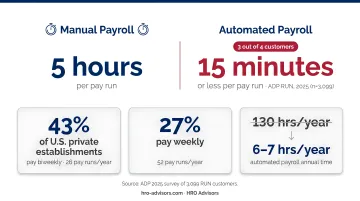
ADP's 2025 survey of 3,099 RUN customers found that 3 out of 4 customers spend 15 minutes or less running payroll. Contrast that with 5 hours for manual processing, and the math is stark.
The compounding factor: most businesses run payroll frequently.
- 43% of U.S. private establishments pay biweekly (26 pay runs/year)
- 27% pay weekly (52 pay runs/year)
At 5 hours per run on a biweekly schedule, that's 130 hours annually on payroll alone. Automated systems bring that figure closer to 6-7 hours total — time that goes back to operations, strategy, or growth.
Who feels this most: Businesses with 10+ employees, weekly or biweekly pay cycles, or companies where payroll falls to non-dedicated staff like office managers or founders.
Reason 2: Tax Compliance Costs and Penalties Are Eliminated
Payroll tax compliance is not a static task. Federal, state, and local withholding rules change. Filing deadlines vary by jurisdiction. Year-end forms — 940, 941, W-2, 1099 — each carry their own requirements.
Miss a deposit or file late, and IRS penalty mechanics kick in fast:
| Days Late | Penalty Rate |
|---|---|
| 1–5 days | 2% |
| 6–15 days | 5% |
| 16+ days | 10% |
| 10+ days after IRS notice | 15% |
For unpaid withheld taxes, the Trust Fund Recovery Penalty can equal 100% of the unpaid balance — assessed personally against responsible individuals, not just the business entity.
Payroll services eliminate this exposure by:
- Updating tax tables automatically as laws change
- Calculating correct withholdings per employee and jurisdiction
- Filing quarterly and annual forms on the employer's behalf
- Submitting tax deposits on time, every cycle
When this matters most: Multi-state employers, businesses adding headcount quickly, and any organization without a dedicated payroll compliance specialist on staff.
Reason 3: Payroll Accuracy Improves, Reducing Costly Correction Cycles
EY's 2022 payroll study found that one in five U.S. payrolls contains errors, with an average remediation cost of $291 per error. The most frequent cause: time and attendance mistakes that flow directly from manual data re-entry between timekeeping and payroll systems.
The cost of a payroll error extends beyond fixing the paycheck:
- HR resolution time — staff hours spent investigating and correcting
- Regulatory exposure — repeated errors can attract scrutiny
- Employee trust — 49% of U.S. workers say they'd start job hunting after just two paycheck mistakes
Automated payroll services reduce error risk by eliminating manual math, integrating time-tracking directly into payroll, and flagging discrepancies before processing completes.
Reason 4: Sensitive Payroll Data Is Protected by Enterprise-Grade Security
Payroll records contain Social Security numbers, bank account details, and compensation data. Stored in spreadsheets or unsecured systems, that information creates serious liability.
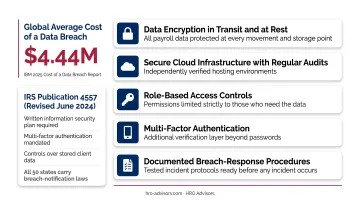
IRS Publication 4557 (revised June 2024) requires payroll and tax preparers to maintain written information security plans, use multi-factor authentication, and implement controls over stored client data. All 50 states carry breach-notification laws on top of that.
IBM's 2025 Cost of a Data Breach report puts the global average breach cost at $4.44 million — a figure that reflects why security infrastructure matters before an incident, not after.
Payroll service providers invest in protections most small businesses can't replicate internally:
- Data encryption in transit and at rest
- Secure cloud infrastructure with regular audits
- Role-based access controls
- Multi-factor authentication
- Documented breach-response procedures
For a business storing payroll in a spreadsheet or shared drive, that list of protections represents a significant security upgrade at no additional infrastructure cost.
Reason 5: Employee Self-Service Reduces HR Administrative Burden
HR teams at small and mid-sized businesses field a steady stream of requests that don't require HR expertise — pay stub copies, direct deposit updates, W-2 timing questions. Modern payroll platforms include self-service portals where employees handle these tasks on their own:
- View and download pay history
- Access and print W-2s and tax forms
- Update direct deposit and personal information
- Monitor deductions and PTO balances
Every request that goes through a portal is one fewer interruption to the HR team. For organizations where payroll administration falls to a single person or a small team wearing multiple hats, self-service isn't a convenience feature — it's meaningful capacity recovery.
What Happens When Businesses Skip Professional Payroll Services
Manual and under-resourced payroll processes create compounding risk over time. Here's what that looks like in practice:
- IRS penalties accumulate from missed deposit deadlines or miscalculated withholdings — and the IRS doesn't offer grace periods for first-timers
- Payroll errors erode employee trust faster than most managers expect, contributing to voluntary turnover at the worst possible time
- HR and operations staff get pulled into correction cycles rather than strategic work, week after week
- Complexity scales with headcount — what took two hours for five employees becomes a multi-day project at thirty
- Spreadsheet-based systems create data breach exposure that most small businesses aren't equipped to detect or contain
Payroll runs 26 to 52 times a year. Each cycle is another opportunity for these problems to surface — and another reason the cost of "doing it manually" compounds faster than most owners anticipate.
How to Get the Most Value from a Payroll Service
Payroll services deliver the most ROI when they're integrated into HR operations rather than treated as a standalone transaction.
Two integrations, in particular, move the needle:
- Time-tracking connected to payroll eliminates manual re-entry — EY identified time and attendance errors as the most frequent payroll mistake category, at 1,139 incidents per 1,000 employees annually. That's largely a re-entry problem.
- Payroll data tied to labor cost reports gives CFOs and COOs visibility into overtime trends, department-level spend, and payroll tax liability — information that directly shapes budgeting and hiring decisions.
If those integrations sound appealing but managing separate vendors for payroll, benefits, and compliance feels like too many moving parts, a PEO bundles all three under one contract. HRO Advisors offers a free, no-obligation comparison of up to 8 PEO providers — drawn from a network of 500+ — with a side-by-side analysis delivered typically within two weeks. There's no cost to the business; HRO Advisors is compensated by the selected provider.
Conclusion
The five advantages of payroll services — time savings, compliance protection, accuracy, data security, and HR efficiency — aren't abstract. They translate into hours recovered and dollars retained each pay period.
The benefits compound. A business that automates payroll in year one avoids years of penalties, correction cycles, and administrative drag as it grows. The real return isn't just what's saved today — it's what's protected across dozens of pay cycles over years of operation.
Getting payroll right early is one of the highest-return operational decisions a growing business can make. If you're evaluating payroll providers or PEO options, HRO Advisors offers free, no-obligation comparisons across multiple providers — so you can find the right fit without the guesswork.
Frequently Asked Questions
What is a payroll timekeeper?
A payroll timekeeper is a person or system responsible for tracking and recording employee hours to ensure accurate wage calculation each pay period. Most automated payroll platforms integrate directly with time-tracking tools, handling this with minimal manual input.
How much can a business save by outsourcing payroll?
Estimates vary by service model. NAPEO's research estimates a 27.2% annual ROI for businesses using a PEO, while switching from manual to automated payroll can save up to 120 hours per year in processing time. HRO Advisors clients report savings of up to 40% on overall HR costs.
What is the difference between payroll software and a PEO?
Payroll software automates processing but keeps compliance and administrative responsibility with the employer. A PEO acts as a co-employer that assumes shared responsibility for payroll, tax filings, benefits, and HR compliance — the better fit for businesses that want to hand off HR entirely.
How do payroll services help with tax compliance?
Payroll services automatically update tax tables, calculate correct withholdings per jurisdiction, file required quarterly and annual forms on time, and generate audit-ready records — eliminating the most common triggers for IRS penalties and missed deadlines.
When does it make sense to outsource payroll?
Outsourcing makes sense when a business has limited in-house HR expertise, is growing quickly, operates across multiple states, or finds that payroll management consumes time disproportionate to its strategic value.
Are payroll services worth the cost for small businesses?
For most small businesses, yes. Forbes Advisor estimates costs as low as $4 per employee per month — an amount most businesses recover within the first few pay cycles through time savings and penalty avoidance alone.