The good news: most payroll compliance failures trace back to a handful of recurring root causes, and all of them have clear fixes. This guide covers what goes wrong, what it costs, and exactly how to address it — before an audit forces your hand.
Key Takeaways
- Payroll compliance problems typically stem from four core issues: tax filing errors, employee misclassification, missed deadlines, and multi-state gaps.
- In FY2025, the DOL's Wage and Hour Division recovered more than $259 million in back wages for nearly 177,000 employees — the highest recovery since 2019.
- Most compliance failures are preventable with updated payroll systems, regular audits, and structured classification reviews.
- Working with a PEO — or a broker like HRO Advisors — can sharply reduce compliance exposure, particularly for businesses operating across multiple states.
Common Payroll Compliance Issues That Create Legal Risk
Compliance breakdowns rarely appear without warning. They almost always trace back to one of four recurring problems that compound over time, undetected.
Tax Withholding and Filing Errors
Incorrect federal or state tax withholding typically happens when payroll systems aren't updated to reflect current tax tables, bracket changes, or revised W-4 elections. A business that's still calculating payroll manually — or running software that hasn't been updated since last year — may be withholding the wrong amounts without realizing it.
The IRS publishes updated employer guidance annually in Publication 15 (Circular E). When those updates don't make it into your payroll calculations, the result is incorrect filings, amended returns, and underpayment penalties that could have been avoided entirely.
Employee Misclassification
Classifying a worker as an independent contractor (1099) instead of an employee (W-2) — or labeling a non-exempt worker as exempt from overtime — creates real financial exposure. Getting this wrong isn't a technicality; it triggers back taxes, penalties, and wage liability.
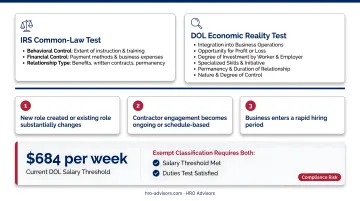
The IRS uses a behavioral control, financial control, and type-of-relationship framework to determine worker status. The DOL applies a separate six-factor economic reality test under the FLSA. These are two different standards, and satisfying one doesn't guarantee compliance with the other.
When a business gets this wrong, the consequences include:
- Back taxes and unpaid FICA contributions
- Retroactive overtime liability (up to 3 years for willful violations)
- Liquidated damages equal to the unpaid wages
- State-level fines on top of federal penalties
Fast-growing companies are especially vulnerable here. New roles get created quickly, and classification decisions get made for administrative convenience rather than based on the applicable legal tests.
Missed Payroll Tax Deadlines
The IRS assigns businesses to either a monthly or semiweekly deposit schedule based on their lookback period. Employers with $50,000 or less in employment taxes during the lookback period are monthly depositors; those above that threshold deposit semiweekly. Miss either schedule, and the IRS Failure to Deposit Penalty kicks in at escalating rates:
| Days Late | Penalty Rate |
|---|---|
| 1–5 calendar days | 2% |
| 6–15 calendar days | 5% |
| More than 15 days | 10% |
| After IRS notice/immediate payment demand | 15% |
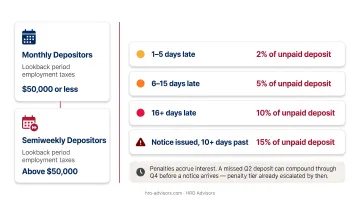
These penalties accrue interest. A missed deposit in Q2 can carry compounding interest through Q4 before it shows up in a notice — by which point the penalty tier has already escalated.
Multi-State and Remote Work Compliance Gaps
Hiring one remote employee in another state can trigger obligations your business isn't set up to handle. Common requirements that catch employers off guard include:
- State income tax withholding registration
- State unemployment insurance (SUI) accounts
- Local payroll taxes
- Varying minimum wage rates
- Paid leave requirements (as of April 2026, 14 states and DC have mandatory paid family leave programs, each with separate employer reporting obligations)
Many businesses don't realize a remote employee working from home creates nexus that requires registration in that state. New York treats remote work days as NY workdays unless a bona fide employer office exists at the remote location. Pennsylvania requires employers to withhold and remit local Earned Income Tax for home-based employees. Both are standard requirements — and both tend to surface only after a state audit, not before.
The Legal and Financial Cost of Ignoring Payroll Compliance
Unresolved payroll compliance issues carry consequences that go well beyond a one-time penalty.
Federal Enforcement Exposure
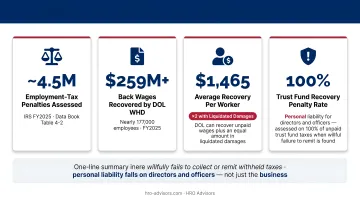
In FY2025, the IRS assessed nearly 4.5 million employment-tax penalties according to IRS Data Book Table 4-2. The DOL's Wage and Hour Division recovered more than $259 million in back wages for nearly 177,000 employees — averaging $1,465 per worker. For wage-and-hour violations, the DOL can recover both unpaid wages and an equal amount in liquidated damages.
The Trust Fund Recovery Penalty adds another layer of risk. When a responsible person willfully fails to collect or remit withheld taxes, the IRS can assess a penalty equal to 100% of the unpaid trust fund taxes — and that liability falls personally on directors and officers, not just the business.
Warning Signs You're Headed for a Compliance Problem
Compliance failures almost always have early indicators. Watch for these:
- Your payroll process is still largely manual, or your software hasn't been updated in over a year — tax tables, exemption thresholds, or wage rules may be out of date.
- You've added employees in new states or shifted to remote work without reviewing multi-state withholding registration and SUI obligations.
- Employee classifications haven't been reviewed since roles were first created — particularly for contractors who work regular hours, follow set schedules, or use company equipment.
Each of these gaps creates real exposure. If more than one applies to your business, it's worth doing a compliance review before the DOL or IRS does it for you.
How to Solve Payroll Compliance Issues
Most payroll compliance problems have clear, actionable fixes. The key is addressing them systematically — before a penalty notice or audit forces a reactive response.
Automate Tax Calculations and Regulatory Updates
Replace or upgrade to a payroll system that automatically updates tax tables, withholding rates, and state-specific rules when regulations change. This eliminates the most common source of filing errors: stale calculations.
Automation handles deposit schedule management, keeps multi-state filings current, and removes the human-error variable from routine tax calculations. For businesses that have been calculating payroll manually or running outdated software, this single change addresses the root cause of most withholding and filing errors.
Conduct Regular Payroll Audits
Schedule quarterly or semi-annual internal payroll audits to verify wages, deductions, overtime calculations, classifications, and tax filings against current requirements. Only 46% of HR professionals say their organization conducts internal wage audits on a regular, scheduled basis — which leaves most businesses exposed between incidents.
Audits catch discrepancies before they compound. They also create documentation that protects the business if an agency inquiry arrives.
Establish a Clear Employee Classification Review Process
Build a structured process for classifying new hires and existing workers. Apply both the IRS common-law test and the DOL's economic reality test to determine whether a worker is an employee or independent contractor — and verify that any salaried worker classified as exempt meets both the salary threshold ($684 per week under current DOL regulations) and the duties test.
Run this review when:
- New roles are created or existing roles change substantially
- A contractor's engagement becomes ongoing or schedule-based
- Your business enters a rapid hiring period
Proactive classification reviews prevent the most expensive compliance failures: back taxes, retroactive overtime, and DOL enforcement actions.
Partner with a PEO or Payroll Compliance Expert
A Professional Employer Organization co-employs your workforce and takes on shared responsibility for payroll tax filings, regulatory compliance, and multi-state administration. PEOs handle the compliance infrastructure most small businesses aren't equipped to manage in-house, including:
- Federal and state payroll tax filings
- SUI registrations and multi-state administration
- ACA and ERISA compliance
- EEO-1 reporting
For businesses evaluating PEO options, working with a broker simplifies the process significantly. HRO Advisors compares 3–8 PEO providers side-by-side at no cost to the business — compensated by the provider you select, with no added cost to you. The process starts with a free consultation, followed by a side-by-side comparison across 500+ providers, direct negotiation, and a final recommendation typically delivered within two weeks.
Multi-state compliance is a core matching criterion. For distributed workforces in technology, life sciences, financial services, or manufacturing, HRO Advisors specifically evaluates providers on their multi-jurisdiction payroll and tax compliance capabilities.
Long-Term Strategies to Stay Payroll Compliant
Staying compliant as your business grows means building systems and habits that hold up under pressure — not just patching problems after the fact.
Best practices for ongoing compliance:
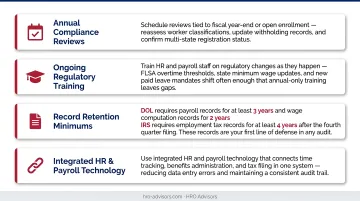
- Schedule annual compliance reviews tied to fiscal year-end or open enrollment — reassess worker classifications, update withholding records, and confirm multi-state registration status.
- Train HR and payroll staff on regulatory changes as they happen — FLSA overtime thresholds, state minimum wage updates, and new paid leave mandates shift often enough that annual-only training leaves gaps.
- Keep payroll records for the full required retention periods: the DOL requires payroll records for at least 3 years and wage computation records for 2 years; the IRS requires employment tax records for at least 4 years after the fourth quarter filing. These records are your first line of defense in any audit.
- Use integrated HR and payroll technology that connects time tracking, benefits administration, and tax filing in one system — reducing data entry errors and maintaining a consistent audit trail.
If evaluating platforms feels overwhelming, HRO Advisors can walk you through PEO solutions that bundle these capabilities together — comparing providers side by side so you find the right compliance infrastructure for your business size and industry.
Conclusion
Payroll compliance issues — tax filing errors, misclassification, missed deadlines, multi-state gaps — have identifiable causes and proven solutions. Businesses that address them proactively avoid the penalties, enforcement actions, and operational disruptions that catch reactive businesses off guard.
Getting payroll right protects your employees, reduces legal exposure, and frees up resources for growth. The harder part is finding providers who actually fit your business — size, industry, and compliance footprint included.
That's where HRO Advisors helps. As a PEO broker, they compare up to eight payroll and HR providers side-by-side on your behalf, at no cost to you. It's a straightforward way to get the right compliance infrastructure in place without doing the vendor research yourself.
Frequently Asked Questions
How do you ensure payroll compliance?
Payroll compliance requires up-to-date payroll systems, regular audits, accurate worker classification, and consistent tracking of federal, state, and local regulatory changes. Many businesses strengthen compliance by partnering with a PEO or working with a broker like HRO Advisors to find a provider that matches their specific workforce and multi-state needs.
What is the biggest challenge in payroll?
Staying current with constantly changing federal and state tax laws is consistently the top challenge — compounded by multi-state complexity when businesses have remote employees or operate across state lines, where each state adds its own withholding, unemployment, and paid leave requirements.
How do you choose the best payroll solution for compliance?
Look for a solution that:
- Automatically updates tax tables as laws change
- Handles multi-state filings and registrations
- Integrates with your HR and benefits systems
- Includes dedicated compliance support
A PEO broker can compare platforms side-by-side — HRO Advisors evaluates 3–8 providers against your specific compliance requirements at no cost.
What are the penalties for payroll non-compliance in the US?
IRS failure-to-deposit penalties range from 2% to 15% based on deposit timing, and compound with interest if unresolved. DOL can recover back wages plus equal liquidated damages for wage-and-hour violations. State fines add additional exposure on top of federal penalties.
Can a PEO help my business stay payroll compliant?
Yes. A PEO co-employs your workforce and assumes shared responsibility for payroll tax filings, multi-state registration, benefits compliance, and regulatory reporting — a direct way for small and mid-sized businesses to reduce compliance risk without expanding headcount.