Introduction
Most startup founders didn't sign up to spend their Thursday afternoons processing payroll or tracking I-9 documentation. Yet that's exactly where time goes. An NSBA survey cited by the U.S. Chamber of Commerce found that 41% of small business owners spend 3 to 10 hours monthly just handling payroll taxes — before factoring in benefits questions, onboarding paperwork, or compliance reviews.
That time compounds quickly. Every hour spent on HR administration pulls focus from product development, customer acquisition, and fundraising — the work that actually moves the needle.
HR outsourcing addresses this directly. For growth-stage companies, it's a way to access professional-grade HR infrastructure without the fixed overhead of a full internal team.
This guide covers what HR outsourcing delivers for startups, where the real risks sit, and what separates arrangements that work from ones that become expensive distractions.
Key Takeaways
- HR outsourcing converts fixed HR overhead into a flexible, scalable expense — without sacrificing compliance coverage.
- PEOs give startups access to Fortune 500-level benefits they couldn't negotiate independently.
- The biggest risks — control, data security, cultural misalignment — are manageable with the right vetting process.
- Federal compliance thresholds hit at 15, 20, 50, and 100 employees — outsourcing keeps startups ahead of each one.
- A PEO broker like HRO Advisors lets startups compare up to 8 providers side-by-side — free of charge.
What HR Outsourcing Actually Means for Startups
HR outsourcing means delegating some or all HR functions — payroll, benefits administration, compliance, recruiting, employee relations — to an external provider. Unlike HR software, it involves ongoing expert support from professionals who manage HR day-to-day — not just a platform that automates forms.
The Three Main Models
Fractional or consulting HR — Part-time or project-based strategic guidance. Best for startups that need occasional expertise without committing to ongoing support.
HR service providers — Ongoing administrative support covering payroll processing, onboarding, and benefits questions — without the provider taking on employer-of-record status.
PEOs (Professional Employer Organizations) — A co-employment model where the PEO becomes the employer of record for tax and compliance purposes, handling payroll, benefits, workers' compensation, and regulatory compliance on behalf of the startup. PEOs pool employees across hundreds of client companies, which gives small businesses access to group health plans and retirement benefits that would otherwise require thousands of employees to negotiate.
According to NAPEO, more than 200,000 businesses currently use PEO services, employing more than 4.5 million people. For startups with 5 to 100 employees, the PEO model is often the most powerful option available.
What Outsourcing Doesn't Mean
Founders retain full authority over hiring decisions, culture, compensation philosophy, and people strategy. The outsourcing partner handles administrative execution — not the decisions behind it. That distinction matters when evaluating whether outsourcing fits your operation.
For startups navigating that evaluation, HRO Advisors compares 3 to 8 PEO and ASO options side-by-side — covering pricing, compliance features, and benefits quality — at no cost to the client.
Key Benefits of HR Outsourcing for Startups
Cost Efficiency
The math is straightforward. According to the Bureau of Labor Statistics, HR specialists earn a median annual wage of $72,910 — and that's before benefits, payroll taxes, and HR software licenses. For a 20-person startup, that's a significant fixed cost with limited utilization.
By comparison, PEO services typically run $50 to $150 per employee per month, according to Forbes Advisor — a flexible, scalable expense that adjusts as headcount changes. For many startups, outsourcing to a PEO costs less than a single mid-level HR hire while delivering far broader coverage.
NAPEO's research found that PEO clients realized average annual savings of $1,775 per employee, with $965 attributable to reduced internal HR staffing costs alone.
Compliance Protection
Federal compliance obligations don't arrive gradually — they arrive in step-function jumps tied to headcount:
- 15 employees — Title VII, ADA, and GINA anti-discrimination protections apply
- 20 employees — Age Discrimination in Employment Act (ADEA) coverage begins
- 50 FTE employees — ACA Applicable Large Employer obligations activate
- 100 employees — EEO-1 workforce demographic reporting required
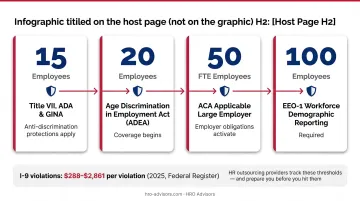
Most startups hit these thresholds faster than they expect. The penalties for missing them are real. Per the Federal Register, I-9 violations alone can cost $288 to $2,861 per violation in 2025. HR outsourcing providers track these thresholds and help companies prepare before they hit them — not after.
Access to Enterprise-Level Benefits
The benefits gap between small firms and large employers is stark. According to KFF's 2025 Employer Health Benefits Survey, only 59% of small firms with 10 to 199 workers offer health benefits — compared to 97% of large firms. PEOs close that gap by pooling employees across their client base to negotiate group rates.
NAPEO data shows that 52% of PEO client employees at small businesses have access to a retirement plan, versus 23% at comparable companies without a PEO. That gap directly affects a startup's ability to compete for talent against better-resourced companies.
Scalability and Strategic Focus
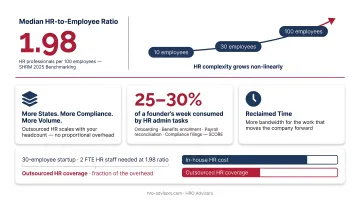
As a startup moves from 10 to 100 employees, HR complexity grows non-linearly. More states, more compliance layers, more onboarding volume — but that doesn't mean proportionally more HR headcount. Outsourced HR scales with the business.
SHRM's 2025 benchmarking data puts the median HR-to-employee ratio at 1.98 HR professionals per 100 employees. A startup with 30 employees shouldn't need two full-time HR staff — but it does need that level of functional coverage. Outsourcing fills that gap without the overhead.
The practical payoff for founders is time. HR administrative tasks — onboarding, benefits enrollment, payroll reconciliation, compliance filings — can consume 25–30% of a small business owner's week, according to SCORE. Reclaiming that time means more bandwidth for the work that actually moves the company forward.
Risks and Challenges to Watch Out For
Loss of Visibility and Control
When HR moves outside the company, routine decisions now route through a third party instead of being handled on the spot. Employee relations issues, approval workflows, and day-to-day questions all take longer as a result.
This risk is manageable, but only if it's addressed contractually. Clear SLAs (Service Level Agreements) and a dedicated point of contact are non-negotiable in any outsourcing agreement. A general support queue is not the same as a dedicated HR contact who knows your company.
Data Security
HR departments handle the most sensitive employee data a company holds — compensation, health information, Social Security numbers, performance records. Outsourcing requires sharing all of it with an external vendor.
IBM's 2025 Cost of a Data Breach report put the global average cost of a data breach at $4.4 million. Before signing with any HR outsourcing provider, ask directly:
- Is data encrypted at rest and in transit?
- Are you SOC 2 compliant?
- What is your breach notification protocol?
- How is data stored and deleted when our contract ends?
SOC 2 compliance, in particular, provides meaningful assurance that a provider's security controls have been independently verified.
Cultural Misalignment
External HR providers work across many clients simultaneously. They may not fully understand a startup's culture, communication style, or the informal norms that define employee experience. The result can be policies that feel rigid or disconnected from how the team actually operates.
Require a cultural onboarding period before the provider goes live. Schedule regular check-ins to keep them aligned as the company evolves — what works at launch rarely looks the same at 50 employees.
Vendor Dependency and Transition Risk
If the outsourcing relationship ends unexpectedly — due to a contract dispute, a provider acquisition, or changing business needs — a startup can find itself without HR infrastructure at a critical moment.
Protect against this from day one:
- Keep all HR documentation and employee records in systems your company controls
- Never allow records to be siloed exclusively within the provider's platform
- Confirm data portability and export rights in writing before signing
Signs Your Startup Is Ready to Outsource HR
Three operational signals indicate it's time:
- Compliance gaps — You're unsure whether your worker classifications, I-9 documentation, or leave policies meet current state and federal requirements.
- Transactional overload — Founders or office managers are spending meaningful hours weekly on payroll runs, benefits questions, and onboarding paperwork.
- Strategic deficit — There's no structured approach to performance management, compensation benchmarking, or employee development.
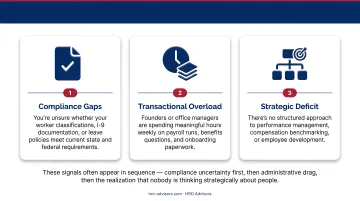
These signals often appear in sequence — compliance uncertainty first, then administrative drag, then the realization that nobody is thinking strategically about people. The two H3 sections below help pinpoint where your startup actually stands.
The Employee Count Inflection Point
Federal compliance obligations create real inflection points at 15, 20, 50, and 100 employees (per the EEOC and IRS thresholds noted above). Many startups reach the point where informal HR processes break down well before they hit the 50-employee ACA threshold — particularly those hiring across multiple states, where each new state brings its own wage laws, unemployment insurance requirements, and leave policies.
The Opportunity Cost Test
If leadership is regularly postponing strategic work — a fundraising deck, a product roadmap decision, a key partnership — to handle HR tasks, the cost of not outsourcing has already exceeded the cost of outsourcing. At that point, the decision isn't financial. It's about whether founders and operators are spending their time on work only they can do.
Best Practices for Choosing and Managing an HR Outsourcing Partner
Audit Your HR Needs First
Before evaluating any vendor, map out which HR functions consume the most internal time, where compliance gaps exist, and what capabilities the team genuinely lacks. This prevents overpaying for services you don't need and ensures you ask the right questions during provider evaluation.
Evaluate on Compliance Depth and Industry Fit
A provider that understands your specific regulatory environment is worth more than a generalist. A tech startup hiring across six states has different needs than a manufacturing company managing OSHA obligations in two facilities.
Ask prospective providers directly:
- What experience do you have with companies in our industry?
- How do you track and communicate regulatory changes?
- Can you provide references from clients of similar size in our sector?
- What happens if we hit a new employee count threshold mid-contract?
Negotiate Transparent, Scalable Terms
Avoid long lock-in contracts and opaque per-employee pricing models. Request a detailed breakdown of what is and isn't included, and confirm how pricing changes as headcount grows. The contract terms that work at 20 employees need to still make sense at 75.
Insist on Cultural Alignment and a Dedicated Contact
The provider should invest time understanding your company's values, work style, and employee expectations before going live. A dedicated HR contact rather than a rotating support queue significantly improves service quality and response times.
Use a PEO Broker to Cut Through the Evaluation Process
Evaluating dozens of PEO and HR outsourcing providers on your own takes time most startup leaders don't have. A PEO broker like HRO Advisors handles that process for you.
HRO Advisors works in three steps:
- Gather your HR cost baseline and compliance requirements
- Analyze costs and coverage across 500+ providers
- Negotiate directly with shortlisted providers on your behalf
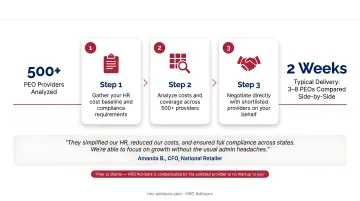
The full comparison — covering 3 to 8 PEOs side-by-side — is typically delivered in under two weeks. The service costs nothing to the client; HRO Advisors is compensated by the selected provider at no markup to you.
As one client, Amanda B. (CFO, National Retailer), put it: "They simplified our HR, reduced our costs, and ensured full compliance across states. We're able to focus on growth without the usual admin headaches."
Frequently Asked Questions
What is the difference between a PEO and an HR outsourcing provider?
A PEO enters a co-employment relationship and becomes the employer of record for payroll, benefits, and tax compliance purposes — sharing legal employer responsibilities with your company. A traditional HR outsourcing provider manages specific HR functions without taking on co-employment status, leaving full administrative employer liability with you.
When is the right time for a startup to start outsourcing HR?
Federal compliance obligations begin at 15 employees for major anti-discrimination laws and escalate at 20, 50, and 100 employees. Beyond those thresholds, if founders are losing significant time to HR administration or have compliance uncertainty, that's the signal, regardless of headcount.
How much does HR outsourcing typically cost for a startup?
Costs vary by model. PEO services typically run $50 to $150 per employee per month, though actual rates depend on service tier, benefits package, and industry. Startups that use a broker comparison process often realize savings of up to 40% versus rates negotiated independently.
Will outsourcing HR mean losing control over hiring and people decisions?
No. Founders retain full authority over who they hire, how teams are structured, and how the company operates. The outsourcing partner handles administrative execution — payroll, compliance filings, benefits enrollment — not the decisions that shape your culture or workforce.
What HR functions should a startup outsource first?
Start with payroll and compliance — these carry the highest legal risk if mishandled and are the most time-intensive for non-specialists. From there, expand to benefits administration and HR support as headcount and complexity grow.
Can a startup with fewer than 10 employees benefit from HR outsourcing?
Yes, particularly through a PEO. Very small teams gain access to group benefits rates and compliance infrastructure they couldn't otherwise afford — and the cost advantage is greatest when negotiating leverage is lowest.