These concerns are common — and they're also mostly preventable. The businesses that feel like they've lost control after outsourcing HR almost always set up the arrangement poorly from the start. According to Deloitte's outsourcing handbook, the most cited outsourcing risks — weak governance, poor ongoing management, and loss of visibility — aren't inherent to outsourcing itself. They're setup failures.
This guide walks through a practical process for outsourcing HR strategically: what to define before you sign anything, which functions to keep in-house, and the specific decisions that determine how much oversight you retain.
Key Takeaways
- Outsourcing HR means delegating execution, not decision-making authority over your people or culture
- Define scope, governance, and communication expectations before contracting with any provider
- An internal HR liaison is the single most effective safeguard against losing oversight
- Keep culture-sensitive HR functions — performance management, investigations, and disciplinary decisions — in-house
- Businesses that outsource through vetted, industry-matched providers can cut HR costs by up to 40% while improving compliance accuracy
How to Outsource HR Functions Without Losing Control
Step 1: Decide Which HR Functions to Outsource and Which to Keep
The most important distinction in HR outsourcing is between transactional tasks and relational responsibilities.
Transactional tasks are process-driven, repeatable, and rule-based. They're ideal outsourcing candidates:
- Payroll processing and tax filings
- Benefits enrollment and administration
- Compliance documentation and regulatory filings
- Onboarding paperwork and I-9 management
- COBRA administration
Relational responsibilities require cultural context, judgment, and knowledge of your specific people. These generally belong in-house:
- Performance reviews and disciplinary actions
- Workplace investigations and conflict resolution
- Culture-building and employee recognition
- Senior-level hiring decisions
- DEI initiatives
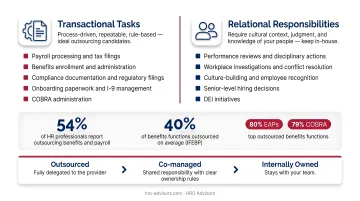
The data backs up where outsourcing is most common: over 54% of HR professionals report outsourcing benefits and payroll, and the International Foundation of Employee Benefit Plans found that companies outsource 40% of benefits functions on average, with EAPs (80%) and COBRA administration (79%) leading the way.
Before engaging any vendor, create a written scope-of-authority document. List every HR function your business performs and designate each one as:
- Outsourced — fully delegated to the provider
- Co-managed — shared responsibility with clear ownership rules
- Internally owned — stays with your team
This document becomes the foundation of any service agreement and the primary tool for preventing scope creep.
Step 2: Build a Governance Structure with Your Provider
Without a governance structure, you're trusting outcomes to chance. Governance is what keeps you informed and in control.
Three non-negotiable governance elements:
1. A Service Level Agreement (SLA) with measurable standards
Every contract should specify performance benchmarks — not vague commitments. Ask for:
- Payroll processing accuracy rates
- Response time guarantees for employee queries
- Turnaround time for compliance filings
- Escalation protocols for issues requiring owner input
Per SHRM's guidance on HR vendor management, SLAs should contain individual metrics measuring efficiency, effectiveness, and value — not just general service descriptions.
2. A structured communication cadence
Monthly dashboards and quarterly service reviews are the industry standard, per HRO Today's governance framework. Businesses that go months without structured touchpoints are far more likely to feel out of the loop. Set a review schedule at contract signing and treat it as non-negotiable.
3. Real-time data access
You must be able to pull your own payroll records, benefits enrollment data, and compliance documentation at any time — not wait for the provider to send them to you. This isn't just an operational preference; it's a legal requirement. DOL rules require employers to retain payroll records for at least three years under the FLSA, and EEOC regulations set similar requirements for personnel records. Outsourcing doesn't transfer that legal responsibility — it stays with you.
Any provider that limits your access to your own workforce data is a warning sign worth acting on before you sign.
Step 3: Designate an Internal HR Liaison
Skipping this step is the single most common reason businesses feel like they've lost control after outsourcing HR.
The internal HR liaison doesn't need to be a full-time HR professional. It can be an office manager, a senior operations lead, or a part-time HR generalist. What matters is that this person:
- Understands your company culture well enough to contextualize HR decisions
- Serves as the primary contact point between your workforce and the external provider
- Attends quarterly reviews with the vendor
- Fields employee questions that require cultural judgment rather than routing everything to the provider
- Escalates operational issues before they become problems
Without this role filled, employees default to contacting the external provider directly — including for culture-sensitive situations the provider isn't equipped to handle with context. Inconsistent messaging, employee frustration, and cultural drift follow quickly.
Deloitte's outsourcing research calls this the "retained organization" design — the client-side structure responsible for everything outside the outsourcing arrangement. Building it during setup, before problems surface, is what keeps the arrangement working in your favor.
Step 4: Select the Right Provider for Your Business
A manufacturing company with OSHA compliance obligations needs a fundamentally different HR partner than a financial services firm navigating FINRA and SEC requirements. The selection process should reflect that.
Four questions to ask every prospective provider:
- What is your service model, and who is my dedicated point of contact? — Generic support queues are a warning sign.
- Who owns employee records, and what happens to our data if we exit the contract? — Data portability at contract end is essential.
- What customization exists for company-specific policies? — A provider that can't reflect your handbook and culture in their communications isn't a fit.
- How do you handle regulatory changes in the states where we operate? — Multi-state compliance management should be proactive, not reactive.
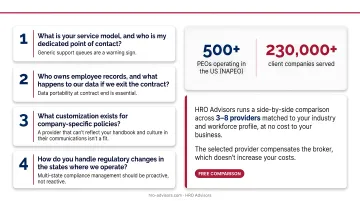
Once you have those answers, the comparison work begins. NAPEO reports over 500 PEOs operating in the US, serving more than 230,000 client companies — evaluating that market independently is genuinely time-consuming. HRO Advisors runs a side-by-side comparison across 3–8 providers matched to your industry and workforce profile, at no cost to your business. The selected provider compensates the broker, which doesn't increase your costs.
When Should You Outsource HR?
Clear signals that outsourcing makes sense:
- Payroll errors are occurring — 60% of small businesses report payroll issues during some, most, or all pay cycles
- HR tasks consume more than 20-25% of a business owner's or manager's weekly time
- Headcount is growing faster than your HR infrastructure
- Employees aren't getting timely responses to HR questions
- Compliance penalties have occurred or feel imminent
That said, outsourcing isn't the right move for every situation right now.
Situations requiring a more selective approach:
- Fewer than 5-10 employees may find full outsourcing cost-prohibitive — a standalone payroll or benefits-only arrangement may be the better starting point
- Organizations mid-merger or mid-leadership transition may need internal stability before introducing an external HR partner
- Companies with a mature HR team may only need point-solution support rather than full outsourcing
Starting with payroll and compliance outsourcing — while keeping hiring and performance management internal — is a practical way to build confidence in a provider before expanding the relationship.
What You Need in Place Before Outsourcing HR
Conduct an internal HR audit before engaging any provider. Document every HR process currently in use, identify where errors or delays occur, and note which tasks consume the most time. This baseline informs which functions to outsource first and sets realistic performance benchmarks.
Once you have that baseline, evaluate whether your current systems can actually support a smooth handoff.
Technology and Integration Readiness
Before committing to any provider, assess your current HR tech stack:
- Does the provider's platform integrate with your payroll software, accounting system, and time-tracking tools?
- Can employee records migrate securely without gaps?
- Will you have real-time dashboard access to your own data post-transition?
When HRO Advisors evaluates providers for clients, cloud-based systems with real-time access and automated reporting are treated as baseline requirements — not optional upgrades.
Data and Compliance Readiness
Your outsourcing partner inherits whatever foundation you give them. Before any transition:
- Verify all I-9s are complete and properly stored (USCIS requires retention for three years post-hire or one year post-termination, whichever is later)
- Confirm all employee tax documentation is current
- Update job descriptions if they're outdated
Switching providers won't fix incomplete records automatically. They create onboarding complications — and your budget is paying for that cleanup time.
The Key Variables That Determine How Much Control You Keep
Control after outsourcing isn't fixed. It's entirely shaped by decisions made at contract setup.
| Variable | Why It Matters | What to Do |
|---|---|---|
| Scope Definition | Vague scope language is the most common source of outsourcing disputes — neither party knows who owns what | Create a written scope-of-authority document before signing anything |
| Communication Cadence | Businesses without structured touchpoints are more likely to feel out of the loop over time | Set monthly dashboards and quarterly reviews at contract signing |
| Technology & Data Access | If you need payroll or benefits data for a compliance audit, you can't wait for a provider to pull it | Require real-time dashboard access and the ability to run your own reports |
| Exit Clauses & Data Portability | A punitive termination clause traps you in a relationship even if service quality declines | Negotiate reasonable transition timelines, data portability at contract end, and performance-based exit rights |
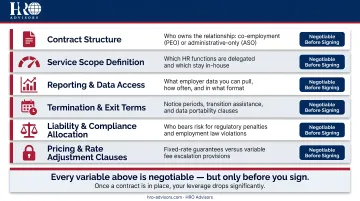
Every one of these variables is negotiable — but only before you sign. Once a contract is in place, your leverage drops significantly.
Common Mistakes That Lead to Loss of Control
No defined scope of authority — Handing off "HR" as a category, rather than a specific list of tasks, guarantees confusion. Responsibilities fall through the cracks, and you end up uninformed on decisions that directly affect your people.
Choosing based on price alone — Low-cost providers tend to have thin support infrastructure. When a compliance issue or payroll error surfaces, you're the one managing the fallout — not them.
No internal liaison — Employees will fill the vacuum. Without someone internally managing the relationship, culture-sensitive questions go straight to your external provider — and the answers won't always reflect your company's values or context.
Set-it-and-forget-it oversight — Compliance gaps and service quality issues rarely announce themselves. They surface after real damage is done. Build a review schedule into the contract from day one, not as an afterthought.
Frequently Asked Questions
Is it a good idea to outsource HR?
For most small to mid-sized businesses lacking dedicated HR expertise, yes. The key is choosing a provider matched to your industry's compliance requirements and maintaining clear governance structures from the start. Outsourcing without those guardrails is where problems arise.
Do you lose control when you outsource HR?
Not when the engagement is structured correctly. Outsourcing delegates task execution — payroll, compliance filings — not decision-making authority over your people. You retain full control over HR strategy, culture, and hiring when scope and governance are defined upfront.
What HR functions should you keep in-house?
Performance management, disciplinary actions, workplace investigations, senior-level hiring decisions, and DEI initiatives. These require deep knowledge of your company culture and employee relationships — context an external provider simply doesn't have.
How do you maintain company culture when outsourcing HR?
Designate an internal liaison who bridges the provider and your team, customize provider-delivered policies to reflect your values, and keep culture-defining moments like onboarding and performance conversations under internal ownership.
What is the difference between a PEO and an HRO?
A PEO enters a co-employment relationship, becoming a legal co-employer and providing bundled HR services including access to group-rate benefits. An HRO provides contracted HR services without co-employment — you remain the sole employer. HRO Advisors can compare options across both models at no cost to your business.
How do I find the right HR outsourcing provider for my industry?
Look for providers with proven experience in your specific sector — manufacturing compliance differs significantly from financial services requirements. HRO Advisors matches businesses with industry-specific providers from a pool of 500+, handling side-by-side comparisons and negotiations at no cost to you.