What Is HR Risk Management?
HR risk management is the proactive process of identifying, assessing, and mitigating risks that arise from managing people. It spans compliance failures, workforce instability, data breaches, and operational gaps — and it stands in direct contrast to reactive HR, where problems surface only after they've cost the organization money, talent, or legal standing.
The numbers make the urgency concrete. The EEOC received 88,531 new discrimination charges in FY 2024 — a 9% increase from the prior year — while the DOL's Wage and Hour Division recovered over $259 million in back wages for nearly 177,000 employees in FY 2025.
Labor laws are shifting at every level: federal, state, and local. Employee expectations have changed. And the cost of missteps — litigation, fines, turnover, reputational damage — compounds fast.
This guide is built for HR leaders who want to move from reactive to strategic. You'll find a breakdown of the six core types of HR risk, a five-step management framework, and the specific mitigation strategies that turn HR from an administrative liability into a genuine competitive advantage.
Key Takeaways
- HR risk management is a continuous, strategic process — not a one-time checklist
- Six core risk types require attention: compliance, workforce, data privacy, operational, talent acquisition, and compensation
- Effective risk management follows five stages: identify, assess, prioritize, mitigate, and monitor
- Manager training and consistent documentation are two of the highest-impact — and most overlooked — risk reduction tools
- Partnering with a PEO transfers compliance and HR administration risk to an experienced outside partner
Why HR Leaders Can't Afford to Ignore Risk
The financial exposure from unmanaged HR risk is real, and it compounds across multiple fronts simultaneously.
The Direct Costs
- Turnover alone costs U.S. employers almost $1 trillion annually, with replacement costs running roughly 33% of an employee's annual salary — about $20,000 for a $60,000 role
- EEOC enforcement secured $508 million in monetary benefits for discrimination victims in FY 2024
- OSHA willful violations carry penalties up to $165,514 per violation — costs that hit manufacturers, contractors, and healthcare facilities hardest
The Cascade Effect
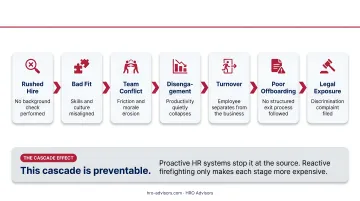
One unmanaged risk rarely stays contained. A rushed hire with no background check leads to a bad fit. The bad fit drives team conflict. The conflict drives disengagement. Disengagement drives turnover. Turnover triggers a discrimination complaint from the departing employee who was also poorly offboarded. Each stage adds legal exposure, productivity loss, and replacement cost.
That cascade is preventable, but only with proactive systems in place. Reactive firefighting doesn't stop it — it just makes each stage more expensive.
The Talent and Reputation Stakes
In a competitive labor market, organizations known for poor HR practices struggle to attract strong candidates. Poor Glassdoor reviews, high turnover rates, and compliance violations signal red flags to job seekers before a recruiter ever reaches them. Each month that passes without addressing these issues narrows the pipeline further.
6 Core Types of HR Risk Every Leader Should Know
These six risk categories show up across nearly every organization — regardless of industry, company size, or workforce composition. Understanding each one is the starting point for any effective HR risk assessment.
Compliance Risk
Compliance risk covers failures to meet federal, state, and local employment law obligations. It's consistently the most common and costly HR risk category. Key exposure areas include:
- Wage and hour violations under FLSA
- Anti-discrimination statutes (Title VII, ADA, ADEA)
- FMLA, ACA, and OSHA requirements
- Data privacy regulations (state-level and federal)
The scale of exposure is significant: 88,531 EEOC charges were filed in FY 2024, DOL recovered $259 million in back wages, and I-9 paperwork violations carry penalties of $288 to $2,861 per form. For multi-state employers, that complexity multiplies with every new jurisdiction.
Workforce and Culture Risk
High turnover, disengagement, burnout, and workplace conflict don't just hurt morale — they create legal exposure. A toxic culture amplifies harassment and retaliation claims while simultaneously driving up replacement costs.
Gallup reports that global employee engagement fell to 20% in 2025 — the lowest level since 2020 — with estimated lost productivity of $10 trillion globally. Critically, 42% of voluntary turnover is preventable, meaning much of this risk is addressable with the right management practices.
Data Privacy and Cybersecurity Risk
HR departments hold some of the most sensitive data in any organization — Social Security numbers, health records, banking details, performance history. The IBM 2025 Cost of a Data Breach Report puts the average global breach cost at $4.44 million.
Risk compounds when offboarding employees retain system access after termination. This is a common gap in organizations without standardized offboarding protocols, and it's one of the more preventable cybersecurity vulnerabilities HR teams face.
Operational and Safety Risk
Inadequate safety protocols, OSHA non-compliance, mismanaged workers' compensation claims, and inefficient HR workflows all fall here. This category is especially acute in manufacturing, construction, healthcare, and senior living — sectors where physical safety and regulatory scrutiny intersect daily.
Talent Acquisition and Retention Risk
Rushed hiring decisions — skipped background checks, unstructured interviews, inconsistent evaluation criteria — carry both financial and legal consequences. SHRM's 2025 benchmarking data puts average cost-per-hire at $5,475 for non-executive roles and $35,879 for executive roles. Beyond recruiting costs, poor onboarding extends time-to-productivity and accelerates early attrition.
Compensation, Benefits, and M&A Risk
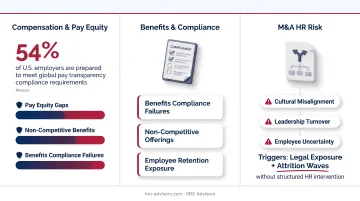
Pay equity gaps, non-competitive benefits, and benefits compliance failures all generate exposure. Mercer reported that only 54% of U.S. employers are prepared to meet global pay transparency compliance requirements. Mergers and acquisitions layer on additional risk: cultural misalignment, leadership turnover, and employee uncertainty can trigger both legal exposure and attrition waves without structured HR intervention.
The HR Risk Management Process: A 5-Step Framework
This framework is a continuous cycle, not a one-time project. It must be revisited as the organization grows, regulations change, and workforce dynamics shift.
Step 1: Identify Risks
Start with a comprehensive HR audit across all workforce touchpoints:
- Hiring and onboarding — Are background check processes consistent? Are I-9 forms completed accurately and on time?
- Performance management — Are managers documenting performance issues properly?
- Compensation — Are pay practices equitable and compliant with wage and hour law?
- Offboarding — Are system access credentials revoked promptly after termination?
- Safety — Are OSHA training records up to date?
Engage both managers and frontline employees during this process. The people closest to daily operations often surface risks that aren't visible from the top.
Step 2: Assess and Prioritize
Evaluate each identified risk on two dimensions:
- Likelihood of occurrence — How probable is this risk given your current controls, existing policies, and workforce behaviors?
- Severity of potential impact — How significant would the legal, financial, or operational damage be if it materialized?
Focus mitigation resources on high-likelihood, high-impact risks first. A wage and hour violation affecting 50 employees is a higher priority than a theoretical risk with low probability and limited financial exposure.
Step 3: Select Mitigation Strategies
Not every risk warrants the same response. Four core strategies cover the full range of options:
| Strategy | When to Use |
|---|---|
| Avoidance | Eliminate the activity creating the risk |
| Reduction | Implement controls to lower likelihood or impact |
| Retention | Accept the risk when mitigation costs exceed the exposure |
| Transference | Shift risk via insurance, outsourcing, or PEO partnerships |
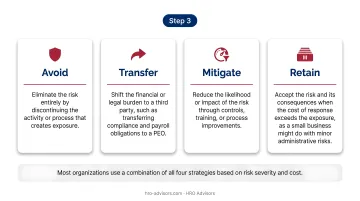
Most organizations use a combination. A small business might retain minor administrative risks while transferring compliance and payroll obligations to a PEO.
Step 4: Implement and Communicate
A risk plan only works if it's put into practice — not just documented. That means:
- Policies must be documented in writing and signed by employees
- Training must be delivered — not just scheduled
- Managers must understand their specific roles in executing the plan
- Leadership must model the behaviors the plan requires
The gap between planning and execution is where most HR risk programs fail — which is exactly why ongoing monitoring is the step that holds everything together.
Step 5: Monitor and Adapt
Build a review schedule before risks have a chance to resurface undetected:
- Quarterly check-ins to track whether active strategies are working and flag emerging issues
- Annual comprehensive review to assess new risks introduced by regulatory changes, headcount growth, or business model shifts
Document every update. If a plan is challenged legally, a clear audit trail of reviews and revisions demonstrates diligence.
Proven HR Risk Mitigation Strategies
Build a Compliance Monitoring System
Build a dedicated compliance calendar that tracks key filing deadlines — EEO-1 submissions, ACA reporting, benefits enrollment windows, OSHA log requirements. For multi-state or growing employers, a technology platform or compliance partner that monitors regulatory updates automatically is worth the investment. Missing a single deadline in the wrong jurisdiction can trigger penalties that dwarf the cost of the system.
Standardize Documentation and Recordkeeping
Consistent documentation is the strongest legal defense in any employment dispute. This includes:
- Signed employee handbooks (updated annually)
- Performance reviews and disciplinary records
- Accommodation request documentation
- Termination paperwork with documented rationale
- Leave request records
Practical tip: If your team still manages these in paper files or shared drives without version control, transition to a secure digital HR system with audit trails.
FLSA requires payroll records to be retained for at least three years; EEOC regulations require personnel records for one year from termination. Digital systems make compliance with both requirements far easier to demonstrate.
Invest in Manager Training
Most HR risk originates at the manager level. SHRM found that 84% of U.S. workers say poorly trained managers create unnecessary work and stress — and Gallup's research shows managers account for at least 70% of variance in employee engagement scores.
Effective manager training should cover:
- Documentation standards for performance issues
- Leave and accommodation request handling
- Conflict resolution and de-escalation
- Anti-harassment conduct and bystander intervention
- How to recognize signs of employee distress
Training isn't a one-time event — build quarterly reinforcement sessions and track completion rates as an ongoing risk metric.
Strengthen Onboarding and Offboarding Protocols
The beginning and end of employment are the two highest-risk transitions in the employee lifecycle. Common exposures include:
- Onboarding: Incomplete I-9 forms, missed benefits disclosures, unsigned policy acknowledgments
- Offboarding: Failure to revoke system access, unclear final pay timing, missing separation agreements
A standardized checklist system for both processes eliminates these gaps. Assign a single owner for each checklist and require sign-off before the process is considered complete.
Support Employee Wellbeing to Reduce Behavioral and Turnover Risk
Mental health, burnout, and work-life balance directly correlate with absenteeism, workplace conflict, and voluntary turnover — all of which generate HR risk. Practical steps include:
- Offering an Employee Assistance Program (EAP) with confidential counseling access
- Including mental health coverage in benefits plans
- Training managers to recognize early signs of distress and refer appropriately
- Building cultural norms that normalize boundaries and discourage always-on expectations
Gallup's data shows 42% of voluntary turnover is preventable, and better management and stronger wellbeing support drive most of that prevention.
How a PEO Can Strengthen Your HR Risk Management
Partnering with a Professional Employer Organization is a formal risk transference strategy. The PEO assumes co-employer status and takes on compliance administration, payroll tax obligations, benefits management, and regulatory reporting — significantly reducing the employer's direct HR risk exposure.
For small and mid-sized businesses, this matters enormously. According to NAPEO industry data, businesses working with PEOs grow twice as fast, experience 10–14% lower employee turnover, and are 50% less likely to go out of business than comparable businesses without a PEO. The ROI from cost savings alone averages 27%.
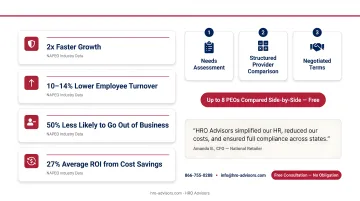
The challenge is that choosing the wrong PEO can itself introduce risk — misaligned services, hidden fees, or a compliance track record that doesn't hold up to scrutiny. That's where an independent PEO broker provides a concrete advantage: independent vetting, provider comparisons, and negotiated terms the business couldn't access on its own.
HRO Advisors is a PEO broker based in Dallas, TX that compares up to 8 PEO providers side-by-side for each client at no cost to the business. Their process starts with a needs assessment — evaluating HR costs, compliance requirements, workforce structure, and industry-specific risk profile.
From there, they present a structured comparison of providers whose capabilities actually match the client's situation, rather than a generic shortlist.
Their advisors are former industry insiders with direct relationships across 500+ PEO providers, negotiating rates and contract terms that individual businesses can't access independently. Clients report savings of up to 40% on HR costs.
Amanda B., CFO of a national retailer, describes the result directly: "HRO Advisors simplified our HR, reduced our costs, and ensured full compliance across states."
For businesses evaluating whether a PEO partnership fits their risk management strategy, HRO Advisors offers a free consultation that covers your current HR costs, compliance gaps, and provider options — with no obligation to proceed. Reach them at 866-755-0288 or info@hro-advisors.com.
Frequently Asked Questions
What is HR risk management?
HR risk management is the proactive process of identifying, assessing, and addressing risks related to workforce management — spanning compliance, employee behavior, operational processes, and workplace culture. It builds systems to catch and contain problems before they escalate into legal, financial, or operational damage.
What are the key pillars of HR risk management?
The core pillars are compliance, documentation, workforce culture, data security, talent management, and continuous monitoring. Each supports the overall goal of reducing legal, financial, and operational exposure across the employee lifecycle.
What are the main types of risk management in HR?
The four strategic response types are avoidance, reduction, retention, and transference. Effective HR programs use a combination of all four depending on the nature and severity of each risk.
What are the biggest HR risks for small and mid-sized businesses?
The most common risks are wage and hour violations, employee misclassification, poor documentation practices, discrimination or harassment claims, and benefits compliance failures. These risks grow worse with limited in-house HR resources and multi-state operating complexity.
How do you conduct an HR risk assessment?
Audit all HR functions, identify potential risk areas across hiring, performance, compensation, and offboarding, then rate each risk by likelihood and impact. Prioritize the highest-exposure risks, assign mitigation responsibilities, and set a monitoring schedule to track progress.
How can a PEO help reduce HR risk?
A PEO acts as a co-employer that manages compliance, payroll, and benefits administration — effectively transferring significant HR risk while giving businesses access to expert HR support and enterprise-grade infrastructure. Businesses using PEOs report lower turnover, stronger compliance, and up to 40% reduction in HR costs.