
Introduction
Restaurant operators face an HR workload that most industries never encounter: tipped wage rules, volatile scheduling, seasonal hiring surges, and turnover rates that never seem to stabilize. Between tipped wage regulations, unpredictable scheduling, seasonal staffing swings, and constant turnover, the administrative burden on owners and managers is relentless.
The numbers are concrete. The restaurant and lodging sector averaged 802,000 employee separations per month over the 12 months preceding June 2026, per the National Restaurant Association — and replacing a single hourly worker costs an estimated $5,864.
Compliance failures carry their own price. The DOL recovered more than $29.6 million in back wages for nearly 26,000 food service workers in FY2023 alone — what happens when wage rules slip through the cracks.
The right HR solution reduces that administrative load while keeping the business on the right side of wage and scheduling regulations — the two areas where restaurants consistently take the hardest hits.
This guide reviews five solutions built for exactly that.
Key Takeaways
- Restaurant HR spans payroll (including tips), scheduling, onboarding, compliance, and benefits
- Tipped wage miscalculations and illegal tip pools are the most common DOL violations in foodservice
- Platforms like Gusto and 7shifts target specific problems; PEOs handle the entire HR stack
- 9 in 10 restaurants have fewer than 50 employees — most qualify for lightweight, cost-effective solutions
- HRO Advisors compares up to 8 PEO providers side-by-side, free to the restaurant owner
What HR Solutions for Restaurants Actually Cover
"HR solution" means something different in a restaurant than in most other businesses. It's not just payroll software.
In practice, restaurant HR spans:
- Payroll processing — including multiple pay rates, tipped wage calculations, and FLSA minimum wage true-ups
- Scheduling — drag-and-drop tools tied to labor cost forecasts and POS sales data
- Time and attendance — with overtime alerts and break compliance tracking
- Onboarding — digital paperwork, e-signatures, I-9s, and food handler certifications
- Benefits administration — health insurance, workers' compensation, and PTO
- Compliance management — federal and state wage laws, tip pooling rules, and tax filings
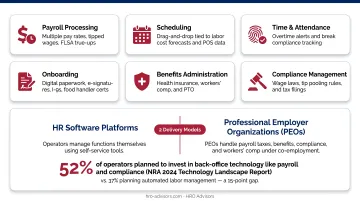
How restaurants handle these functions varies as much as the functions themselves. Two delivery models dominate the market. HR software platforms give restaurant operators the tools to manage these functions themselves. Professional Employer Organizations (PEOs) take over many of these functions entirely under a co-employment arrangement. They handle payroll taxes, benefits, compliance, and workers' compensation on the restaurant's behalf.
The NRA's 2024 Technology Landscape Report found that 52% of operators planned to invest in back-office technology like payroll and compliance, while 37% planned to adopt automated labor management systems. That 15-point gap suggests many operators are still managing labor manually — a costly approach as wage laws grow more complex.
The 5 Best HR Solutions for Restaurants in 2026
These five solutions were selected based on how well they address the specific pain points of restaurant HR: tipped wage accuracy, labor compliance, scheduling flexibility, onboarding speed, and scalability across different restaurant sizes.
Gusto
Gusto is a cloud-based payroll and HR platform built for small-to-medium businesses, and its restaurant-specific capabilities are more developed than most general-purpose payroll tools. The platform handles tipped wage calculations, FLSA tip credits, and automatic minimum wage adjustments — if an employee's combined wages and tips fall short of the federal minimum, Gusto flags and corrects the shortfall automatically.
| Detail | Info |
|---|---|
| Key Features | Full-service payroll with tip and overtime calculation, new-hire reporting, benefits administration, time tracking integration, employee self-service portal, automatic tax filings |
| Pricing | Starts at $49/month base + $6/employee/month (Simple plan); multistate payroll available on higher tiers |
| Best For | Restaurants prioritizing payroll accuracy and tipped wage compliance across multiple pay rates |
Gusto's integrations with accounting and time-tracking tools make end-of-period reconciliation faster for operators who are currently managing these processes manually or across disconnected systems.
7shifts
7shifts is built exclusively for restaurants, and every feature reflects that focus. Scheduling, time tracking, tip pooling, team communication, and payroll integration are all designed around the operational reality of front- and back-of-house management — not adapted from a generic HR template.
| Detail | Info |
|---|---|
| Key Features | Drag-and-drop scheduling, labor cost forecasting tied to POS sales data, tip pooling (equal distribution, percentage, or points weighting), time clock with overtime alerts, team chat, hiring and onboarding tools |
| Pricing | Free plan for 1 location up to 15 employees; paid plans start at $44.99/month/location |
| Best For | Independent restaurants and small chains that need a scheduling-first platform with built-in labor cost controls |
The labor forecasting tool is worth highlighting: it pulls sales data from integrated POS systems to recommend optimal staffing levels, which directly reduces the over-scheduling that inflates labor costs. More than 55,000 restaurants use 7shifts, which means the platform has real operational depth behind its feature set.
Rippling
Rippling is an all-in-one HR and IT platform designed for businesses that want to manage the full employee lifecycle from a single system. For multi-location restaurant groups, the appeal is centralization: one platform handles onboarding, payroll, time and attendance, benefits, and workflow automation across every location.
| Detail | Info |
|---|---|
| Key Features | Workflow and lifecycle automation, global payroll, time and attendance, benefits administration, employee surveys, 600+ app integrations, automated onboarding flows |
| Pricing | Custom pricing; base fee plus per-employee monthly cost (quote required) |
| Best For | Growing multi-location restaurant groups that need a scalable, highly automated HR platform |
The onboarding automation is particularly relevant for high-turnover environments. When a new hire is added, Rippling provisions accounts, sends welcome packets, and assigns first-day tasks automatically.
That matters in restaurants because the manual workload of onboarding compounds fast when you're replacing staff on a rolling basis.
BambooHR
BambooHR focuses on the people side of HR rather than payroll mechanics. Its strengths are onboarding workflow automation, document management, and training tracking — which makes it a practical fit for restaurants that cycle through new hires constantly and need a repeatable, organized process.
| Detail | Info |
|---|---|
| Key Features | Automated onboarding workflows, e-signatures for I-9s and W-2s, document storage, training tracking, time off management, employee self-service, performance reviews (Pro plan) |
| Pricing | Core plan starts at $10/employee/month; payroll, benefits admin, and time tracking available as add-ons |
| Best For | Restaurants with ongoing hiring needs that want a structured onboarding and document management system |
For restaurants where paper onboarding is a bottleneck, the e-signature and digital document flow can meaningfully cut the time before a new hire is productive. BambooHR has processed over 15 million electronic signatures — adoption numbers that go well beyond feature availability.
PEO Services (via HRO Advisors)
A Professional Employer Organization operates as a co-employer — taking over payroll processing, tax filings, benefits administration, workers' compensation, and HR compliance on the restaurant's behalf. This model suits restaurant operators who want enterprise-level HR infrastructure without building or maintaining an in-house HR function.
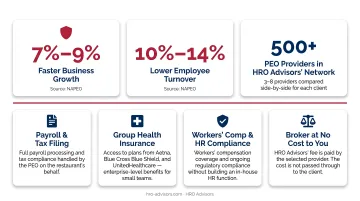
HRO Advisors is a PEO broker, not a PEO itself. The distinction matters: rather than selling you one solution, HRO Advisors compares between 3 and up to 8 PEO providers side-by-side from a network of 500+ providers, negotiates rates on your behalf, and presents a detailed comparison — all at no cost to the restaurant owner. Their broker fee is paid by the selected provider, and they confirm explicitly that this cost is not passed through to the client.
| Detail | Info |
|---|---|
| Key Features | Full payroll and tax administration, workers' compensation management, group health insurance access (including major carriers), compliance support, HR advisory services, onboarding assistance, risk management |
| Pricing | NAPEO data cites an average PEO cost of $1,395 per employee per year, with average annual savings of $1,775 per employee — a 27.2% ROI based on cost savings alone; HRO Advisors' comparison service is free |
| Best For | Restaurant owners who want hands-off HR management, better employee benefits, and compliance coverage without hiring an HR team |
The access to group health insurance is a practical recruiting lever. Small restaurants can't typically offer competitive benefits on their own — through a PEO, they gain access to plans from carriers including Aetna, Blue Cross Blue Shield, and UnitedHealthcare, which changes the conversation with prospective hires who might otherwise choose a larger employer.
According to NAPEO, businesses using PEOs grow 7% to 9% faster and have 10% to 14% lower employee turnover than comparable businesses that manage HR independently.
How These Solutions Were Evaluated
Generic HR software often fails restaurants on specifics. A platform might handle payroll competently while missing tipped wage true-ups entirely. Another might look great in a demo but lack integration with Toast, Square, or the POS system the restaurant already uses.
The five solutions above were assessed on:
- Tipped wage and FLSA compliance — automatic tip credit calculations, minimum wage adjustments, and overtime based on full minimum wage (not reduced cash wage)
- Scheduling and mobile access — tools built for shift-based workforces with real-time availability and labor cost visibility
- Onboarding efficiency — digital workflows capable of handling high-volume, frequent hiring without creating manager bottlenecks
- POS and accounting integration — ability to pull sales data for labor forecasting and sync with existing restaurant tech stacks
- Pricing transparency — accessible to single-location independents, not just enterprise operators
- Compliance depth — tip pooling rules, I-9 documentation, workers' compensation classifications, and state wage law alerts
The software vs. PEO decision isn't a matter of preference. It comes down to operational scale and risk exposure.
A 10-person independent restaurant might get everything it needs from Gusto plus 7shifts. A 40-person multi-location operator dealing with multistate payroll, compliance exposure, and benefits gaps often gets more value from a PEO — sometimes at lower total cost once benefits purchasing power and avoided compliance penalties are factored in.
Conclusion
The best HR solution for a restaurant in 2026 is the one that actually matches the scale, complexity, and compliance exposure of that specific operation. A scheduling tool that's perfect for a 15-person café won't serve a 120-person restaurant group with four locations and multistate payroll.
Both software-first tools and fully outsourced PEO models have real advantages. The key is understanding where your administrative pain is concentrated — and whether you want to manage it with better tools or offload it to specialists.
When evaluating options, factor in the full cost equation: not just monthly software fees, but the cost of a wage violation, the time your managers spend on scheduling and compliance, and whether your current benefits package is competitive enough to reduce turnover.
That cost equation is exactly where a broker comparison pays off. HRO Advisors helps restaurant operators cut through that complexity — comparing up to 8 PEO providers side-by-side, negotiating rates directly with providers, and delivering a personalized analysis at no charge. To get started, call 866-755-0288 or email info@hro-advisors.com.
Frequently Asked Questions
What does HR do for a restaurant?
Restaurant HR covers payroll (including tipped wages and overtime), staff scheduling, hiring and onboarding, labor law compliance, workers' compensation, and benefits administration. Strong HR management directly reduces legal risk and improves staff retention, both of which matter more in foodservice than almost any other industry.
What are the 7 main principles of HR?
The seven core HR functions are staffing, development, compensation, benefits, employee relations, health and safety, and compliance. For restaurants, the highest-stakes areas are compensation (tipped wage rules), staffing (constant turnover), and compliance (FLSA, state wage laws, tip pooling).
What is a PEO and how does it help restaurants?
A PEO (Professional Employer Organization) co-employs a restaurant's workforce, taking over payroll, tax filings, benefits administration, and compliance management. This gives small and mid-size restaurants access to enterprise-level HR infrastructure — including competitive group health insurance — without the cost of an in-house HR team.
How much does HR software or outsourcing cost for a restaurant?
HR software typically runs $6–$10 per employee per month for core platforms. PEO services average around $1,395 per employee per year, but NAPEO data shows average annual savings of $1,775 per employee — a net positive when benefits purchasing power and compliance risk reduction are included.
What HR compliance issues are most common in restaurants?
The most frequent violations include failure to meet tipped minimum wage requirements (the federal cash wage floor is $2.13/hour), overtime calculated at straight time instead of full minimum wage, illegal tip pools that include managers or supervisors, and missing I-9 documentation.
Can a small independent restaurant afford professional HR solutions?
Yes. Free tiers on platforms like 7shifts cover single locations with up to 15 employees, and Gusto's Simple plan starts at $49/month plus $6 per employee. For restaurants with 5+ employees, PEO services can reduce total HR costs by pooling benefits and handling compliance — often less expensive than managing it alone when you factor in administrative time and legal exposure.