
Many violations carry per-employee, per-pay-period penalties. A single payroll error doesn't cost you once; it costs you every pay period it goes uncorrected. For small and mid-sized businesses that lack dedicated HR infrastructure, that math gets ugly quickly.
This checklist covers the key compliance areas California employers must manage: wage and hour rules, worker classification, leave laws, safety obligations, and recordkeeping requirements. Whether you have 5 employees or 500, these obligations apply — and the thresholds matter.
Key Takeaways
- California's daily overtime rule kicks in after 8 hours in a single day — not just after 40 hours in a week
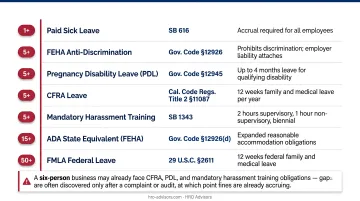
- Employee-count thresholds trigger new obligations at 5, 15, 25, 50, and 100 employees
- Misclassifying a worker under AB5 carries civil penalties of $5,000–$15,000 per violation
- Pay stub errors alone can cost up to $4,000 per employee
- Local ordinances in LA, San Francisco, and San Diego layer additional requirements on top of state law
Why California HR Compliance Is Uniquely Challenging
The Three-Layer Problem
California employers operate under three simultaneous compliance layers:
- Federal law — the FLSA baseline
- California state law — almost always stricter than federal standards; when the two conflict, the more employee-protective rule applies
- Local ordinances — cities like Los Angeles, San Francisco, and San Diego add their own minimum wages, scheduling rules, and leave requirements on top
That third layer is where most employers get caught off guard. A business operating in multiple California cities may need location-specific compliance policies for each.
Those city-level wage differences add up fast. Here's where key California cities stand heading into mid-2026:
Current local minimum wage examples (as of mid-2026):
| City | Current Rate | Next Rate |
|---|---|---|
| Los Angeles | $17.87/hour (through June 30, 2026) | $18.42/hour (July 1, 2026) |
| San Francisco | $19.18/hour (through June 30, 2026) | $19.61/hour (July 1, 2026) |
| San Diego | $21.06/hour (within city boundaries) | — |
How Headcount Triggers Compliance Obligations
California doesn't use a single definition of "small employer." Different statutes trigger different obligations at different headcounts:
| Employees | Obligation Triggered |
|---|---|
| 5+ | CFRA leave, PDL, harassment training, bereavement leave |
| 15+ | Pay-scale disclosure in job postings |
| 25+ | School/childcare activity leave (up to 40 hours/year) |
| 50+ | Emergency responder training leave |
| 100+ | Annual California pay data reporting |
A six-person business may already face CFRA, PDL, and mandatory harassment training obligations. Businesses that underestimate these thresholds often discover the gap only after a complaint or audit — at which point fines are already accruing.
California Wage, Hour & Payroll Compliance Checklist
Minimum Wage and Overtime
The California state minimum wage is $16.90/hour effective January 1, 2026. Always pay the highest applicable rate — state, county, or city.
California's overtime rules go further than federal law in one critical way: overtime is calculated daily, not just weekly.
California overtime rules:
- 1.5x pay after 8 hours in a single workday
- 2x pay after 12 hours in a single workday
- 1.5x pay for the first 8 hours on a 7th consecutive workday
- 2x pay beyond 8 hours on a 7th consecutive workday
- 1.5x pay after 40 hours in a workweek (same as federal)
An employer following only federal rules — paying overtime after 40 weekly hours — will undercut California employees who work long daily shifts, triggering back-pay liability plus potential PAGA penalties.
Meal and Rest Break Requirements
California mandates precise break schedules — and enforcement is strict:
- First meal break: 30 minutes, unpaid, must begin before the end of hour 5
- Second meal break: 30 minutes, unpaid, must begin before the end of hour 10
- Rest breaks: 10 paid minutes per 4 hours worked (or major fraction thereof)
Miss a required break? The penalty is one additional hour of pay at the employee's regular rate for each missed break, per workday.
Pay Stub and Payroll Requirements
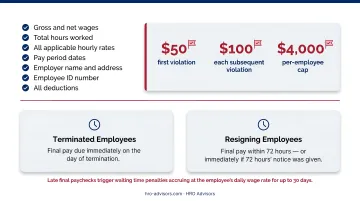
Under California's itemized wage statement law, every pay stub must include:
- Gross and net wages
- Total hours worked
- All applicable hourly rates
- Pay period dates
- Employer name and address
- Employee ID number
- All deductions
Pay stub violation penalties: $50 for the first violation, $100 for each subsequent violation, capped at $4,000 per employee.
Final paycheck timing is just as tightly regulated:
- Terminated employees must receive final pay immediately on the day of termination
- Resigning employees must receive final pay within 72 hours (or immediately if they gave 72 hours' notice)
Late final paychecks trigger waiting time penalties — accruing at the employee's daily wage rate for up to 30 days.
Employee Classification & New Hire Requirements Checklist
AB5 and Worker Classification
California's ABC Test under AB5 is the default standard for classifying workers. A worker is an employee unless the hiring entity proves all three prongs:
- (A) The worker is free from the company's control and direction
- (B) The work is performed outside the usual course of the business
- (C) The worker is customarily engaged in an independently established trade or business
Misclassification penalties are substantial:
- $5,000–$15,000 per violation for willful misclassification
- $10,000–$25,000 per violation for pattern or practice violations
Back wages, benefits owed, and PAGA exposure are separate and cumulative — none of these penalties offset the others.
New Hire Paperwork Checklist
California employers must provide the following at or before the start of employment:
- DE 2515 — State Disability Insurance pamphlet
- DE 2511 — Paid Family Leave pamphlet
- DLSE Wage Theft Prevention Notice — includes pay rate, pay schedule, employer info
- Workers' Compensation Time-of-Hire Notice
- CRD Sexual Harassment Fact Sheet (DFEH-185)
If 10% or more of your workforce speaks a language other than English, many of these notices must also be provided in that language.
Exempt vs. Non-Exempt Classification
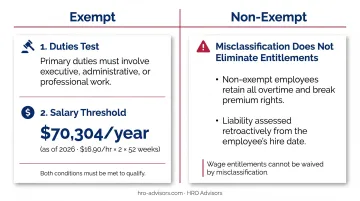
To qualify as exempt from California overtime and break rules, an employee must meet both:
- A duties test — the employee's primary duties must involve executive, administrative, or professional work
- A salary threshold — the employee must earn at least $70,304/year (as of 2026, based on $16.90/hour × 2 × 52 weeks)
Misclassifying a non-exempt employee as exempt doesn't eliminate their wage entitlements. They remain eligible for all overtime and break premiums, assessed retroactively from their hire date.
New Hire Reporting
All new hires and rehires must be reported to the California EDD within 20 calendar days of their start date. Independent contractors paid $600 or more in a calendar year must also be reported within 20 days of the payment or contract, whichever comes first.
Leave Laws & Workplace Policy Compliance Checklist
Paid Sick Leave
Under SB 616, the baseline is 5 days (40 hours) of paid sick leave per year. Key rules employers must follow:
- Accrual rate of at least 1 hour per 30 hours worked
- Employees may use leave after 90 days of employment
- Some cities (Los Angeles, San Francisco) set higher accrual requirements
- Retaliating against an employee for using sick leave can trigger civil suits and fines up to $10,000 per violation
CFRA and Paid Family Leave
California Family Rights Act (CFRA) — applies to employers with 5 or more employees:
- Up to 12 weeks of unpaid, job-protected leave per year
- Covers the employee's own serious health condition, care for a family member, or bonding with a new child
- Broader family scope than federal FMLA
- Does not run concurrently with Pregnancy Disability Leave (PDL)
Pregnancy Disability Leave (PDL) — also applies at 5+ employees:
- Up to 4 months of leave for pregnancy-related disability
Paid Family Leave (PFL) through EDD provides up to 8 weeks of partial wage replacement, generally at 70–90% of wages, for qualifying leaves.
Other Required Leave Types
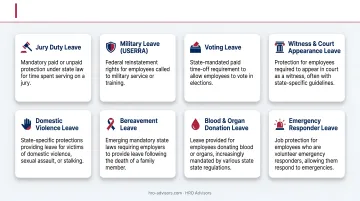
| Leave Type | Threshold | Details |
|---|---|---|
| Bereavement (AB 1949) | 5+ employees | 5 days |
| School Activity Leave | 25+ employees | Up to 40 hrs/year, 8 hrs/month |
| Voting Leave | All employers | Up to 2 paid hours |
| Jury/Witness Leave | All employers | Protected, Labor Code 230 |
| DV/Stalking/Assault Leave | All employers | Job-protected |
Employee Handbook Requirements
Every leave type above needs to be documented — which is why an up-to-date employee handbook is a compliance requirement, not just best practice. At minimum, California handbooks must include:
- Harassment and discrimination prevention policy
- At-will employment notice
- Meal and rest break policy
- Sick leave and PTO policy
- Lactation accommodation policy
- Workplace Violence Prevention Plan — required under SB 553, effective July 1, 2024
California's Labor Commissioner actively audits handbook compliance, and gaps in required policies are frequently cited in wage-and-hour claims and DFEH complaints.
Workplace Safety, Training, Recordkeeping & Posting Requirements
Cal/OSHA Compliance
Cal/OSHA requirements exceed federal OSHA standards — and the penalties for non-compliance are steep enough to threaten a small business's finances. Every California employer must maintain:
- A written Injury and Illness Prevention Program (IIPP)
- A Heat Illness Prevention Program for outdoor workers
- A written Workplace Violence Prevention Plan for most general-industry employers (required since July 1, 2024 under SB 553)
Cal/OSHA penalty ranges as of 2025:
| Violation Type | Maximum Penalty |
|---|---|
| General/regulatory | $16,285 |
| Serious | $25,000 |
| Willful or repeat | $162,851 |
| Failure to abate | Up to $15,000/day |
Mandatory Training Requirements
Safety obligations don't stop at physical hazards. California mandates ongoing employee training, starting with harassment prevention.
Sexual Harassment Prevention Training is required for employers with 5 or more employees:
- Supervisors: 2 hours every 2 years
- Non-supervisory employees: 1 hour every 2 years
- Training must be interactive and documented
Some industries — warehousing, food service, healthcare — face additional sector-specific training mandates.
Recordkeeping and Workplace Postings
Documenting that training happened is just the start. California's recordkeeping rules extend to payroll, personnel files, and required workplace notices — each with its own penalty structure.
Retention requirements:
- Payroll records: 3 years minimum; accessible to employees within 21 days of a request (failure to comply: $750 penalty)
- Personnel files: retained during employment plus 3 years after termination
Required workplace posters must be displayed (or electronically distributed for remote workers):
- California minimum wage
- Paid sick leave
- CFRA/FMLA
- Workers' compensation (failure to post: up to $7,000)
- Cal/OSHA safety notices
- IWC Wage Order applicable to your industry
- Federal EEOC poster
How a PEO Can Help California Employers Stay Compliant
Given the volume and frequency of California employment law updates — most effective January 1 each year — many small and mid-sized businesses partner with a Professional Employer Organization (PEO) to handle compliance on an ongoing basis. A PEO co-employs the workforce and shares liability for payroll accuracy, tax filings, benefits administration, and regulatory compliance, which meaningfully limits an employer's exposure.
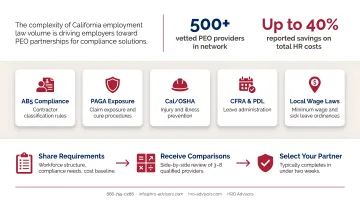
For California employers, the right PEO goes well beyond federal baseline standards. Look for partners with direct experience in:
- AB5 contractor classification rules
- PAGA claim exposure and cure procedures
- Cal/OSHA injury and illness prevention requirements
- CFRA and PDL leave administration
- Local minimum wage and paid sick leave ordinances
Finding a PEO with that California-specific depth takes time most employers don't have. That's where HRO Advisors comes in.
HRO Advisors offers a no-obligation PEO comparison service that matches California employers with vetted partners from a network of 500+ providers. Their advisors gather your compliance requirements, workforce structure, and cost baseline, then deliver a side-by-side comparison of 3–8 qualified providers. The process typically completes in under two weeks, and clients regularly report savings of up to 40% on total HR costs.
You can reach HRO Advisors at 866-755-0288, via email at info@hro-advisors.com, or schedule a call directly.
Frequently Asked Questions
Do California labor and employment laws apply to small employers?
Yes. Many California labor laws apply regardless of size — including minimum wage, overtime, meal and rest breaks, and final pay rules. Certain provisions have specific thresholds (CFRA and harassment training both kick in at 5+ employees), but small employers should not assume they are exempt from California's core requirements.
What is the California definition of a small or mid-sized employer?
California doesn't use a single universal threshold. Different statutes set different triggers: CFRA and PDL apply at 5+ employees, pay-scale disclosure requirements apply at 15+ employees, and annual pay data reporting applies at 100+ employees. Each law defines its own scope.
What is the 7-minute rule for payroll in California?
The 7-minute rule is a federal rounding guideline under 29 CFR 785.48, not a California-specific rule. It allows rounding to the nearest quarter-hour: 1–7 minutes rounds down, 8–14 rounds up. California courts have increasingly scrutinized time-rounding — the California Supreme Court rejected it for meal periods — and any rounding practice must be neutral and not consistently favor the employer.
What are the penalties for violating California wage and hour laws?
Penalties stack fast. A single payroll error can trigger unpaid wages plus liquidated damages, PAGA civil penalties, waiting time penalties up to 30 days of daily wages, and pay stub penalties up to $4,000 per employee — compounding across every affected pay period.
How is California overtime different from federal overtime?
Federal law requires overtime after 40 hours in a workweek. California requires overtime after 8 hours in a single workday — a fundamentally different trigger. An employee working four 10-hour days earns 8 hours of daily overtime under California law despite working exactly 40 hours for the week.
How often do California employment laws change?
Frequently. New legislation typically takes effect January 1 each year, and wage rates often adjust July 1. Annual compliance reviews are essential — partnering with a PEO that actively tracks California law changes removes the burden of monitoring every update yourself.