
A Professional Employer Organization (PEO) is a direct structural response to those pressures. According to NAPEO, 14% of employers with 20–499 employees now use one, and the industry has more than quadrupled in size since 2012.
This article explains what a PEO actually is, how the co-employment model works in practice, and what the measurable business outcomes look like — not just in theory, but across cost, compliance, and growth.
Key Takeaways
- A PEO becomes your co-employer for tax and benefits purposes while you retain full control over your team and operations
- PEO clients grow twice as fast and are 50% less likely to go out of business, per NAPEO research
- Small-firm workers pay $8,889 annually for family health coverage vs. $6,227 at large firms — PEOs help close that gap
- Co-employment is not the same as payroll processing, HR outsourcing, or staffing
- Choosing the right PEO matters as much as choosing to use one — not all providers are equal
What Is a PEO?
A Professional Employer Organization enters a co-employment arrangement with your business: it becomes the employer of record for tax and benefits purposes, while you retain complete authority over day-to-day operations and every workforce decision.
In practice, the PEO puts your employees on its payroll and issues W-2s under its own EIN. You continue to hire, fire, set pay rates, assign responsibilities, and run your business exactly as before. The administrative and legal infrastructure shifts to the PEO; your operational control stays with you.
How Co-Employment Differs from Other Options
Many businesses confuse PEOs with similar-sounding services. The distinctions matter:
| Model | Employer of Record? | Shares Legal Liability? | Scope |
|---|---|---|---|
| PEO | Yes | Yes (co-employer) | Payroll, benefits, compliance, workers' comp, HR admin |
| Payroll Company | No | No | Payroll processing and tax filing only |
| HR Outsourcing Firm | No | No | HR consulting and administration, limited scope |
| Staffing Agency | Yes (for their workers) | Yes (sole employer) | Supplies temporary labor; you don't own the employment relationship |
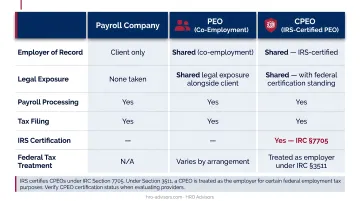
The key legal distinction is shared employer-of-record status. A payroll company processes your checks and files taxes — that's where the relationship ends. A PEO takes on shared legal exposure alongside you, which is what makes it fundamentally different from every other model in this table.
For tax purposes, the most rigorous version of this is an IRS-certified PEO, or CPEO. The IRS certifies CPEOs under IRC Section 7705, and under Section 3511, a CPEO is treated as the employer for certain federal employment tax purposes. This certification is worth checking when evaluating providers.
Key Advantages of a PEO
The value of a PEO shows up in specific, trackable business outcomes. The three advantages below each connect to measurable operational impact — not just administrative convenience.
Cost Savings and Access to Enterprise-Level Benefits
The core mechanism is purchasing power. A PEO pools employees across hundreds or thousands of client companies, giving it the negotiating leverage of a large employer when securing health, dental, vision, and retirement plans. A 30-person company cannot replicate that leverage alone.
The results are significant. The KFF 2025 Employer Health Benefits Survey found that small-firm workers contribute an average of $8,889 per year for family health coverage, compared to $6,227 at large firms. That $2,600+ annual gap per employee represents both a cost burden and a talent disadvantage — candidates compare benefits packages, and small businesses often lose that comparison.
The offer-rate gap is even starker: only 59% of small firms with 10–199 employees offer health benefits at all, versus 97% of large firms. Through a PEO, smaller businesses gain access to the group health plans that allow them to compete.
Beyond health coverage, NAPEO data shows 52% of PEO users with 10–49 employees have retirement plans, compared to 23% of non-users. That gap in benefits access directly affects hiring and retention.
KPIs most affected: benefits cost per employee, total HR spend as a percentage of payroll, offer acceptance rate, employee retention rate
Time Savings and Operational Freedom
When payroll processing, tax filing, benefits enrollment, compliance tracking, and HR administration transfer to the PEO, the hours those tasks consumed return to the business. For owners handling HR themselves alongside their core work, that recaptured time is often the most immediate change they notice.
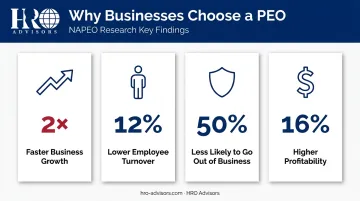
The operational impact extends beyond convenience. NAPEO reports that PEO clients:
- Grow twice as fast as comparable non-PEO businesses
- Experience 12% lower employee turnover
- Are 50% less likely to go out of business
- Show 16% higher profitability
Those outcomes trace directly back to reduced administrative burden. The NAPEO ROI research (2019) found that PEO clients use 1.6 HR FTEs per 100 employees versus a national average of 2.6 FTEs per 100 employees — a meaningful efficiency difference that compounds as headcount grows.
KPIs most affected: HR admin hours per week, revenue per employee, business growth rate, owner time on non-core tasks
When this matters most: Companies with lean or no dedicated HR staff, businesses in rapid growth phases, and owners who are currently the de facto HR department.
Compliance Protection and Liability Reduction
Employment law compliance is one of the highest-risk areas for SMBs — and the complexity keeps growing. In 2026 alone, businesses face new pay transparency laws across multiple states, evolving AI hiring regulations, and ongoing multi-state wage-and-hour developments.
SHRM reports that new pay transparency requirements took effect in Illinois, Minnesota, New Jersey, Vermont, and Massachusetts in 2025, with more states in the pipeline.
The volume of employment claims reflects the risk environment. The EEOC processed 88,201 new discrimination charges in FY2025 — nearly 9% higher than FY2024, which itself saw a 9% increase over the prior year. For SMBs without dedicated legal or HR compliance staff, a single claim can consume months of attention and significant expense.
A PEO addresses this through:
- Dedicated compliance experts monitoring regulatory changes continuously
- Payroll tax filing and reporting managed under the PEO's employer-of-record status
- Workers' compensation coverage and claims management
- OSHA compliance support and HR policy guidance
- Shared legal liability as co-employer — meaning the PEO has skin in the compliance game
That shared liability is the structural difference that sets a PEO apart. When the PEO is co-employer, a compliance failure is also their problem — which means proactive compliance support, not just reactive damage control after something goes wrong.
KPIs most affected: compliance violation incidents, penalties and fines, workers' compensation premiums, employment-related legal costs
What Happens When You Skip the PEO Model
Managing HR without PEO support at scale looks predictable. The consequences tend to follow the same pattern:
- Payroll errors that surface at the worst moments
- Missed compliance updates that create regulatory exposure
- Benefits packages that can't compete with larger employers
- HR staff buried in administration instead of supporting the business
The cost gaps compound from there. Without group purchasing power, small businesses pay more per employee for weaker health coverage — the KFF data puts hard numbers behind that gap. Without dedicated compliance support, regulatory issues often go undetected until they trigger audits or litigation years later.
The SBA Office of Advocacy's 2026 FAQ reports that federal paperwork alone costs small businesses over $81 billion annually — and that's before accounting for penalties, legal fees, or the productivity drain of HR administration handled by people whose primary role is running the business.
What catches most businesses off guard is the lag. A compliance misstep in year one can trigger an audit two years later. A weak benefits package that costs one key hire creates recruiting gaps and lost institutional knowledge six months down the road. By the time the damage is visible, it's rarely contained to a single line item.
How to Get the Most Value from a PEO Partnership
PEO value is highest when the relationship starts correctly. Before signing anything, audit your current HR costs — payroll, benefits, workers' comp premiums, admin time — to establish a measurable baseline. Without that baseline, you cannot calculate ROI.
Key Criteria for Evaluating a PEO
When comparing providers, prioritize these filters:
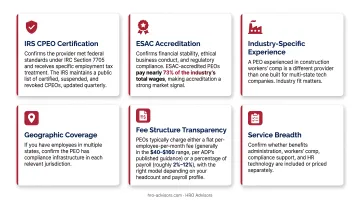
- IRS CPEO certification — confirms the provider met federal standards under IRC Section 7705 and receives specific employment tax treatment. The IRS maintains a public list of certified, suspended, and revoked CPEOs, updated quarterly
- ESAC accreditation — confirms financial stability, ethical business conduct, and regulatory compliance. ESAC-accredited PEOs pay nearly 73% of the industry's total wages, making accreditation a strong market signal
- Industry-specific experience — a PEO experienced in construction workers' comp is a different provider than one built for multi-state tech companies. Industry fit matters
- Geographic coverage — if you have employees in multiple states, confirm the PEO has compliance infrastructure in each relevant jurisdiction
- Fee structure transparency — PEOs typically charge either a flat per-employee-per-month fee (generally in the $40–$160 range, per ADP's published guidance) or a percentage of payroll (roughly 2%–12%), with the right model depending on your headcount and payroll profile
- Service breadth — confirm whether benefits administration, workers' comp, compliance support, and HR technology are included or priced separately
Why Comparison Shopping Matters
With over 500 PEOs operating in the U.S. market, no two providers are identical in pricing, benefits carriers, compliance depth, or service model. Comparing them independently is time-consuming and requires knowing what questions to ask.
A PEO broker like HRO Advisors short-circuits that process. Businesses get a free, expert-guided comparison of up to 8 PEOs, shortlisted from a network of 500+ providers based on industry, workforce size, compliance requirements, and budget.
The full process — from initial consultation to a side-by-side comparison with negotiated pricing — typically wraps in under two weeks. HRO Advisors is compensated by the selected provider, and that arrangement does not inflate client costs. Clients typically report savings of up to 40% on HR spend.
Conclusion
A PEO delivers measurable impact across three dimensions: it reduces costs through group purchasing power, returns time to the business by absorbing HR administration, and limits compliance exposure by sharing employer-of-record status. Businesses that treat the partnership as an ongoing operational relationship — not a one-time fix — tend to compound those advantages as they grow.
In 2026, compliance requirements are expanding, quality benefits have become a retention lever, and internal HR overhead is a cost most SMBs can't justify absorbing alone. A PEO provides structural capabilities that would otherwise take years and significant budget to build in-house. Whether that advantage pays off depends almost entirely on choosing the right provider — and HRO Advisors' free side-by-side comparison service exists specifically to make that decision easier.
Frequently Asked Questions
What is a Professional Employer Organization (PEO)?
A PEO is a co-employer that handles HR administration — including payroll, benefits, compliance, and risk management — on your behalf. The business retains full operational and workforce control while the PEO serves as the employer of record for tax and benefits purposes.
How much do PEO services cost per employee?
PEOs typically charge either a flat per-employee-per-month fee (generally $40–$160, per ADP's published guidance) or a percentage of total payroll (roughly 2%–12%). The net cost is often offset by savings on benefits premiums, reduced HR overhead, and avoided compliance penalties.
What is the difference between a PEO and a payroll company?
A payroll company processes wages and handles tax filings but does not become the employer of record or assume any employment liability. A PEO takes on shared legal responsibility as a co-employer and provides a much broader range of HR services, including benefits, compliance support, and workers' compensation.
Who owns the employees in a PEO arrangement?
The business retains full authority over hiring, managing, and terminating employees. The PEO serves as employer of record for tax and benefits purposes only, issuing W-2s under its EIN — but every workforce decision remains with the business owner.
What types of businesses benefit most from a PEO?
Small and mid-sized businesses — typically 5 to 500 employees — benefit most, particularly in professional services, construction, healthcare, manufacturing, and technology, where compliance complexity and talent competition create the highest administrative burden.
What should I look for when choosing a PEO?
Key factors to evaluate:
- IRS CPEO certification and ESAC accreditation
- Industry-specific experience and multi-state geographic coverage
- Service breadth and transparent, itemized pricing
Always compare multiple providers before committing — they vary significantly in both cost and service depth.