Introduction
Scaling from 50 to 250 employees doesn't just add headcount — it multiplies HR complexity. At this scale, your team is fielding multi-state payroll runs, tracking ACA compliance, managing benefits renewals, and processing onboarding paperwork simultaneously. The administrative workload grows faster than the business does.
Hiring more HR staff is one option — but an expensive one. A payroll specialist, HR manager, and benefits administrator each command six-figure salaries. And even a fully staffed internal team typically can't match the group buying power that larger employers use to offer competitive health plans.
Professional Employer Organizations (PEOs) offer a direct alternative. PEO services let medium-sized businesses hand off payroll processing, compliance tracking, and benefits administration to a dedicated partner — without giving up day-to-day operational control.
This article covers how PEO services address the specific HR and payroll challenges companies with 50–250 employees face, what the financial case actually looks like, how PEOs compare to other outsourcing options, and how to evaluate providers before signing anything.
Key Takeaways
- PEOs use a co-employment model — you keep control of your team while they handle payroll, benefits, and compliance
- Medium businesses gain access to enterprise-level benefits packages they couldn't afford independently
- A PEO complements your internal HR team rather than replacing it, freeing staff for strategic work
- Evaluate PEOs on compliance depth, service model, and scalability — not all are built for mid-sized companies
- Working with a broker like HRO Advisors lets you compare 3–8 providers side-by-side at no cost
The Unique HR Challenges Medium Businesses Face
The Middle-Ground Problem
At 50–250 employees, you've outgrown founder-led HR but probably haven't built a fully staffed internal department. Most companies at this scale have one to three HR generalists covering everything from hiring paperwork to open enrollment to termination processes. That's manageable at 40 people. At 150, it breaks.
Multi-state employment adds another layer. If your team spans two or more states, each jurisdiction brings its own wage and hour rules, leave requirements, and workers' comp classifications. A lean HR team can't track all of it reliably.
The Benefits Gap
According to BLS data from March 2025, medical care benefits were available to just 60% of workers at establishments with fewer than 100 employees, compared to 90% at companies with 500 or more. The dental gap is even wider: 30% vs. 70%. For vision, it's 21% vs. 44%.
These aren't perception gaps — they're a structural recruiting disadvantage when you're competing against larger employers for the same talent.
Compliance Exposure at This Scale
Medium businesses are large enough to trigger several significant federal requirements that many smaller companies never face:
- ACA employer mandate: Once you hit 50 full-time employees (including FTEs), you're an Applicable Large Employer required to offer qualifying health coverage or face penalties
- FMLA: Applies to private-sector employers with 50 or more employees in 20 or more workweeks
- COBRA: Triggered when you reach 20 or more employees
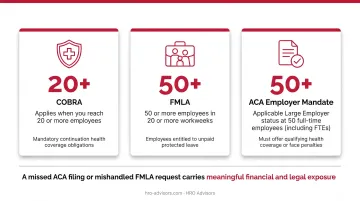
These aren't minor administrative details. A missed ACA filing or mishandled FMLA request carries meaningful financial and legal exposure — and most companies at this scale don't have a dedicated compliance specialist watching for regulatory changes.
Administrative Drag
As headcount grows, so does the volume of every HR transaction:
- Payroll runs and tax filings
- Onboarding packets and new-hire documentation
- Benefits enrollments and annual open enrollment
- PTO requests, offboarding checklists, and termination processing
The cumulative weight of these tasks pulls HR and leadership attention away from higher-value work: hiring strategy, manager development, and workforce planning.
What PEO Services Cover for Growing Companies
The Co-Employment Model Explained
Under a PEO arrangement, the PEO becomes the employer of record for tax and benefits purposes while you retain complete day-to-day control over your employees — who they are, what they do, how they're managed, and when they leave. You keep all employment decisions; the PEO absorbs the administrative and regulatory infrastructure that surrounds them.
Payroll & Tax Administration
PEO payroll services for medium businesses typically cover:
- Multi-state payroll processing and direct deposit
- Federal, state, and local tax withholding and filing
- W-2 and 1099 management
- Garnishment administration
- Quarterly and annual tax return preparation
The compliance risk here isn't hypothetical. The IRS charges failure-to-deposit penalties of 2% to 15% depending on how late the deposit is and whether the IRS has issued a demand notice. A PEO handles these deposits under its own employer identification number, absorbing that liability.
Benefits Administration & Access
This is one of the most tangible advantages for medium businesses. PEOs pool employees across their entire client base — sometimes tens of thousands of worksite employees — to negotiate group-rate benefits. A 75-person company can access the same medical, dental, vision, and 401(k) plans that were previously available only to large corporations.
HRO Advisors' network, for example, connects businesses with major national carriers including Aetna, Blue Cross Blue Shield, and UnitedHealthcare — plans that most mid-sized companies couldn't access or afford on their own.
HR Compliance & Risk Management
Benefits access is one piece of the picture. On the compliance side, PEOs monitor federal and state regulatory changes continuously and push those updates directly into client workflows. This typically includes:
- Workers' compensation administration and claims management
- Employee handbook updates reflecting new legal requirements
- Employment law guidance on hiring, terminations, and leave
- Support for audits and regulatory inquiries
For medium businesses without a dedicated compliance function, this ongoing monitoring catches regulatory gaps before they become EEOC charges, state audit notices, or wage-and-hour claims.
HR Administration & Employee Lifecycle Support
Beyond compliance, PEOs handle the operational mechanics of HR:
- Onboarding and offboarding workflows with consistent, auditable documentation
- Centralized employee records management in a single HRIS
- Performance management frameworks and supporting documentation
- Employee self-service portals for pay stubs, benefits enrollment, and PTO — reducing routine HR inquiries to HR staff
How PEOs Reduce Costs and Drive ROI for Medium Businesses
The Financial Case
NAPEO's 2019 ROI white paper provides the most cited benchmark: PEO clients saw an average 27.2% annual ROI, with $1,775 in annual cost savings per employee. Breaking that down:
| Savings Category | Per Employee (Annual) |
|---|---|
| Internal HR salary & benefits | $965 |
| Health benefits costs | $654 |
| Workers' compensation | $66 |
| Other external HR costs | $90 |
| Total | $1,775 |
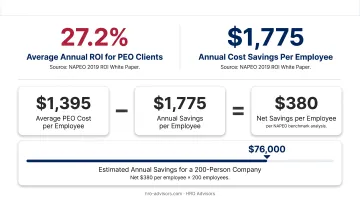
Against an average PEO cost of $1,395 per employee in that analysis, the net savings of $380 per employee adds up fast — roughly $76,000 annually for a 200-person company.
Understanding PEO Pricing
PEOs typically price their services one of two ways:
- PEPM (per-employee-per-month): Fixed cost per head, regardless of salary. Budgets stay stable even as compensation rises.
- Percentage of payroll: A cut of total gross payroll. Costs climb with every raise, bonus, or market adjustment.
For medium businesses where compensation grows with performance reviews and market adjustments, PEPM pricing tends to produce more stable budget forecasting. When comparing proposals, confirm which model applies and model out both scenarios using your actual payroll figures.
Indirect ROI Drivers
The cost savings extend well beyond the direct line items. Replacing an employee costs 50% to 200% of their annual salary, according to SHRM, depending on the role. For managers and technical professionals, those costs sit at the higher end.
A NAPEO study found that companies using PEOs for at least four consecutive quarters had turnover 10 to 14 percentage points lower than comparable companies. The same study found an annual business failure rate of roughly 4% for PEO clients versus 8% for private businesses overall.
Better benefits attract stronger candidates, and consistent HR support keeps them. Each retained employee is a avoided replacement cost — often $50,000 or more at the manager level.
PEO as HR Force Multiplier
For medium businesses that already have internal HR staff, the PEO case isn't "replace your team." It's the opposite. When the PEO handles payroll processing, benefits enrollment, and compliance monitoring, your HR staff gets their time back for the work that actually moves the business forward.
HRO Advisors clients regularly report this shift once administrative load lifts. Their HR teams move from reactive to strategic — spending time on:
- Building culture and engagement programs
- Supporting leadership development and succession planning
- Partnering with finance on workforce cost modeling
- Developing employer brand and talent acquisition strategy
PEO vs. Other HR Outsourcing Options
PEO vs. HRO (Human Resources Outsourcer)
| Dimension | PEO | HRO |
|---|---|---|
| Co-employment | Yes | No |
| Benefits pooling | Yes | No |
| Compliance scope | Broad, shared liability | Function-specific |
| Service model | Bundled | À la carte |
| Pricing | PEPM or % of payroll | Per-service fees |
The table above captures the structural difference, but context matters. An HRO handles specific HR functions — payroll only or benefits administration only — without entering a co-employment relationship. For businesses that need targeted, narrow support, that works. For medium businesses navigating multi-state complexity and competing on benefits to attract talent, the PEO's bundled model typically delivers stronger coverage at lower total cost.
PEO vs. In-House HR Expansion
The alternative many medium businesses consider first: hire another HR person. The numbers are worth reviewing. BLS data puts the May 2024 median wage for HR managers at $140,030 and HR specialists at $72,910. With benefits adding roughly 30% to compensation costs (per BLS March 2026 ECEC data), a single HR manager represents a loaded cost of roughly $182,000 annually. That figure also doesn't account for what one person simply can't do alone:
- Negotiate group benefits rates with insurance carriers
- Provide multi-state compliance counsel across jurisdictions
- Build and maintain a full HRIS platform
A PEO delivers all of this through a team of specialists — payroll experts, benefits administrators, compliance professionals — typically for less than the loaded cost of a single HR manager.
PEO vs. HR Software/HRIS
Software platforms automate workflows well, but they don't negotiate benefits rates, provide compliance guidance, or absorb employment tax liability. A platform can surface a compliance risk; it can't resolve it.
Many PEOs include a full HRIS platform as part of their service package, combining workflow automation with the human expertise and shared liability that software alone can't offer.
How to Evaluate and Choose the Right PEO
Key Criteria for Medium Businesses
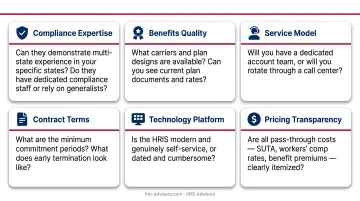
When evaluating PEO providers, prioritize these dimensions:
- Compliance expertise: Can they demonstrate multi-state experience in your specific states? Do they have dedicated compliance staff or rely on generalists?
- Benefits quality: What carriers and plan designs are available? Can you see current plan documents and rates?
- Service model: Will you have a dedicated account team, or will you rotate through a call center?
- Contract terms: What are the minimum commitment periods? What does early termination look like?
- Technology platform: Is the HRIS modern and genuinely self-service, or dated and cumbersome?
- Pricing transparency: Are all pass-through costs — SUTA, workers' comp rates, benefit premiums — clearly itemized?
The Challenge of Comparing Independently
NAPEO's 2023 Industry Footprint documents 523 PEOs operating in the U.S. as of end-2022, serving over 208,000 clients with 4.5 million worksite employees. With that many providers, pricing models vary significantly, service inclusions differ, and proposals are structured in ways that make apples-to-apples comparison difficult without industry experience.
HRO Advisors, a PEO broker based in Dallas, TX, solves this directly. The firm analyzes costs and coverage across more than 500 providers and delivers a side-by-side comparison of 3–8 shortlisted PEOs tailored to your specific business — industry, headcount, compliance needs, and budget. The service costs nothing; HRO Advisors is compensated by the provider you select, and that arrangement does not increase your cost.
Vetting Checklist Before Signing
- CPEO certification: The IRS certifies PEOs under IRC section 7705, which makes the CPEO solely liable for employment tax deposits and filings — a meaningful liability distinction worth confirming upfront.
- Contract terms: Scrutinize minimum commitment periods, renewal provisions, and termination procedures before signing anything.
- Client references: Ask for references from companies in your industry and headcount range, not just the provider's best-case showcase clients.
- All-in cost transparency: Verify that pass-through costs like SUTA and workers' comp are itemized separately in your proposal, not buried in a blended rate.
Frequently Asked Questions
What is the difference between a PEO and an HRO for medium businesses?
A PEO enters a co-employment relationship with your business, sharing employer responsibilities and bundling payroll, benefits access, and compliance under one arrangement. An HRO handles specific HR functions à la carte without co-employment. Medium businesses with broad, multi-state HR complexity typically get more comprehensive coverage — and better benefits access — from a PEO.
How much do PEO services typically cost for a medium-sized business?
PEO pricing runs either as a per-employee-per-month (PEPM) fee — typically $100–$200 per employee — or as a percentage of gross payroll, usually 2–12%. Costs vary by provider, service scope, and headcount. Always request a fully itemized quote that includes pass-through costs, and compare multiple providers before deciding.
Can a medium business use a PEO if it already has an internal HR team?
Yes — and it's common. The PEO handles high-volume administrative and compliance tasks, freeing your internal HR staff to focus on culture, employee relations, and workforce strategy. Think of it as augmentation — your HR team sheds the administrative load and refocuses on strategy.
What HR functions can a PEO handle for medium businesses?
Core service areas include:
- Payroll processing and tax filing
- Benefits administration and enrollment
- Workers' compensation management
- Compliance monitoring across states
- Onboarding and offboarding workflows
- Self-service HRIS platform access
How long does it take to implement PEO services?
Timelines vary by provider and company complexity. ADP TotalSource estimates most implementations take 60–90 days, with early steps like payroll and benefits setup often completed within the first 30 days. TriNet cites a typical implementation of around 8 weeks.
What should a medium business look for when comparing PEO providers?
Focus on multi-state compliance expertise, benefits quality and carrier access, CPEO certification, pricing transparency, contract flexibility, and whether you'll have a dedicated account team. A PEO broker like HRO Advisors can simplify this process by running the comparison on your behalf at no cost.