
This guide breaks down the true, all-in costs of both models—fee structures, hidden expenses, compliance implications, and the specific situations where each approach makes financial sense. By the end, you'll have enough clarity to run the actual math for your business.
Key Takeaways
- PEOs typically cost $40–$150 per employee per month or 2–12% of payroll; NAPEO data puts average annual PEO cost at $1,395 per employee
- In-house HR costs go well beyond salary — software, benefits admin, small-group workers' comp rates, and diverted owner time all add up fast
- A 2019 NAPEO-commissioned study found businesses using PEOs see an average 27.2% annual ROI from cost savings alone
- PEOs deliver peak value for companies with 10–49 employees — half of all PEO clients fall in this range for a reason
- Companies crossing 10 employees or expanding into new states typically hit the point where PEO economics start beating in-house HR
PEO vs. In-House HR: Quick Comparison
| Dimension | PEO | In-House HR |
|---|---|---|
| Cost Structure | Per-employee fee or % of payroll; large-group benefits rates offset some cost | Salary + benefits load + software + admin overhead |
| Compliance & Risk | Co-employer shares liability; specialists handle multi-state complexity | Full burden on the business; gaps create penalty exposure |
| Benefits Access | Fortune 500-level plans through pooled purchasing | Small-group rates; higher employee premiums and deductibles |
| Customization & Control | Standardized systems; policy flexibility is limited | Full policy ownership; direct cultural alignment |
| Best Suited For | 10–100 employees, rapid growth, multi-state, high-risk industries | 75+ employees, stable growth, high HR utilization, unique culture needs |
Note: The "Cost Structure" row reflects fully-loaded costs. The headline fee or base salary alone is the most frequently misread figure in this comparison — neither tells the full story without accounting for all contributing costs.
Understanding Your Options: PEO and In-House HR Defined
What Is a PEO?
A Professional Employer Organization operates under a co-employment model—the PEO becomes the employer of record for tax and HR purposes, handling payroll processing, benefits administration, compliance, and workers' comp, while your company retains full control over hiring decisions and day-to-day management.
The core financial advantage comes from scale. PEOs pool employees across hundreds of client companies, giving small businesses access to large-group health insurance rates that they couldn't negotiate independently. According to NAPEO, the U.S. PEO industry now covers 4.5 million worksite employees across 230,000 client businesses through more than 500 providers.
Three standard PEO pricing models:
- Flat PEPM (per employee per month) — typically $40–$150/employee; easy to budget, predictable
- Percentage of payroll — typically 2–12%; scales with compensation costs, which can get expensive as salaries rise
- Hybrid structures — a base PEPM plus variable components tied to specific services
Pricing varies by company size, industry risk profile, and service scope. Because bundles differ so widely across 500+ providers, working with a PEO broker like HRO Advisors—which compares 3 to 8 providers side-by-side at no cost—often yields better terms than approaching providers directly.
What Is In-House HR?
In-house HR means a company-employed team—or a single HR generalist—manages all functions internally: hiring, payroll, compliance, benefits, and employee relations. The business retains full employer liability and policy ownership. That's a meaningful distinction when compliance stakes are high.
The cost reality runs deeper than a salary line. Using BLS data as a baseline, an HR specialist earns a median of $72,910 annually as of May 2024. Add the BLS-reported benefits load for small employers (roughly 25.9% of total compensation for firms with 1–49 employees), plus employer payroll taxes, and the fully-loaded annual cost of one HR hire sits well above $95,000 before you've purchased a single software subscription.
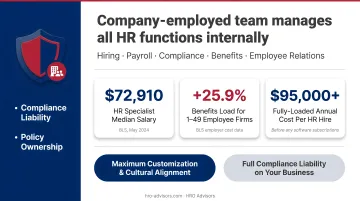
In-house HR offers maximum customization and cultural alignment—but it places all compliance liability, expertise gaps, and administrative burden squarely on your business.
Breaking Down the True Costs: PEO Fees vs. In-House HR Expenses
The In-House HR Cost Stack
For a 25-person company, the annual in-house HR cost picture looks something like this:
- HR Generalist (fully loaded): ~$95,000+ (median $72,910 salary + ~25–30% benefits and tax load)
- Payroll software: $1,500–$4,000/year (Gusto Simple runs $49/month + $6/person; QuickBooks starts at $88/month + $6.50/person)
- Benefits broker/admin fees: KFF reports national small-group broker fees averaging $29.79 per member per month—roughly $8,900/year for 25 employees
- Workers' comp premiums: Small employers without favorable loss history pay higher experience-rated premiums than large employers
- Compliance/legal review: Ad-hoc employment law consultations add $2,000–$10,000+ annually depending on complexity
The health insurance gap alone is significant. KFF's 2025 Employer Health Benefits Survey found small-firm workers contribute 36% of family premiums vs. 23% at large firms, and face average single-coverage deductibles of $2,631 vs. $1,670 at large firms. PEO pooling directly addresses this gap.
What PEO Pricing Actually Includes
Beyond the headline PEPM or percentage-of-payroll quote, watch for:
- Setup/implementation fees: Some PEOs charge $500–$2,000 to onboard
- Per-transaction payroll fees: Additional charges per payroll run not covered in the base rate
- Add-on services: HRIS premium features, training platforms, or enhanced compliance tools billed separately
- Workers' comp coverage: Typically included or discounted through the PEO's master policy
- Early termination fees: The U.S. Chamber of Commerce warns these can be substantial; always review exit terms before signing
These line items rarely appear in a first-pass quote, which makes side-by-side comparison difficult without a structured process.
The Hidden Cost: Owner Time Spent on HR Administration
A 2025 U.S. Chamber of Commerce survey found one-third of companies spend at least 11 hours per week on HR administration. At a conservative $75/hour opportunity cost for an owner or senior leader, that's over $42,000 per year in diverted leadership time—on top of every direct HR dollar already spent.
What the ROI Data Shows
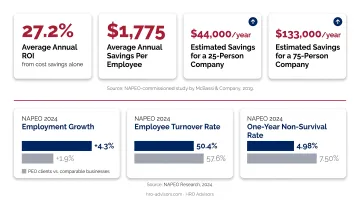
A 2019 NAPEO-commissioned study by McBassi & Company found businesses using PEOs generate an average 27.2% annual ROI from cost savings alone, with $1,775 average annual savings per employee. For a 25-person company, that's roughly $44,000/year in savings. At 75 employees, the number approaches $133,000.
Additional outcomes from NAPEO's 2024 research:
- PEO clients grew employment +4.3% vs. +1.9% for comparable non-PEO businesses
- PEO client turnover was 50.4% vs. 57.6% for comparable companies
- PEO client one-year non-survival rate: 4.98% vs. 7.50% for non-clients
When In-House HR Wins on Cost
Once a company reaches 75–100+ employees and can fully utilize a dedicated HR team, the math shifts. A single HR generalist at $95,000 fully loaded, supporting 80 employees, costs roughly $1,190 per employee annually—potentially below PEO per-employee fees at that scale. The break-even point varies based on your industry risk, current PEO pricing, and how much of your HR generalist's capacity actually gets used.
Services, Control, and What Each Model Actually Delivers
Service Breadth
PEOs deliver a bundled suite managed by specialists:
- Payroll processing and tax filing
- Benefits administration (health, dental, vision, 401k)
- HRIS platform access
- Compliance management and legal updates
- Workers' comp coverage and claims handling
- Risk management and safety programs
In-house HR can be customized to any configuration—but every capability the PEO bundles must be built, bought, or outsourced individually. That disaggregation is where costs and gaps accumulate.
Compliance and Legal Risk
PEOs assume co-employer responsibility for specific compliance obligations—payroll tax remittance, labor law adherence, benefits compliance—which reduces exposure for SMBs operating across multiple states or in regulated industries.
The DOL's 2026 penalty schedule puts the stakes in clear terms:
- Serious OSHA violations: up to $16,550 per incident
- Willful or repeated OSHA violations: up to $165,514
- FLSA violations: up to $2,515 per occurrence
In-house teams carry the full burden of avoiding these penalties without the specialist depth that PEOs provide.
Control and Culture
In-house HR responds faster to employee relations issues and stays directly tied to company culture. A PEO operates within standardized systems and master service agreements—some policy flexibility is limited by what the PEO's platform supports.
For businesses where HR functions as a strategic partner—not just an administrative function—in-house alignment matters. If culture is a primary driver of talent acquisition, the control and responsiveness of an internal team may outweigh the cost savings a PEO delivers.
Which Is Better: PEO or In-House HR for Your Business?
Decision Framework
PEO is likely the better fit when:
- Headcount is between 10 and ~100 employees
- The company is growing quickly and HR complexity is outpacing internal capacity
- Operations span multiple states with varying compliance requirements
- Industry carries elevated workers' comp risk (construction, healthcare, manufacturing)
- Leadership is spending significant hours on HR administration instead of revenue-generating work
In-house HR is likely the better fit when:
- Headcount exceeds 75–100 and a dedicated HR team can be fully utilized
- Growth is stable and HR needs are predictable
- Company culture or policy customization requires direct internal ownership
- The organization has already built compliance expertise internally
Four Questions Worth Answering Before You Decide
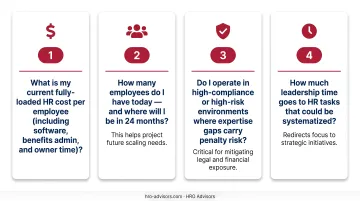
- What is my current fully-loaded HR cost per employee (including software, benefits admin, and owner time)?
- How many employees do I have today—and where will I be in 24 months?
- Do I operate in high-compliance or high-risk environments where expertise gaps carry penalty risk?
- How much leadership time goes to HR tasks that could be systematized?
The Transition Question
Many companies start with a PEO during the 10–100 employee phase, then transition to an in-house team as they scale past 100–150 employees. That path works, but the decision to switch starts long before you actually switch. PEO contracts have exit terms that matter. Review termination fees, data portability provisions, and benefits transition timelines before signing — understanding the off-ramp is as important as understanding the on-ramp.
For businesses ready to compare PEO options, HRO Advisors offers a no-cost comparison of 3–8 PEOs side-by-side. Their advisors gather your current HR costs, benefits needs, and compliance requirements, then deliver a provider comparison in under two weeks. There's no cost to you — HRO Advisors is compensated by the provider you select.
Conclusion
Neither model is universally superior. A 20-person construction company with multi-state crews has a completely different calculation than a 90-person professional services firm with a stable, single-location workforce.
The right answer comes from running the full cost math. That means going beyond the quoted fee or the HR generalist salary to include:
- Software and HRIS licensing costs
- Benefits scale disadvantage at lower headcounts
- Compliance exposure and potential penalty risk
- Leadership time diverted to HR administration
One practical approach: revisit this decision at meaningful headcount milestones—25, 50, and 100 employees. HR needs shift at each threshold, and the model that fit at 20 people rarely fits the same needs at 60. Treating this as a periodic decision rather than a one-time choice keeps your HR structure aligned with where your business actually is.
If you're ready to run those numbers, HRO Advisors offers a free side-by-side PEO comparison across up to eight providers — no cost, no obligation — so you can see exactly where the math lands for your headcount, industry, and workforce structure.
Frequently Asked Questions
How much does a PEO cost per employee?
A 2019 NAPEO-commissioned study put the average annual PEO cost at $1,395 per worksite employee. Pricing typically ranges from $40–$150 per employee per month (flat fee) or 2–12% of payroll, with actual costs varying by company size, industry risk, and service scope.
How does a PEO differ from in-house HR?
A PEO is an external co-employer that takes over administrative HR functions—payroll, benefits, compliance—under a shared-employer model. In-house HR is a team of company employees who manage those same functions internally, with the business retaining full employer liability.
What hidden fees should I watch for when evaluating a PEO?
Look closely at setup and implementation charges, early termination penalties, per-transaction payroll fees, and add-on services that fall outside the base PEPM or percentage-of-payroll quote. The U.S. Chamber of Commerce specifically flags termination fees as potentially substantial.
At what company size does a PEO make the most financial sense?
NAPEO data shows 50% of PEO clients have 10–49 employees, with strong adoption through the 50–99 range. Companies under 10 employees may find the cost less efficient; those above 150 typically have enough scale to justify dedicated in-house HR.
What is the average ROI of using a PEO?
A 2019 McBassi & Company study commissioned by NAPEO found an average 27.2% annual ROI from cost savings alone, with $1,775 saved per employee annually. PEO clients also reported higher employment growth, lower turnover, and better survival rates than non-PEO peers.
Can I switch from a PEO back to in-house HR later?
Yes, and transitions are common around the 100–150 employee mark. Before signing with any PEO, review the contract's exit terms, data portability provisions, and benefits transition timelines. Understanding how to leave is as important as understanding what you're signing up for.