Introduction
A company with employees in California, New York, and Illinois already faces at least three separate mandatory harassment training requirements — each with different hour minimums, content standards, and renewal cycles. Add OSHA safety obligations, HIPAA privacy training, and cybersecurity awareness mandates, and the compliance matrix gets complicated fast.
The financial stakes for getting it wrong are real. OSHA penalties effective January 2026 reach $16,550 per serious violation and $165,514 per willful or repeated violation. On the HIPAA side, willful neglect that goes uncorrected can cost $73,011 to $2,190,294 per violation — with an annual cap at the same upper figure. New York City's Human Rights Law carries civil penalties up to $250,000 for willful violations of its harassment training requirements.
Navigating that exposure requires knowing which compliance categories apply to your workforce, which platforms are built to handle multi-state complexity, and whether a standalone training tool or a PEO that bundles compliance management into its HR services is the right fit for your organization's regulatory footprint.
Key Takeaways
- A single national-baseline course rarely satisfies overlapping federal and state mandates for multi-state employers.
- States like CA, NY, IL, and CT require separate harassment training versions with distinct hour minimums and content rules.
- Top platforms auto-assign training by employee work location — not just job title or department.
- Many PEOs bundle state-specific compliance training administration into their HR services, offering a managed alternative to standalone platforms.
- Match your platform choice to your organization's size, state footprint, and internal HR capacity.
Multi-State Compliance Training in 2026: What Employers Must Cover
The Federal Baseline
Federal law establishes the floor. Key requirements include:
- OSHA Hazard Communication — employers must train workers on hazardous chemicals at initial assignment and when new chemical hazards are introduced; updates under the HazCom final rule phase through November 2026
- HIPAA Privacy Rule — covered entities must train workforce members on PHI policies "as necessary and appropriate," with required training for new hires and after material policy changes
- HIPAA Security Rule — security awareness training is required for all workforce members, including management
- FTC Safeguards Rule — covered financial institutions must provide updated security awareness training tied to identified risks
The EEOC encourages anti-harassment training but does not impose a universal federal mandate on private employers. There is currently no federal OSHA standard for workplace violence — though California's general industry workplace violence prevention requirements took effect July 1, 2024.
The State Layer
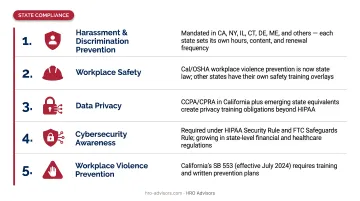
State mandates add requirements federal law doesn't touch. The core categories every multi-state employer must track:
- Harassment and discrimination prevention — mandated in CA, NY, IL, CT, DE, ME, and others; each state sets its own hours, content, and renewal frequency
- Workplace safety — Cal/OSHA workplace violence prevention is now state law; other states have their own safety training overlays
- Data privacy — CCPA/CPRA in California, plus emerging state equivalents, create privacy training obligations beyond HIPAA
- Cybersecurity awareness — required under HIPAA Security Rule and FTC Safeguards Rule; growing in state-level financial and healthcare regulations
- Workplace violence prevention — California's SB 553 (effective July 2024) requires training and written prevention plans
Why National-Baseline Courses Fail
A single "all-states" harassment course almost never satisfies individual state regulators. California's Civil Rights Department requires specific hours (1 for non-supervisors, 2 for supervisors), interactive delivery, and California-specific content on FEHA and bystander intervention. New York requires annual training with its own minimum content standards. Connecticut mandates 2 hours with a 10-year supplemental refresh cycle.
Managing those variations across a distributed workforce requires either a dedicated compliance function or a partner already built for it. Many PEO providers handle this complexity directly — bundling state-specific course assignment, completion tracking, and regulatory updates into their HR services — so employers aren't maintaining a manual calendar of 50-state requirements on their own.
Best Compliance Training Platforms for Multi-State Workforces in 2026
These platforms were selected specifically for their ability to manage multi-state training complexity: state-specific content, automated assignment by employee work location, and audit-trail quality that holds up to regulatory review. The five platforms below span SMB to enterprise needs — each addresses multi-state compliance differently, so the right fit depends on your headcount, jurisdictions, and admin capacity.
Traliant
Traliant is a compliance training specialist with a catalog covering harassment prevention, workplace conduct, cybersecurity, privacy, and multi-jurisdiction content. Its in-house legal team tracks regulatory changes and updates course content before those changes become a compliance problem for customers.
The standout feature for multi-state employers: dedicated harassment course versions built for each jurisdiction's specific requirements — not a generic national course repurposed per state. Covered jurisdictions include:
- California, Connecticut, Delaware, Illinois, Maine
- New York (state), New York City, and Chicago
| Attribute | Detail |
|---|---|
| Best For | Mid-market and enterprise organizations with broad, multi-state compliance needs |
| Key Multi-State Feature | State-specific harassment course versions across 8+ jurisdictions; legal-team content updates |
| Pricing | Essential: $15.95/learner/year; higher tier: $24.95/learner/year; enterprise custom pricing available |
EasyLlama
EasyLlama targets SMBs and mid-market employers that want compliance training to feel less like a box-checking exercise. Its 450+ course library covers harassment prevention, DEI, GDPR, CCPA, and workplace safety, with state-specific harassment content available for California, Colorado, Connecticut, Delaware, Illinois, Maine, New York, and Washington.
The platform lets administrators choose which state's training each employee receives — a straightforward implementation of location-based assignment that works well for smaller HR teams without dedicated compliance staff.
| Attribute | Detail |
|---|---|
| Best For | SMB and mid-market employers prioritizing engagement alongside state-specific harassment compliance |
| Key Multi-State Feature | Dedicated state-specific harassment courses for 8 states; CCPA and GDPR data privacy coverage |
| Pricing | Pay Per Course: $24.95/course/learner/year; Core: $59.95/user/year; Ultimate: $89.95/user/year |
Absorb LMS
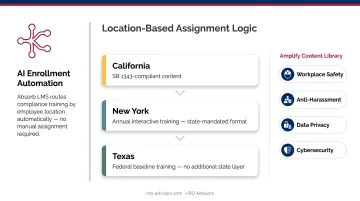
Absorb LMS is an enterprise-grade platform that reduces compliance administration overhead through AI-driven enrollment automation. Its Amplify content library provides pre-built compliance courses across workplace safety, anti-harassment, data privacy, and cybersecurity — updated regularly as regulations change.
Location-based assignment logic is where Absorb earns its place on this list. A California employee gets SB 1343-compliant content, a New York employee gets the annual interactive version required under state law, and a Texas employee gets the federal baseline — no manual work required when someone is hired or changes locations.
| Attribute | Detail |
|---|---|
| Best For | Mid-to-large enterprises needing automated multi-state compliance administration |
| Key Multi-State Feature | AI-driven enrollment by role, department, or location; managed Amplify content library with compliance categories |
| Pricing | Custom pricing — contact Absorb LMS directly for a quote |
NAVEX One
NAVEX One is a purpose-built ethics and compliance platform that combines training delivery with policy management, hotline management, and risk assessment. It's designed for regulated enterprise environments where training, policy acknowledgment, and compliance recordkeeping need to live in one system.
What separates NAVEX One for multi-state and global employers is its ability to consolidate training completion records with policy attestations in a single platform — particularly valuable when managing overlapping state and federal obligations and preparing for regulatory audits.
| Attribute | Detail |
|---|---|
| Best For | Large enterprises with complex multi-state and global compliance obligations |
| Key Multi-State Feature | Integrated training + policy management + compliance recordkeeping in a single platform |
| Pricing | Custom enterprise pricing — contact NAVEX for a quote |
Cornerstone OnDemand
Cornerstone OnDemand is a large-enterprise HCM and compliance platform that connects training obligations directly to each employee's role and work location. A manager in California sees different required training than a frontline worker in Texas, and assignments update automatically when employees change roles or relocate.
The platform's HRIS integration pulls live organizational data to automate training populations — meaning compliance assignment stays accurate without manual list management as headcount and locations shift.
| Attribute | Detail |
|---|---|
| Best For | Large enterprises with complex org structures and employees distributed across many states |
| Key Multi-State Feature | Location + role-based compliance assignment; automatic updates when employees change states |
| Pricing | Custom enterprise pricing — contact Cornerstone for a quote |
How to Choose the Right Platform for Your Organization
Five Evaluation Criteria That Matter for Multi-State Employers
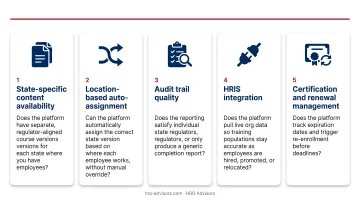
Platforms were assessed on the factors most relevant to multi-state training complexity:
- State-specific content availability — Does the platform have separate, regulator-aligned course versions for each state where you have employees?
- Location-based auto-assignment — Can the platform automatically assign the correct state version based on where each employee works, without manual override?
- Audit trail quality — Does the reporting satisfy individual state regulators, or only produce a generic completion report?
- HRIS integration — Does the platform pull live org data so training populations stay accurate as employees are hired, promoted, or relocated?
- Certification and renewal management — Does the platform track expiration dates and trigger re-enrollment before deadlines?
The Common Buying Mistake
Many organizations evaluate compliance platforms on overall course catalog size. Catalog size is the wrong metric. A library of 1,000 courses doesn't help if the platform assigns a national-baseline harassment course to a California employee — when SB 1343 requires a California-specific, interactivity-compliant version running 1 hour for non-supervisors and 2 hours for supervisors.
The better test: does the platform assign the right state version to the right employee, track completion by jurisdiction, and produce documentation that satisfies each state's individual reporting standards?
The PEO Alternative
Not every organization needs to manage a compliance platform internally. For employers without a dedicated HR or L&D function, a standalone tool adds administrative overhead that may outweigh its value.
Many PEO providers bundle compliance training administration into their HR services — handling state-specific assignment, completion tracking, and regulatory updates on the employer's behalf. HRO Advisors' free comparison service lets employers evaluate PEOs that include these features, comparing up to 8 providers side-by-side across cost, compliance coverage, and service levels.
Conclusion
For multi-state employers, compliance training is a layered challenge — each state adds its own requirements, deadlines, and documentation standards. The right solution is either a platform built specifically to manage location-based assignments and jurisdiction-specific recordkeeping, or an HR partner that handles compliance as part of a broader service model.
The right fit depends entirely on your size and spread:
- A 50-person tech company in two states needs something different from a 500-person manufacturer operating across eight
- Evaluate any platform on how well it maps to your actual regulatory footprint — not just its feature list
Neither option works universally. The decision comes down to your compliance complexity, internal HR capacity, and how much administrative lift you're willing to carry.
If that evaluation feels complex, that's where outside guidance helps. HRO Advisors offers a free, no-obligation consultation to help businesses compare PEO providers — including those that bundle state-specific compliance training, completion tracking, and audit reporting into their HR services. Reach the team at 866-755-0288 or info@hro-advisors.com.
Frequently Asked Questions
What is the best compliance training platform?
There's no single best platform — the right choice depends on company size, number of states, and whether you need a standalone compliance tool or an integrated HR solution. Traliant and EasyLlama serve SMB-to-mid-market needs well; Absorb LMS, NAVEX One, and Cornerstone OnDemand fit larger enterprises with complex assignment logic requirements.
Do all employees need to complete FWA compliance training?
No. FWA training applies only to employees working within Medicare Parts C and D programs — Medicare Advantage Organizations, Prescription Drug Plan sponsors, and their downstream entities. CMS requires initial training within 90 days of hire and annually after that. Employers outside federally funded healthcare programs are not subject to this requirement.
Can one compliance training course satisfy all state harassment training requirements?
No. Each mandated state publishes its own approved curriculum with specific hour requirements, content standards, and delivery format rules. California requires 1–2 hours of interactive, FEHA-specific content; New York mandates annual training with its own minimum content; Illinois requires annual training for all employees. A national-baseline course will not satisfy any of these individually.
How often do employees need to complete mandatory compliance training?
Frequency varies by mandate. California harassment training renews every two years (next deadline: January 1, 2027). New York and Illinois both require annual training. OSHA Bloodborne Pathogens training is annual. HIPAA Privacy Rule training is required "as necessary and appropriate" — in practice, most covered entities train annually and after material policy changes.
What happens if a company fails to provide mandatory compliance training?
The costs are substantial. OSHA serious violations carry fines up to $16,550 per violation; willful or repeated violations reach $165,514. HIPAA willful neglect penalties range from $73,011 to $2,190,294 per violation. A 2025 HHS OCR HIPAA ransomware settlement required a $250,000 payment and mandatory annual security training. NYC Human Rights Law willful violations can reach $250,000 in civil penalties.
Does mandatory training apply to remote employees working in a different state than headquarters?
Yes. Training obligations are based on the employee's primary work location, not where the company is headquartered. California's CRD requires training for California-based employees regardless of where the employer is based. Illinois law covers every employer with employees working in Illinois. A remote employee in California triggers SB 1343 obligations even if the company's offices are in Texas.