
The stakes are real. According to NAPEO's industry data, more than 230,000 U.S. businesses currently use PEO services, covering 4.5 million worksite employees. With 14% of employers with 20–499 employees already in PEO arrangements, the market is mature — and so is the risk of making a costly selection mistake.
PEO administrative fees typically run $40–$250 per employee per month (PEPM) or 2%–12% of total payroll, depending on the pricing model, company size, service scope, and industry. What one provider bundles into a base fee, another bills as an add-on — and those gaps add up fast.
This article breaks down what you'll actually pay at each service tier, what drives costs up or down, the two dominant pricing models and their trade-offs, hidden fees to audit before signing, and how to evaluate genuine value rather than just the headline rate.
Key Takeaways
- PEO costs range from $40–$250+ PEPM or 2%–12% of total payroll, depending on pricing model and scope
- Two primary fee structures exist: per-employee per month (PEPM) and percentage of payroll — each suits different workforce profiles
- Cost drivers include headcount, industry risk, geographic footprint, and service scope
- The lowest-priced PEO is rarely the best value — hidden fees and service gaps frequently erode perceived savings
- Working with a PEO broker like HRO Advisors is free and typically uncovers pricing gaps businesses overlook when comparing providers on their own
How Much Does a PEO Cost in 2026?
PEO pricing has no universal standard. What one provider bundles into a base fee, another charges as an add-on. Without understanding the full picture, businesses routinely underbudget or pay for services they never use.
Published 2026 benchmarks from established sources establish the following ranges:
| Source | Published Cost Range |
|---|---|
| Forbes | $50–$150 PEPM or 2%–12% of payroll |
| ADP | $40–$160 PEPM or 2%–12% of total payroll |
| Business.com | $50–$250 PEPM |
These ranges shift based on headcount, service scope, and industry risk. The three tiers below translate those benchmarks into a practical framework — they're an editorial guide, not a standardized industry schedule.
Entry-Level PEO Services ($40–$80 PEPM or 2%–4% of Payroll)
Entry-level plans cover the basics:
- Payroll processing and basic tax filing
- Standard benefits enrollment access
- Self-service HR platform with limited compliance support
Best for small businesses under 25 employees with straightforward payroll in one or two states and low regulatory exposure. The right fit if payroll is the priority and deeper HR advisory isn't yet needed.
Mid-Range PEO Services ($80–$150 PEPM or 4%–8% of Payroll)
Mid-range plans are where most small-to-mid-sized businesses land:
- Full payroll and multi-state tax administration
- Group health, dental, and vision benefits at group rates
- Workers' compensation coverage
- Onboarding/offboarding workflows and a shared HR advisor
Best for growing businesses with 25–200 employees, multi-state operations, or rising compliance complexity — think professional services, technology, and retail. This tier delivers real HR relief without premium pricing.
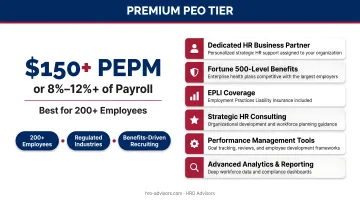
Premium PEO Services ($150+ PEPM or 8%–12%+ of Payroll)
Premium plans include everything in mid-range, plus:
- A dedicated HR Business Partner (HRBP)
- Fortune 500-level benefits and EPLI coverage
- Strategic HR consulting and performance management tools
- Advanced analytics and reporting
Best for businesses with 200+ employees, regulated industries like healthcare or financial services, or any organization where benefits quality is central to recruiting outcomes.
Key Factors That Drive PEO Pricing
PEO pricing reflects a combination of operational, structural, and regulatory variables. Knowing what drives the numbers before you request quotes puts you in a stronger position to compare proposals and push back where needed.
Number of Employees
Headcount is the single largest pricing variable. Per-employee fees decrease at volume — according to Business.com, flat PEO fees often start around $100–$150 PEPM for smaller organizations but may fall to $50–$80 PEPM for larger ones. NAPEO notes the average PEO client is a small business with 19 worksite employees, which means most businesses are paying toward the higher end of the per-head rate scale.
Industry and Risk Profile
Workers' compensation is where industry risk hits the invoice most directly. Official rate data illustrates the gap:
- Florida's 2026 rates list clerical office workers (Code 8810) at 0.105 per $100 payroll
- Carpentry for detached dwellings runs 7.689 per $100 payroll — roughly 73x higher
PEOs typically cover workers' comp through a master policy covering all client employees. High-risk classifications — construction, manufacturing, healthcare — carry significantly higher premiums that flow through to PEO quotes. Lower-risk industries like consulting or technology pay far less on this line item.
Geographic Complexity
Multi-state businesses face more complex payroll tax registrations, varying state labor laws, and different unemployment insurance rates. Each additional state adds administrative overhead. How that overhead gets priced varies by provider — some charge a flat add-on per state, others build it into a blended rate. Always ask how multi-state operations are billed before comparing proposals.
Key questions to ask any PEO about multi-state coverage:
- How do you handle new state registrations mid-contract?
- Is multi-state administration priced as a flat fee or per-state add-on?
- Are unemployment insurance rate variations passed through or absorbed?
Scope of Services
Basic packages (payroll + compliance) cost meaningfully less than full-service engagements including HRBP support, learning and development, or recruiting assistance. Many PEOs price modularly, so adding services post-signing can escalate costs quickly.
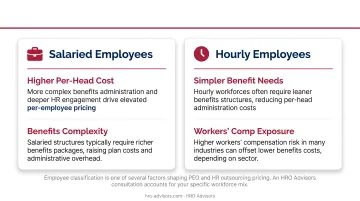
Employee Classification
Employee type affects pricing in two distinct ways:
- Salaried employees typically cost more per head due to more complex benefits administration and HR engagement
- Hourly workforces often have simpler benefit needs but may carry higher workers' comp exposure depending on the industry
PEO Pricing Models: What You're Actually Paying For
The fee structure a PEO uses determines how costs behave as your business changes. The same base service can produce dramatically different totals depending on which model applies and how your payroll evolves.
Per-Employee Per Month (PEPM)
PEPM charges a fixed dollar amount per active W-2 employee each month, regardless of their salary. This model is highly predictable and budget-friendly for companies with stable headcount.
The trade-off: it can feel expensive when onboarding low-wage or part-time workers who generate low payroll value per head. A $100 PEPM fee on a $15/hour employee represents a much larger percentage of that worker's payroll cost than the same fee on a $90,000 salaried employee.
Best fit: Stable, higher-wage workforces where predictability matters more than keeping costs proportional.
Percentage of Payroll
This model charges 2%–12% of total payroll, so costs scale directly with compensation. It naturally favors lower-wage workforces but creates cost creep as salaries, bonuses, or commissions grow.
One critical audit point: ask the PEO to define the payroll base in writing, specifically whether fees apply to gross wages, taxable wages, bonuses, owner compensation, or pre-tax benefit deductions. The difference between fee bases can shift your actual cost significantly.
Best fit: Lower-wage, high-headcount businesses where costs should track with compensation levels.
What's Included vs. Billed Separately
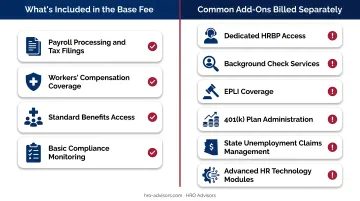
Understanding which model fits your business is only part of the equation — you also need to know what that base fee actually includes. Most PEO base fees cover:
- Payroll processing and tax filings
- Workers' compensation coverage
- Standard benefits access
- Basic compliance monitoring
Common add-ons that generate surprise invoices:
- Dedicated HRBP access
- Background check services
- EPLI coverage
- 401(k) plan administration
- State unemployment claims management
- Advanced HR technology modules
Hidden Fees to Audit Before Signing
Contract language creates most of the unpleasant surprises. Before signing, request a full itemized fee schedule and ask directly about:
- Setup and onboarding fees charged at contract start
- Health insurance pricing basis — confirm what the PEO charges against actual carrier costs
- Annual administrative or compliance fees — often buried in contract schedules, not the headline rate
- Early termination penalties — especially relevant if your business is growing quickly and may outgrow the provider
The headline PEPM rate rarely reflects what you'll actually pay. Request itemized fee schedules from every provider — it's the only way to catch what the summary quote leaves out.
Low-Cost PEO vs. Premium PEO: What's the Difference?
The gap between a $60/employee budget PEO and a $175/employee premium PEO isn't purely price — it's a difference in service depth, HR expertise, benefits quality, and long-term employer risk.
| Dimension | Lower-Cost PEO | Premium PEO |
|---|---|---|
| Support model | Ticket-based or shared HR support, no dedicated advisor | Named HR Business Partner with proactive guidance |
| Benefits quality | Standard group plans | Fortune 500-caliber medical, mental health, family-building, and voluntary options |
| Compliance depth | Reactive filing and basic regulatory updates | Proactive multi-state monitoring, handbook audits, EPLI coverage |
| Technology | Basic self-service portal | Advanced analytics, performance management, and integrations |
A lower PEPM rate can end up costing more over time — through compliance fines, talent attrition from weak benefits, or the disruption of switching providers mid-year.
NAPEO's industry research shows PEO clients grow twice as fast, experience 12% lower employee turnover, and are 50% less likely to go out of business than comparable non-PEO businesses.
The McBassi research commissioned by NAPEO found an average 27.2% ROI from PEO use, with $1,775 in average annual savings per employee — a figure that includes benefits access, compliance cost avoidance, and reduced HR overhead.
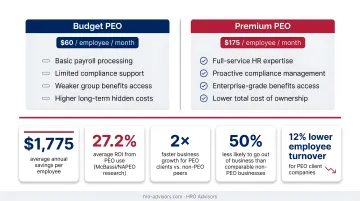
A budget PEO that delivers basic payroll processing but misses on compliance or retention is not saving you money. It's pushing those costs into less visible places — attrition, fines, and disruption.
How to Find the Best-Value PEO for Your Business
The best-value PEO matches the right service scope, pricing model, and provider capabilities to your specific workforce, industry, and growth trajectory — not just the one with the lowest sticker price.
Before Requesting Quotes
Start with these two questions:
What's your core pain point? Multi-state payroll compliance, competitive benefits for recruiting, workers' comp management, and reducing HR admin overhead each point toward different pricing tiers and service models. Your primary need should drive which tier is appropriate — not the other way around.
Which pricing model fits your payroll dynamics? PEPM works best for stable, higher-wage workforces. Percentage of payroll works better for lower-wage, high-headcount businesses. Run the math on both models using your actual payroll figures before comparing any proposals.
Use a PEO Broker to Compare Options Side-by-Side
Going vendor-by-vendor independently is slow and one-sided — each PEO only shows you their own pricing, with no market context to judge it against.
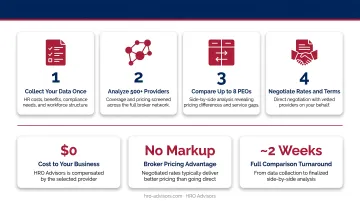
HRO Advisors works differently. As a PEO broker, HRO Advisors collects your business data once — current HR costs, benefits needs, compliance requirements, and workforce structure — then analyzes coverage and pricing across a network of 500+ providers. The result is a side-by-side comparison from up to 8 vetted PEOs, revealing pricing differences and service gaps that businesses routinely miss when shopping independently.
The process also includes direct negotiation on rates and contract terms. Key details:
- No cost to your business — HRO Advisors is compensated by the selected provider
- No price markup — negotiated broker pricing typically delivers better rates than going direct
- Fast turnaround — the full comparison, from data collection to finalized analysis, typically completes within two weeks
Frequently Asked Questions
How much do PEO companies charge?
PEO costs typically range from $40 to $250+ per employee per month, or 2%–12% of total payroll, depending on pricing model, company size, industry, and service scope. Published benchmarks vary by source, and actual costs often differ from headline rates once add-ons, insurance pricing, and contract fees are included.
What is the difference between per-employee and percentage-of-payroll PEO pricing?
PEPM charges a flat dollar amount per employee regardless of salary, making it predictable and easy to budget. Percentage-of-payroll pricing scales with compensation, so costs rise as wages and bonuses grow. Businesses with higher average wages often pay less under PEPM, while lower-wage, high-headcount workforces may benefit from the percentage model.
What hidden fees should I watch for when evaluating a PEO?
The most common surprises include setup and onboarding fees, health insurance pricing basis versus actual carrier costs, annual administrative or compliance fees buried in contract schedules, and early termination penalties. Request a full itemized fee breakdown before signing. The headline PEPM rate rarely reflects the total cost.
How many employees do you need to use a PEO?
Most PEOs work with businesses starting at 2–5 employees, though per-employee rates run higher for very small groups. The core market is businesses with 20–499 employees; NAPEO puts the average client at 19 worksite employees, and mid-sized companies typically see the strongest ROI.
Can a PEO save money compared to handling HR in-house?
Yes, often significantly. NAPEO-commissioned research found an average 27.2% ROI and $1,775 in annual savings per employee for businesses using PEOs. Those savings come from group-rate benefits, lower workers' comp premiums, reduced compliance liability, and lower HR overhead — typically more than offsetting the PEO fee.
Is there a cost to using a PEO broker to compare providers?
No. HRO Advisors, like other reputable PEO brokers, charges no fees for comparison or consultation. Brokers are compensated directly by the PEO provider the client selects, and that arrangement doesn't increase what the client pays. In most cases, it reduces total costs through negotiated pricing and competitive comparison.