
For small business owners, the calculus is getting harder. Compliance requirements are multiplying. Benefits costs keep climbing. And the PEO market now has 500+ providers to sort through — each with different pricing models, service depths, and specializations.
This article covers where the PEO industry stands today, why adoption is accelerating among smaller employers, the compliance trends reshaping provider offerings in 2025–2026, and what to look for when evaluating your options.
Key Takeaways
- 230,000+ U.S. businesses use PEOs, with over one-third having fewer than 10 employees
- PEOs use co-employment — you keep full operational control; the PEO handles payroll, benefits, and compliance
- New regulations on AI in hiring, pay transparency, and remote workforce taxes are pushing more businesses toward PEO compliance support
- Look for IRS CPEO certification and ESAC accreditation when vetting provider credibility
- HRO Advisors compares up to 8 PEO providers side-by-side — free to your business, compensated by the selected provider
The PEO Industry Today: What the Latest Research Reveals
The PEO industry is no longer a niche corner of the HR services market. The numbers tell a clear story.
NAPEO's 2025 industry data shows NAPEO members generate more than $372 billion in revenue, with total industry revenue reaching $414 billion.
For context on where that's heading: Mordor Intelligence reports the North America PEO market reached $6.86 billion in 2025 and projects it will reach $10.43 billion by 2031 at a 6.93% CAGR.
Who's Actually Using PEOs
The client profile has changed. NAPEO's October 2025 white paper found:
- 35% of PEO clients now have fewer than 10 employees
- Half of all clients fall in the 10–49 employee range
- The traditional 50–150 employee profile is no longer the dominant segment
Where these businesses are located matters, too. Geographic concentration skews toward a handful of states — Florida leads at 18% of all PEO client businesses, followed by California at 16%, New York at 9%, and Texas at 8%.
Penetration rates among mid-sized employers (20–499 employees) show which markets are most saturated:
- Hawaii — 50%
- Florida — 45%
- Utah — 38%
Industries With the Highest Adoption
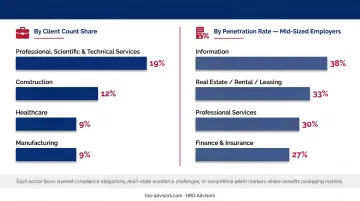
PEO clients now span nearly every sector. The largest shares by client count:
- Professional, Scientific & Technical Services — 19%
- Construction — 12%
- Healthcare — 9%
- Manufacturing — 9%
By penetration rate among mid-sized employers, Information sector leads at 38%, followed by Real Estate/Rental/Leasing at 33%, Professional Services at 30%, and Finance & Insurance at 27%.
The pattern across these sectors isn't accidental — each faces layered compliance obligations, multi-state workforce challenges, or fierce competition for skilled talent where benefits packaging makes a real difference.
Understanding the PEO Model: How Co-Employment Works
Co-employment is widely misunderstood — and that confusion stops many businesses from exploring an arrangement that could benefit them.
When you sign a PEO agreement, the PEO becomes the employer of record for tax and compliance purposes. They file payroll taxes under their Federal Employer Identification Number (FEIN), administer benefits through their plans, and carry workers' compensation coverage.
You retain complete control over hiring, firing, day-to-day management, and every operational decision.
What a PEO Handles
Every PEO covers a core set of functions, though service depth varies considerably:
- Payroll processing — taxes withheld, filed, and remitted on your behalf
- Benefits administration — health, dental, vision, life, and retirement plans managed through the PEO's group coverage
- Workers' compensation — coverage procurement and claims management
- HR compliance — employment law guidance, policy development, regulatory filings
- Risk management — safety programs, employee handbooks, EPLI coverage access
What a PEO Does Not Do
Despite the co-employment label, PEOs have no authority over how you run your business. Specifically, a PEO cannot:
- Make independent hiring or termination decisions
- Dictate job functions or performance standards
- Redirect your employees' work priorities
- Override your management decisions
The relationship is administrative and compliance-focused — your employees work for you, and that doesn't change.
Why More Small Businesses Are Turning to PEOs
The business case is stronger than most owners realize. NAPEO's 2024 research comparing PEO clients to non-clients found:
- 4.3% annual employee growth for PEO clients vs. 1.9% for comparable non-clients
- 12% lower employee turnover (50.4% vs. 57.6%)
- 50% less likely to go out of business — a 4.98% non-survival rate for PEO clients vs. 7.50% for non-clients from 2020–2023
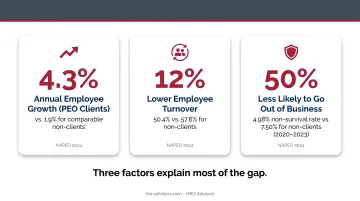
Those outcomes don't happen by accident. Three factors explain most of the gap.
Benefits Access at Group Pricing
Small businesses pay dearly for health coverage when purchasing on their own. The U.S. Chamber of Commerce cites 2023 data showing average single-coverage health premiums at small businesses hit $8,722, with firms under $600,000 in annual revenue carrying a median health insurance payroll burden of nearly 12%.
PEOs pool employees across hundreds of client companies to negotiate large-group rates — the same mechanism that gives Fortune 500 companies pricing leverage. NAPEO reports that businesses with fewer than 10 employees using a PEO have more than 3x the retirement plan participation rate of comparable non-users. For 10–49 employee firms, 52% of PEO clients offer retirement plans versus just 23% of comparable non-users.
Compliance Without a Legal Department
Compliance complexity has accelerated — not just in volume but in specificity. Pay transparency laws, AI hiring regulations, remote workforce tax nexus rules, and evolving ACA requirements create real liability for businesses without dedicated HR or legal staff. PEOs provide ongoing compliance guidance as regulations change, reducing exposure without requiring you to hire in-house expertise.
Cost Predictability
Both common PEO pricing models — per-employee-per-month (PEPM) and percentage-of-payroll — consolidate what are otherwise multiple vendor relationships, penalty risks, and variable HR costs into a single, predictable fee. For small businesses without a finance team, that means fewer surprise line items and easier annual planning.
With 500+ PEO providers in the U.S. market, however, finding the right match on your own is a genuine time investment. HRO Advisors' free comparison service analyzes costs and coverage across its network, then presents a side-by-side comparison of 3–8 providers in under two weeks — at no cost to your business. HRO Advisors' compensation comes from the provider you select, which doesn't increase your price.
Top Trends Reshaping the PEO Landscape in 2025–2026
Compliance With AI in Hiring and HR
State-level AI employment regulations moved from proposed to enacted fast. According to SHRM, new AI laws in California, Colorado, Illinois, New York, and Texas are already reshaping HR compliance requirements.
Specific timelines:
- Colorado — AI high-risk system obligations took effect in 2026
- Illinois — AI workplace notice requirements effective January 1, 2026
- California — Civil rights protections for automated hiring tools clarified October 1, 2025
- Texas — Responsible Artificial Intelligence Governance Act effective January 1, 2026
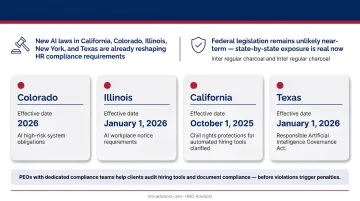
PEOs with dedicated compliance teams help clients audit hiring tools and document compliance now — before violations trigger penalties. Federal legislation in this space remains unlikely near-term, but state-by-state exposure is already real for any employer using automated screening or decision-making tools.
Pay Transparency and Wage Equity Mandates
The list of states requiring salary ranges in job postings keeps growing. Per SHRM and Bloomberg Law, jurisdictions with active pay transparency requirements include California, Colorado, Hawaii, Illinois, Maryland, Massachusetts, Minnesota, Nevada, New Jersey, New York, Vermont, Washington, and Washington D.C. Five of those laws took effect or expanded in 2025 alone.
For multi-state employers, staying current on each jurisdiction's posting rules is a real administrative burden. PEOs provide market compensation benchmarking and build compliant job posting practices into their HR workflows — cutting the need for outside legal counsel on routine postings.
Remote and Distributed Workforce Compliance
Remote work created a multi-state compliance problem that wasn't on most employers' radar five years ago. When an employee works from another state, the hiring company generally becomes subject to that state's requirements — regardless of where it's headquartered.
That means exposure across:
- Wage and hour laws
- State leave requirements
- Local tax registrations
- Workers' compensation rules
PEOs with multi-state HR infrastructure handle these variations automatically, covering registrations and filings across every state where employees are physically located.
Holistic Employee Benefits and Wellness
Benefits expectations have expanded well past medical coverage. Mercer reports health benefit costs per employee rose 6.0% in 2025 and projects 6.7% growth in 2026 — the highest rate in 15 years. In parallel, Gallagher's 2025 Workforce Trends Report notes that nearly 50% of organizations say financial wellbeing increased in importance, with 58% implementing SECURE Act provisions and 56% using auto-enrollment.
For smaller employers, matching these benefits on their own isn't realistic. PEOs pool hundreds of client companies to negotiate group rates, and many now include mental health services, financial wellness programs, and flexible time-off structures — giving SMBs access to the kind of benefits packages that typically require a 500-person headcount.
PEO vs. Other HR Solutions: Key Differences to Know
| Solution | Co-Employment? | Who It's For |
|----------|---------------|--------------|
| PEO | Yes — shared employer liability | U.S.-based SMBs wanting full HR support |
| ASO | No — business retains all liability | Companies with existing HR staff needing task support |
| EOR | Full legal employment by provider | International hiring, no local entity required |
| Staffing Agency | No — agency employs temp workers | Businesses needing temporary or contract labor |
The most common point of confusion is PEO vs. ASO. An ASO handles HR administration — payroll, benefits, HR support — without co-employment. The business stays the sole legal employer and retains all compliance liability. That makes ASOs better suited for companies that already have HR infrastructure but want to outsource specific tasks.
EOR arrangements work on a different axis: the provider becomes the full legal employer, with no shared liability. They're primarily used for international hiring in countries where the company lacks a registered entity — a distinct use case from domestic PEO arrangements.
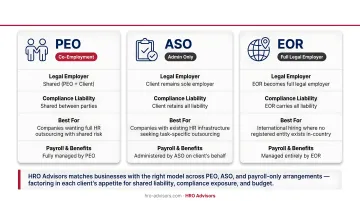
HRO Advisors matches businesses with the right model across PEO, ASO, and payroll-only arrangements — factoring in each client's appetite for shared liability, compliance exposure, and budget.
How to Find the Right PEO for Your Business
Not all PEOs are built the same. Here's what to evaluate beyond the sales pitch.
Key Evaluation Criteria
- Service depth — Is compliance support reactive (responding to problems) or proactive (anticipating regulatory changes)?
- Pricing transparency — Are fees clearly broken out, or bundled in ways that obscure true cost?
- Industry specialization — Does the PEO have demonstrated experience in your sector?
- Technology platform — How does their HR portal handle onboarding, time tracking, and benefits enrollment for your employees?
- Contract flexibility — What are the exit terms? Is there a multi-year lock-in?
- Customer support — What's the actual support structure after you sign?
Certifications That Signal Credibility
IRS CPEO (Certified Professional Employer Organization): A voluntary federal certification with rigorous requirements — audited financials, background checks, a CPA attestation on federal employment tax compliance, and a surety bond (minimum $50,000, maximum $1,000,000 at 5% of Section 3511 tax liability). CPEO status means the IRS treats the PEO as the employer for remuneration it pays under Section 3511 — a meaningful tax compliance assurance for client businesses.
ESAC Accreditation: The Employer Services Assurance Corporation sets independent financial, ethical, and operational standards for PEOs. Accredited PEOs must maintain audited financials within 120 days of fiscal year-end, meet net worth requirements (greater of $100,000 or 5% of total adjusted liabilities), and carry a surety bond of at least $250,000. ESAC accreditation signals independent verification that the PEO is financially stable and operating to defined ethical standards.
Using a Broker to Navigate the Market
Even with the right criteria in hand, comparing 500+ providers independently isn't realistic for most business owners. A PEO broker does that legwork for you — at no cost to your business, since brokers are compensated by the selected provider.
A structured broker process typically covers:
- Collecting your HR cost baseline, benefits needs, and compliance requirements
- Analyzing options across hundreds of providers against your specific profile
- Presenting a side-by-side comparison of 3–8 matched PEOs with full cost and service breakdowns
- Negotiating directly with shortlisted providers on your behalf
The full process usually takes under two weeks. HRO Advisors, for example, operates this way — clients have reported savings of up to 40% on HR costs, with no fee on the client side.
Frequently Asked Questions
How does a PEO affect my employees?
Employees typically gain access to better benefits — including health plans, retirement options, and wellness programs — along with more consistent HR support and professional onboarding resources. Day-to-day work relationships, compensation decisions, and management authority remain entirely with the employer.
Is a PEO the same as a staffing agency?
No. Staffing agencies supply temporary workers and remain those workers' sole employer throughout the engagement. PEOs partner with a business's existing workforce, sharing HR and compliance responsibilities under co-employment — they don't supply workers at all.
What is the current size and growth of the PEO industry?
Over 230,000 U.S. businesses currently use PEOs, employing more than 4.5 million worksite employees. The North American PEO market is projected to grow from $6.86 billion in 2025 to $10.43 billion by 2031, with growth particularly strong among employers with fewer than 10 employees.
What types of businesses benefit most from a PEO?
PEOs serve businesses across all industries, with the strongest adoption in Professional Services, Construction, Healthcare, and Manufacturing. Most clients have 5–150 employees, though larger businesses use PEOs too — especially for multi-state compliance and benefits cost control.
What does it cost to use a PEO?
Two pricing models are standard: a flat per-employee-per-month fee (typically $50–$250, per Business.com) or a percentage of total payroll. The right model depends on workforce size, service scope, and industry. A PEO broker like HRO Advisors can negotiate rates and compare providers side-by-side, often lowering your total cost.
How do I know if a PEO is reputable and financially stable?
Look for IRS CPEO certification (which requires audited financials and federal tax compliance attestation) and ESAC accreditation, which verifies independent financial and ethical standards. Always request references from clients in your industry before signing.