They sound similar. Both outsource HR functions to a third party. But the legal structures underneath them are fundamentally different, and choosing the wrong one can mean assuming unexpected compliance liability, overpaying for services that don't fit your situation, or discovering too late that the model you picked doesn't cover where your employees actually are.
This article breaks down exactly how each model works, compares them across the criteria that matter most to small business owners, and gives you a clear framework for deciding which one fits your situation.
Key Takeaways
- A PEO co-employs your US workforce — you stay the legal employer and share compliance responsibility while the PEO handles HR administration.
- An EOR becomes the sole legal employer, absorbing full compliance liability — the right fit when you're hiring where no registered entity exists.
- For most US small businesses, a PEO delivers the strongest ROI: better benefits, lighter HR burden, and built-in compliance support.
- EORs solve one specific problem: hiring internationally or in states where setting up a legal entity isn't worth it.
- Many businesses eventually use both — a PEO for domestic employees, an EOR for international hires.
PEO vs. EOR: Quick Comparison
Here's how PEOs and EORs stack up across the factors that matter most to small business owners.
| Factor | PEO | EOR |
|---|---|---|
| Legal Employer | Co-employment — you and the PEO share employer status | EOR is the sole legal employer on record |
| Entity Requirement | Your business must have a registered entity in the state | No entity needed — EOR uses its own |
| Compliance Liability | Shared between your company and the PEO | EOR assumes full compliance responsibility |
| Geographic Scope | Primarily US domestic workforce | International or cross-border hiring |
| Typical Cost | 2%–12% of payroll or $40–$250 per employee/month | $399–$599 per employee/month (flat fee) |
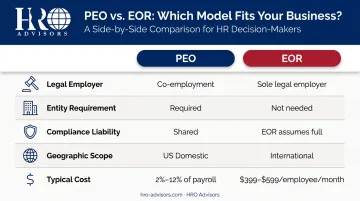
Cost sources: PEO pricing ranges from Business News Daily (2026) and Simon-Kucher (2024). EOR pricing reflects published rates from providers including Deel, Remote, and Pebl.
What Is a PEO?
A Professional Employer Organization is a third-party HR firm that enters a co-employment relationship with your business. The PEO takes over administrative HR functions — payroll processing, benefits administration, workers' compensation, tax filing, compliance support — while you keep full control over who you hire, how you manage them, and what your company culture looks like.
How Co-Employment Actually Works
Under this model, the PEO becomes the employer of record for tax and administrative purposes, using its own Employer Identification Number to process payroll. You remain the employer in every practical and legal sense: you set policies, manage performance, make hiring and termination decisions.
The IRS is clear on this point — in a standard PEO arrangement, the client generally remains the common law employer and is not automatically relieved of employment-tax obligations. A Certified PEO (CPEO) carries more specific IRS-recognized tax treatment, a distinction that affects how tax liabilities transfer between you and the PEO.
What Services a PEO Provides
- Payroll and tax administration across multiple states
- Access to enterprise-level health, dental, vision, 401(k), life insurance, and workers' comp plans
- HR compliance support and employee handbooks
- An HRIS platform integrated with your workflows
- ACA, ERISA, and COBRA administration
Why Small Businesses Specifically Benefit
PEOs pool employees across all their client companies, which means a 15-person firm gets access to group benefits rates that only large corporations can normally negotiate. According to a NAPEO study, 63% of new PEO clients reported lower health benefits costs, and PEO clients experienced 29.3% total employee turnover compared to the national average of 48.9% — a meaningful retention advantage. (Note: this study is from 2019; treat the figures as directionally informative rather than current benchmarks.)
When a PEO Makes Sense
A PEO fits best when all four of these apply to your situation:
- Your employees are US-based
- You want to reduce the administrative HR burden on internal staff
- You need competitive benefits to attract and retain talent
- You're comfortable retaining legal employer status while sharing compliance responsibilities
Common PEO Use Cases
- A 15-person tech firm competing with large companies for engineers who expect strong health plans
- A professional services firm with remote employees across five states needing unified payroll and compliance
- A non-profit wanting to reduce HR overhead while still offering benefits competitive enough to retain staff
If you're evaluating providers, HRO Advisors offers a free side-by-side PEO comparison across more than 500 providers — no cost to you, no obligation to commit.
One important limitation: PEOs require your business to have a registered legal entity in every state where your employees work. If you need to hire internationally without a local entity, a PEO won't solve that problem.
What Is an EOR?
An Employer of Record is a third-party organization that becomes the legal employer of workers on your behalf in locations where you don't have a registered entity. The EOR handles employment contracts, payroll, statutory benefits, tax compliance, and termination processes — and assumes full legal liability for employment matters in that jurisdiction.
The Key Structural Difference from a PEO
With an EOR, the employment contract is between the worker and the EOR provider — your company isn't listed as the employer at all. You retain day-to-day management authority: assigning work, setting expectations, evaluating performance. But every legal employer obligation sits with the EOR.
That means full compliance protection in unfamiliar markets, without maintaining a local entity.
Why Entity Setup Is Often Impractical for Small Businesses
The alternative to using an EOR for international hiring is setting up a local legal entity. For most small businesses, this is neither fast nor cheap. According to Deel's 2026 analysis, foreign entity setup typically costs $22,000 to $63,000 one-time, plus $56,000 to $65,000 in annual administration costs. That's before you've hired anyone.
For a small business hiring one engineer in Germany or one sales rep in Canada, an EOR's flat monthly fee is the practical choice.
A Common Misconception Worth Clearing Up
EOR isn't exclusively a global hiring tool — though that's how most people think of it. Some US small businesses use EOR to employ workers in specific states where they don't want to register a business entity. For purely domestic US teams, though, a PEO typically offers broader HR services and better cost efficiency than an EOR.
Common EOR Use Cases
- Hiring a software developer in Canada or the UK without setting up a foreign entity
- Testing a new international market with one or two local hires before committing to entity setup
- Onboarding a remote contractor as a full-time employee in a country where misclassification risk is high
PEO vs. EOR: Which Is Right for Your Small Business?
For most US-based small businesses with domestic workforces, a PEO is the stronger fit. It delivers more comprehensive HR services, better benefits leverage, and is purpose-built for domestic co-employment. An EOR becomes the right choice in specific circumstances involving international or entity-free employment.
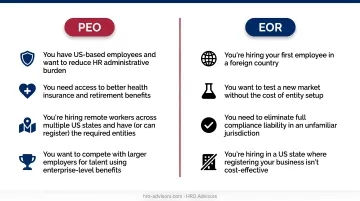
The Decision Framework
Choose a PEO if:
- You have US-based employees and want to reduce HR administrative burden
- You need access to better health insurance and retirement benefits
- You're hiring remote workers across multiple US states and have (or can register) the required entities
- You want to compete with larger employers for talent using enterprise-level benefits
Choose an EOR if:
- You're hiring your first employee in a foreign country
- You want to test a new market without the cost of entity setup
- You need to eliminate full compliance liability in an unfamiliar jurisdiction
- You're hiring in a US state where registering your business isn't cost-effective
A Real-World Scenario
Consider a US-based consulting firm with 20 domestic employees that wants to hire one software engineer in Germany.
A PEO won't solve the Germany hire — the firm has no legal entity there, and PEOs require one. An EOR solves it directly: it employs the German engineer on the firm's behalf, handles German labor law compliance, statutory benefits, and tax filings, while the firm directs the day-to-day work.
For the US team, the PEO relationship stays intact — pooled benefits rates, multi-state payroll compliance, and reduced HR administration all continue. The result is a hybrid model: PEO for domestic employees, EOR for the international hire. Provider documentation confirms this arrangement is operationally supported and increasingly used by growing businesses.
The Cost Consideration
PEO fees — whether a percentage of payroll or a flat per-employee-per-month rate — can look high at first glance. The full picture changes when you factor in lower benefits premiums, reduced compliance exposure, and HR hours recaptured each week.
EOR fees are more straightforward: typically $399–$599 per employee per month based on current provider pricing. They're designed for specific hiring scenarios, not broad HR management.
The better question is what each model actually costs when you include benefits, compliance risk, and administrative time — not just the base fee.
That cost calculation is also where provider selection matters. Comparing 500+ PEO options independently is a real time sink. HRO Advisors matches businesses with the right PEO providers, runs a side-by-side comparison of up to eight options, and negotiates rates on the client's behalf — at no cost to the business.
Conclusion
A PEO is the right model for most US small businesses focused on domestic growth. It reduces administrative burden, unlocks better benefits, and supports multi-state compliance while keeping you in control of your workforce. An EOR is the right tool when international or entity-free employment is the goal. The two aren't competing solutions — many businesses use both as they scale.
Knowing which model fits is only part of the equation. Working with a broker like HRO Advisors accelerates the selection process, provides side-by-side provider comparisons, and secures terms negotiated in your favor — at no cost to you.
Frequently Asked Questions
What is a PEO tool?
A PEO is not a software tool ; it's a full-service HR firm that co-employs your workforce and manages payroll, benefits, and compliance on your behalf. Many PEOs do include an HRIS platform as part of their service, but the platform is a component, not the product itself.
Can a small business use both a PEO and an EOR at the same time?
Yes . A common setup uses a PEO for US-based employees and an EOR for international hires. This lets businesses manage domestic and global workforces through complementary models without gaps in compliance coverage.
Do I need a legal entity to work with a PEO?
Yes. PEOs generally require your business to have a registered legal entity in the states where your employees work. This is one of the key structural differences from an EOR, which uses its own entities and requires no registration on your part.
How much does a PEO cost compared to an EOR?
PEOs typically charge 2%–12% of total payroll or $40–$250 per employee per month, with costs often offset by savings on benefits premiums. EORs generally charge a flat monthly fee, with current provider rates ranging from $399 to $599 per employee per month. Factor in benefits savings and compliance value alongside the service fee when comparing options.
What is the difference between a PEO and HR outsourcing?
HR outsourcing (HRO) covers any arrangement where specific HR tasks are delegated to a vendor, such as payroll or benefits administration only. A PEO goes further: it's a co-employment model where the provider takes on employer-level responsibilities including payroll taxes and benefits sponsorship. Every PEO involves HR outsourcing, but not every HR outsourcing arrangement is a PEO.
How do I choose the right PEO for my small business?
Evaluate PEOs on industry expertise, benefits offerings, compliance support, technology, and pricing structure. Because the market includes hundreds of providers, working with a PEO broker like HRO Advisors lets small businesses compare up to eight providers side-by-side for free with direct negotiation on rates included.