
Professional Employer Organizations (PEOs) have become a popular solution. According to NAPEO, more than 230,000 businesses currently use PEO services, covering 4.5 million workers — and the industry has grown to $414 billion in revenue, more than quadrupling since 2012.
But PEO pricing confuses many buyers. Costs vary widely based on company size, services included, industry risk profile, and geographic complexity. Businesses that don't understand the full pricing picture often underbudget, select the wrong model, or get blindsided by fees that weren't clearly disclosed upfront.
This guide breaks down every component of PEO cost — pricing models, key cost drivers, what's actually included, and how to budget accurately before signing anything.
Key Takeaways
- PEOs charge either $40–$160 per employee per month (flat fee) or 2–12% of total payroll, with NAPEO research citing an average annual cost of $1,395 per employee
- The base fee isn't your true cost: benefits pass-through, workers' comp, setup fees, and add-ons all affect the final number
- The right pricing model depends on headcount, payroll size, industry risk, and desired service scope
- NAPEO data shows businesses using PEOs achieve an average ROI of 27.2%, making provider selection a critical cost decision
How Much Does a PEO Cost?
There's no single fixed price for PEO services. What you pay depends on your pricing model, headcount, services included, and your business's specific risk profile.
The two primary pricing models are per-employee flat fee and percentage of payroll. Knowing how each works helps you build an accurate budget and avoid surprises.
Per-Employee Flat Fee Model
The per-employee-per-month (PEPM) model charges a fixed monthly rate per worker, regardless of what each employee earns. According to ADP, typical rates run $40–$160 per employee per month, or roughly $500–$1,500 per employee annually.
What's typically included:
- Payroll processing and tax filing
- HR support and compliance assistance
- Benefits administration access
- HR technology platform
What's usually billed separately:
- Health, dental, and vision insurance premiums
- Workers' compensation premiums
- Optional add-on services (recruiting tools, training platforms, strategic HR)
This model suits businesses with higher-paid employees since fees don't scale with salary. A company paying a $50/month flat rate for a $100,000-per-year employee pays the same as for a $45,000-per-year employee — a clear advantage when wages are high.
Percentage of Payroll Model
With the percentage-of-payroll model, businesses pay a fee equal to a set percentage of total wages — typically 2–12%, though mid-market rates often settle in the 3–7% range. Rates tend to decrease as payroll volume grows, giving larger employers lower effective rates.
One critical detail to confirm upfront: some PEOs calculate this percentage on gross payroll, which includes pre-tax deductions like health insurance contributions and 401(k) deferrals. Others calculate only on taxable wages. The difference can add thousands to your annual cost — so clarify the billing basis before signing.
Which Model Is Right for Your Business?
| Business Type | Better Model |
|---|---|
| High-salary workforce | Flat per-employee fee |
| Variable headcount or lower-wage staff | Percentage of payroll |
| Mixed workforce structure | Hybrid/tiered model |
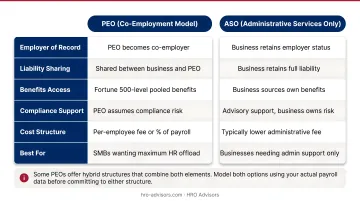
Some PEOs offer hybrid structures that combine both elements. Model both options using your actual payroll data before committing to either structure.
Key Factors That Affect PEO Cost
Beyond the base pricing model, several factors determine exactly where your company lands in the pricing range. Understanding each one upfront prevents budget surprises down the road.
Number of Employees
Headcount drives PEO cost more than any other single variable. While total spend grows with more employees, per-employee rates typically decline at higher volumes due to pricing tiers. Businesses with fewer than 10 employees often face the highest per-employee rates, and some PEOs set minimum monthly fees or headcount thresholds.
Scope of Services
A basic payroll and compliance package costs far less than a full-service arrangement. Add-ons that increase cost include:
- Recruiting and onboarding support
- Learning management and training platforms
- HR consulting and advisory support
- Background check services
- Employee assistance programs
Each add-on raises the per-employee rate, so identify which services your business will actually use before signing.
Industry and Risk Profile
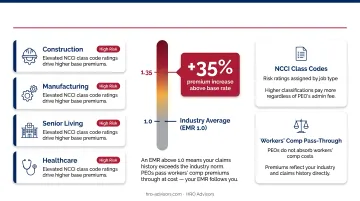
High-risk industries — construction, manufacturing, senior living, healthcare — carry elevated workers' compensation insurance premiums that PEOs pass through directly to clients. NCCI class codes assign risk ratings to job types, and businesses with higher-risk classifications pay more, regardless of their PEO's base administrative fee.
An experience modification rate (EMR) above 1.0 increases workers' comp premiums above the industry average. An EMR of 1.35, for example, adds a 35% premium increase on top of base rates — a significant cost factor for physical-labor-intensive industries.
Geographic Location and Multi-State Complexity
Operating across multiple states introduces layered payroll tax obligations, differing employment laws, and state-specific compliance requirements. Each additional state increases administrative complexity, which typically raises PEO fees. Multi-state registration fees alone can run $250–$750 per state.
Businesses with distributed workforces — national retailers, tech companies with remote teams, financial services firms — need PEOs specifically experienced in multi-state compliance, not just those with national branding.
Contract Length and Terms
Annual contracts generally offer lower per-employee rates, reduced setup fees, and more favorable terms than month-to-month arrangements. Flexibility costs more. If your business is stable and you've done proper due diligence on the provider, a longer commitment typically yields better economics.
Full Cost Breakdown: What You're Actually Paying For
The quoted rate is only one part of your actual spend. A complete picture includes one-time, recurring, and pass-through costs.
One-Time and Setup Costs
Implementation and onboarding fees typically range from $500–$2,000 and cover system integration, data migration, compliance audits, and technology training. Many PEOs waive or reduce these fees for larger contracts or longer-term commitments — which makes them negotiable, not fixed.
Recurring Administrative Costs
The base monthly fee covers the core services you'll use every pay period. What's included varies by provider, but most contracts encompass:
- Payroll processing and direct deposit
- Federal, state, and local tax filing
- HR administration and employee recordkeeping
- Compliance monitoring and regulatory updates
- Access to the PEO's HR technology platform
Customer support tiers vary too. Some PEOs include a dedicated HR advisor at no additional cost; others charge for higher-touch support or route you through a general service queue.
Pass-Through Costs: Benefits and Workers' Compensation
Health insurance, dental, vision, life insurance, and retirement contributions are billed as pass-through costs — meaning you pay the actual premium rates, separate from the PEO's admin fee. PEOs use group purchasing power to negotiate rates most small businesses couldn't access independently.
Workers' compensation follows the same pass-through model. It's calculated as a percentage of payroll and billed at cost (or near cost) through the PEO's master policy — no separate carrier relationship required on your end.
Hidden and Variable Costs to Watch For
These are the fees that inflate actual spend beyond the quoted rate:
- Benefits premium markups — some PEOs add 5–20% on top of actual premium costs without clearly disclosing it
- Gross payroll billing — percentage-based fees calculated on gross payroll (not taxable wages) artificially inflate the fee base
- Termination fees — many contracts include transition fees if you exit before the contract ends
- Annual compliance or administrative fees — sometimes added as separate line items, not included in the per-employee rate
Before signing any PEO agreement, ask each provider to itemize every fee in writing. A provider that won't put the full fee structure on paper is one worth walking away from.
PEO vs. In-House HR: A True Cost Comparison
The real cost of in-house HR is consistently underestimated. It includes HR staff salaries, benefits administration software, compliance training, payroll systems, error remediation, and the opportunity cost of leadership time spent on non-revenue tasks.
SHRM's 2025 benchmarking data puts the median HR expense at $2,479 per FTE annually, with Gartner's 2024 benchmarks reporting $2,810 per employee per year for HR functions. Compare that to NAPEO's reported average PEO cost of $1,395 per employee annually — a gap of $1,000–$1,400 per employee before accounting for benefits savings.
When a PEO Makes the Most Financial Sense
- Small businesses without a dedicated HR team
- Companies growing faster than their HR infrastructure can support
- High-risk industries with complex workers' comp exposure
- Organizations struggling to offer competitive benefits to attract talent
- Businesses operating across multiple states
When In-House HR May Be the Better Fit
- Large organizations with well-established HR departments and existing infrastructure
- Businesses with highly specialized compliance needs requiring dedicated internal expertise
- Companies where deep institutional knowledge of HR operations gives a structural cost advantage
The ROI Case
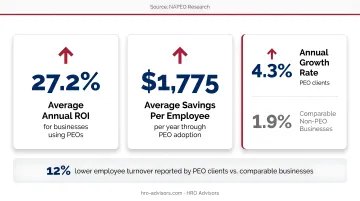
The numbers make a strong case for PEOs beyond simple cost comparison. NAPEO research shows businesses using PEOs achieve a 27.2% average annual ROI, with average savings of $1,775 per employee per year. PEO clients also grow at 4.3% annually — more than twice the 1.9% rate for comparable businesses — and report 12% lower employee turnover.
How to Budget for a PEO (And Avoid Costly Mistakes)
Mistake 1: Evaluating Only the Advertised Rate
The most common budgeting error is comparing PEOs based solely on the per-employee rate or payroll percentage. That number excludes pass-through costs, setup fees, and optional services that materially affect total spend.
Before requesting PEO quotes, document:
- Total headcount and expected growth over 12–24 months
- Total annual payroll (gross and taxable)
- Desired services (payroll only vs. full-service)
- Industry classification and workers' comp history
- States where employees are located
Mistake 2: Not Comparing Multiple Providers
Different PEOs specialize in different industries, company sizes, and risk profiles. Pricing for identical services can vary significantly between providers. Businesses that evaluate only one PEO have no basis for knowing whether the rate was competitive. Those that compare three or more providers consistently find better rates and more appropriate service bundles — without a dramatically longer process.
Mistake 3: Assuming the Listed Rate Is Final
PEO pricing is negotiable. Contract length, headcount commitments, service bundling, and setup fee waivers are all fair ground for negotiation. Most businesses that negotiate directly — without knowing where providers have flexibility — end up paying more than necessary.
HRO Advisors is a free PEO broker that compares up to 8 providers side-by-side from a network of 500+. Their advisors negotiate directly with providers on your behalf to secure better rates and contract terms. HRO Advisors is compensated by the provider you select — that arrangement does not increase your cost.
Budgeting for the Right Time Horizon
Year 1 pricing rarely reflects what you'll pay in Year 2 or 3. When building your budget, factor in:
- Anticipated headcount changes
- Whether you'll add services in Year 2
- Potential contract renewal terms
- Total cost of ownership over 2–3 years, not just the first invoice
Frequently Asked Questions
How much does a PEO cost?
PEOs typically charge $40–$160 per employee per month (flat fee) or 2–12% of total payroll. NAPEO reports an average annual cost of $1,395 per employee. Actual cost depends on headcount, services included, industry, and location.
What does a PEO include?
Most PEO packages cover payroll processing, payroll tax filing, HR compliance support, benefits administration, and workers' compensation. Add-on services like recruiting tools, training platforms, and strategic HR consulting typically cost extra.
What is the difference between per-employee and percentage-of-payroll PEO pricing?
Per-employee pricing charges a flat monthly rate regardless of salary — better for high-earning workforces. Percentage-of-payroll pricing scales with total wages, which may favor lower-wage businesses. Model both scenarios using your actual payroll figures before choosing.
Are there hidden fees in PEO contracts?
Common hidden costs include benefits premium markups, fees calculated on gross rather than taxable payroll, annual administrative fees, and termination clauses. Always request a full written fee disclosure and review contract terms carefully before signing.
Is a PEO worth the cost for small businesses?
For most small businesses without dedicated HR staff, a PEO provides access to enterprise-level benefits, compliance expertise, and administrative infrastructure that would cost significantly more to build in-house. NAPEO data shows average savings of $1,775 per employee annually.
How can I make sure I'm getting the best PEO rate?
Compare multiple PEOs at the same time, not one at a time. A PEO broker like HRO Advisors negotiates across 500+ providers and delivers side-by-side comparisons at no cost to you — which typically surfaces better rates and terms than approaching a single provider directly.