Introduction
Employment law violations are expensive. The EEOC received 88,531 new discrimination charges in FY2024—a 9.2% increase from the prior year—and secured nearly $700 million in monetary relief for affected workers. Meanwhile, the DOL's Wage and Hour Division recovered over $259 million in back wages in FY2025 alone, covering nearly 177,000 employees.
For most businesses, these numbers represent preventable exposure. An HR compliance audit is one of the most practical tools available to identify legal gaps before they become investigations, lawsuits, or penalties.
This guide covers everything you need to run an effective audit: a clear definition, the main audit types, what areas to examine, a step-by-step process, a working checklist, and guidance on who should conduct the review.
Key Takeaways
- An HR compliance audit systematically checks your policies, documentation, and practices against applicable employment laws
- Five main audit types serve different purposes: compliance, functional, strategic, pay equity, and I-9
- Core review areas include wage-and-hour practices, employee classification, records, handbooks, and benefits
- Audits follow a five-step process from scoping through building an action plan
- Complex situations often warrant outside expertise or an ongoing PEO partnership beyond internal review
What Is an HR Compliance Audit?
An HR compliance audit is a systematic evaluation of an organization's HR policies, procedures, documentation, and practices against applicable federal, state, and local employment laws. The goal is to identify gaps, reduce legal exposure, and confirm that rules are applied consistently across the workforce.
This differs from a general HR audit, which examines operational efficiency and strategic alignment (how well HR functions support the business overall). An HR compliance audit is narrower: it focuses strictly on legal and regulatory adherence to laws like the FLSA, FMLA, ADA, Title VII, and OSHA.
Why Proactive Auditing Matters
Waiting for a complaint or government inquiry is a costly strategy. Proactive auditing:
- Identifies compliance gaps before they trigger enforcement actions
- Prevents fines, regulatory investigations, and employee litigation
- Creates documented evidence of good-faith compliance efforts—which matters if legal challenges arise
- Surfaces inconsistencies where policies are written correctly but applied unevenly across departments
What matters is that you identify problems, document your findings, and address them before they become enforcement actions or employee disputes.
Types of HR Compliance Audits
Not every audit covers everything. Choosing the right type depends on what you're trying to accomplish.
Compliance Audit
A compliance audit systematically checks whether HR practices align with applicable employment laws—wage-and-hour rules, anti-discrimination requirements, proper employee classification, leave administration, and required workplace postings. This is usually the right starting point for organizations that haven't audited recently or are entering new jurisdictions.
Functional Audit
A targeted review of one specific HR area rather than the entire function. Use this when an employee complaint, operational gap, or audit finding points to a particular problem—common targets include recruiting and hiring, payroll processing, benefits administration, or performance management.
Strategic Audit
A strategic audit examines whether HR practices and workforce planning support the organization's overall business objectives—assessing succession planning, talent strategy, and whether HR activities align with long-term growth. Most relevant during organizational transitions, rapid scaling, or M&A activity.
Pay Equity and Compensation Audit
A focused review comparing compensation across employee groups to identify unexplained wage disparities by gender, race, or other protected characteristics. This is an increasingly urgent area: 14 states plus Washington, D.C. now have pay transparency laws requiring salary or pay-range disclosures in job postings. Organizations operating in California, Colorado, New York, Illinois, or any of the other covered jurisdictions face specific obligations that make pay equity audits a legal compliance requirement with documentation expectations, not an optional HR initiative.
I-9 and Employment Eligibility Audit
A focused review of Form I-9 records to verify proper completion, timely filing within three business days of hire, and correct retention—three years from hire or one year after separation, whichever is later.
The financial stakes are real. As of January 2025, ICE civil penalties for I-9 paperwork violations run $288 to $2,861 per individual. For knowingly hiring or retaining unauthorized workers, penalties escalate sharply:
- First offense: $716–$5,724 per worker
- Second offense: $5,724–$14,308 per worker
- Third or subsequent offense: $8,586–$28,619 per worker
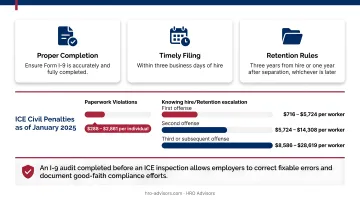
An I-9 audit completed before an ICE inspection gives employers the opportunity to correct fixable errors and document good-faith compliance efforts.
What Should Be Included in an HR Compliance Audit?
A thorough audit covers five core areas. State and local law variations will add requirements on top of these federal baselines.
Employment Law Compliance
Review adherence to major federal statutes:
- FLSA — overtime eligibility, minimum wage, and proper recordkeeping
- Title VII and related anti-discrimination laws — hiring, promotion, termination, and harassment policies
- ADA — disability accommodations, the interactive process, and job description accuracy
- FMLA — leave eligibility determinations, required notices, and designation procedures
- OSHA — workplace safety standards and injury recordkeeping obligations
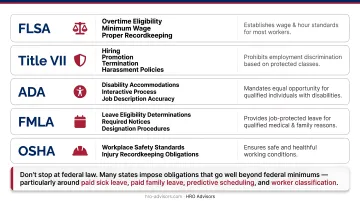
Don't stop at federal law. Many states impose obligations that go well beyond federal minimums—particularly around paid sick leave, paid family leave, predictive scheduling, and worker classification.
Employee Records and Documentation
Auditors review personnel files for completeness and accuracy. Specifically:
- Offer letters and signed handbook acknowledgments
- Performance reviews and disciplinary documentation
- I-9 forms and supporting documentation
- Required disclosures and benefit enrollment records
Beyond file contents, verify that the organization follows legally mandated retention schedules. These vary by record type and jurisdiction: I-9 retention rules differ from OSHA recordkeeping requirements, which in turn differ from payroll records obligations.
Compensation and Employee Classification
This area carries some of the heaviest financial risk. Review:
- Overtime calculations and minimum wage compliance under the FLSA
- Exempt vs. non-exempt classification with documented basis for each role
- Employee (W-2) vs. independent contractor (1099) classification
Worker misclassification is one of the most serious compliance problems the DOL identifies—it denies workers minimum wage, overtime, and other FLSA protections. A 2022 DOL case illustrates the exposure: a Hawaii flooring contractor paid $115,000 in back wages and liquidated damages after misclassifying employees as independent contractors.
HR Policies, Procedures, and Employee Handbook
Evaluate whether:
- The handbook is current and legally compliant
- Policies have been clearly communicated to all employees
- Policies are enforced consistently across the organization
Outdated handbooks are among the most common audit findings. Policies that reference superseded laws — or that omit newer state-specific leave requirements — can trigger regulatory penalties or employee claims even when the underlying intent is sound.
Benefits Administration and Required Workplace Postings
For benefits, check:
- ACA compliance for applicable large employers (50+ full-time equivalent employees)
- COBRA general notice delivery within 90 days of coverage start
- ERISA plan document obligations
For postings, confirm that required federal and state labor law posters are displayed at each worksite. Remote workforces require a different approach. Under DOL Field Assistance Bulletin 2020-7, electronic posting satisfies continuous-posting requirements when all three conditions are met:
- Employees exclusively work remotely
- Employees customarily receive employer information electronically
- Employees have ready access to the electronic posting
The HR Compliance Audit Process: Step by Step
Step 1: Define Scope and Set Objectives
Every audit begins with a clear scope. Determine:
- Full audit vs. targeted review of specific areas
- Which legal standards apply given company size, industry, and states of operation
- Timeline and responsible parties for each section
A documented scope prevents scope creep and ensures your team focuses resources on the highest-risk areas.
Step 2: Gather Documentation and Compile Data
Collect and organize:
- Employee personnel files
- Payroll records and timekeeping data
- Benefits documentation and plan documents
- I-9 forms and supporting documents
- Training records and safety logs
- HRIS data and policy documents
Create a tracking system as you go—noting what's been reviewed, what's missing, and what preliminary findings have emerged. Missing documents are themselves findings.
Step 3: Interview HR Staff and Managers
Document review alone won't show you how policies actually operate. Structured interviews with HR personnel, frontline managers, and a cross-section of employees reveal the gap between written policy and daily practice.
Frame these conversations as process improvement discussions, not investigations. That framing improves candor and surfaces honest feedback about where policies aren't working. That framing improves candor and surfaces honest feedback about where policies aren't working — and those gaps feed directly into Step 4's risk analysis.
Step 4: Identify Gaps and Analyze Risk
Compare current practices to legal requirements and recognized best practices. Categorize findings by severity:
- Critical — Active legal violations requiring immediate correction (misclassification, missing I-9s, FLSA overtime errors)
- High — Serious risk areas with documented legal exposure
- Moderate — Process gaps or inconsistencies without immediate legal consequence
- Low — Improvements worth making but not legally urgent
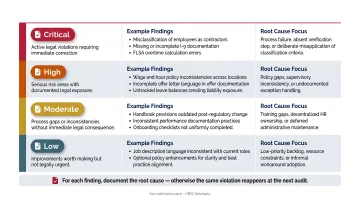
For each finding, identify the root cause. Document what process, training gap, or oversight failure caused each problem — otherwise the same violation reappears at the next audit.
Step 5: Document Findings, Report, and Build an Action Plan
Compile findings into a structured report with:
- An executive summary for leadership
- Detailed findings with supporting documentation
- Prioritized recommendations with assigned owners, deadlines, and resource requirements
Address the highest-risk items first: FLSA misclassification, missing I-9 records, and wage-and-hour violations carry the most immediate financial and legal exposure. Don't let action items sit without a named owner and a deadline.
HR Compliance Audit Checklist
The items below cover core areas that most organizations should review. State and local variations—especially around leave, pay transparency, and worker classification—may require additional items. Adjust this list based on your organization's size, industry, and workforce geography.
Hiring, Onboarding, and Employee Records
- I-9 forms completed and retained on the correct schedule for all current and former employees
- Job descriptions and application forms reviewed for ADA compliance; unlawful pre-employment questions removed
- Background check procedures comply with the FCRA, including written disclosure, written authorization, and proper adverse-action process
- Signed offer letters on file for every employee
- Signed handbook acknowledgments on file for every employee
Compensation, Classification, and Leave
- Employees correctly classified as exempt or non-exempt under FLSA with documented basis for each classification
- Workers correctly classified as employees vs. independent contractors
- Overtime pay properly calculated and recorded
- FMLA leave processes followed with required notices provided to eligible employees
- State-specific leave laws (paid sick leave, paid family leave) identified, implemented, and applied correctly
Policies, Postings, and Safety
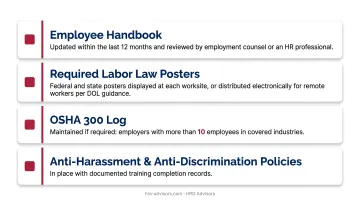
- Employee handbook updated within the last 12 months and reviewed by employment counsel or an HR professional
- Required federal and state labor law posters displayed at each worksite—or distributed electronically for remote workers per DOL guidance
- OSHA 300 log maintained if required (employers with more than 10 employees in covered industries)
- Anti-harassment and anti-discrimination policies in place with documented training completion records
Who Should Conduct Your HR Compliance Audit?
Internal HR Team
Advantages: Familiarity with the organization, lower direct cost, understanding of operational context.
Limitations: Potential blind spots, reduced objectivity, bandwidth constraints, and gaps in specialized compliance knowledge—particularly around pay transparency requirements, multi-state law, or I-9 electronic verification.
Best suited for: routine self-assessments, focused mini-audits on a single topic, or initial gap identification before bringing in outside expertise.
External HR Consultant or Employment Attorney
Outside expertise adds the most value when:
- The organization operates across multiple states with varying legal requirements
- There's potential legal exposure from a specific issue or complaint
- Recent regulatory changes require specialized knowledge to interpret
- Attorney-client privilege is needed to protect audit findings from disclosure in litigation
Conducting an audit under direction of counsel—with restricted distribution and appropriate privilege labeling—can protect the audit memorandum from being used against the organization in subsequent proceedings. An independent review also adds credibility that internal teams, however capable, cannot provide.
PEO Partnership as an Ongoing Compliance Solution
For many small to mid-sized businesses, the more practical question isn't who conducts the annual audit—it's how to maintain year-round compliance without a large dedicated HR team. A Professional Employer Organization (PEO) addresses this through a co-employment model, assuming shared compliance responsibility for wage-and-hour, benefits administration, and regulatory requirements on an ongoing basis.
This gives SMBs access to the compliance infrastructure and regulatory support that larger corporations build in-house—without the overhead of a full internal team.
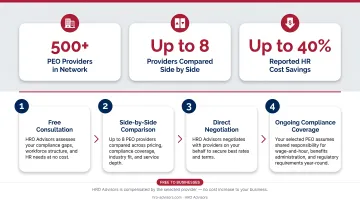
Finding the right PEO requires comparing providers across pricing, compliance coverage, industry fit, and service depth. HRO Advisors simplifies that process as a free PEO broker: they compare up to 8 providers side by side from a network of 500+ options, negotiate directly with providers on your behalf, and charge nothing to the business. Clients typically report HR cost savings of up to 40% through the process.
Frequently Asked Questions
What should be included in an HR compliance audit?
A complete audit covers employment law compliance (FLSA, ADA, FMLA, Title VII, OSHA), employee records and I-9 documentation, compensation and classification practices, HR policies and the employee handbook, and benefits administration along with required workplace postings. State and local obligations will add requirements on top of these federal baselines.
What happens during an HR compliance audit?
Auditors review documentation and personnel records, then conduct structured interviews with HR staff and managers to understand how policies operate in practice. Findings are compared against legal requirements, categorized by severity, and compiled into a prioritized report with specific action items and assigned owners.
Can you fail an HR compliance audit?
There's no formal pass/fail designation. Audits surface findings categorized by severity—critical violations, process gaps, and general improvements. Unaddressed findings carry real consequences, including government fines, employee lawsuits, and regulatory investigations, which is why action planning is as important as the audit itself.
How often should an HR compliance audit be conducted?
Aim for a comprehensive audit at least annually, with more frequent focused reviews for high-risk areas like wage-and-hour compliance, I-9 records, and workplace safety. Certain events—rapid growth, mergers, new regulatory requirements, or formal employee complaints—should trigger an immediate review regardless of your regular schedule.
Who should conduct an HR compliance audit?
Internal HR staff can conduct audits but may lack objectivity or specialized expertise in areas like multi-state law or pay transparency. External consultants and employment attorneys add independence and depth, and may be necessary to preserve attorney-client privilege. Many SMBs also use a PEO partnership for ongoing shared compliance responsibility.
What is the difference between an HR audit and an HR compliance audit?
A general HR audit is broader—it examines operational efficiency, talent strategy, and overall HR effectiveness. An HR compliance audit focuses specifically on legal and regulatory adherence, assessing whether the organization's practices create exposure to employment law violations, government fines, or employee claims.