Introduction
HR compliance has never been more complicated for U.S. employers. Today, 20 states plus D.C. require paid sick or safe leave, 12 states plus D.C. have pay transparency mandates, and federal enforcement is accelerating — the DOL recovered $259 million in back wages in FY2025 alone.
Most businesses respond by bringing in an HR compliance consultant. That makes sense — but the wrong hire compounds your exposure rather than reducing it. A firm that overpromises, under-delivers, or goes quiet when an audit notice arrives leaves you worse off than before.
This guide gives you a practical set of vetting questions — organized by theme — to evaluate any HR compliance consultant before you sign anything. Use them to get past the pitch and into specifics.
Key Takeaways
- Vague questions get vague answers — pressure-test a consultant's expertise with specific, scenario-based questions
- Match a consultant's specialty to your highest-risk areas, not just their broadest claims
- Proactive compliance planning separates strong consultants from those who only respond to problems
- Multi-state and remote workforce complexity requires jurisdiction-specific guidance, not generic advice
- For some businesses, a PEO may offer broader compliance coverage than a standalone consultant
What Does an HR Compliance Consultant Do?
An HR compliance consultant helps businesses interpret and apply employment regulations — this covers wage and hour laws, anti-discrimination requirements, leave management, I-9 verification, EEO-1 reporting, policy development, and federal recordkeeping. The goal is to keep companies compliant without building expensive in-house expertise from scratch.
That said, not all compliance support is created equal. There's a meaningful difference between:
- A compliance consultant : provides expert interpretation, strategic guidance, and proactive risk identification
- A general HR vendor : offers tools, templates, or administrative processing without deep regulatory judgment
- A PEO (Professional Employer Organization) : bundles compliance support with payroll, benefits, and co-employment, effectively becoming an extension of your HR function
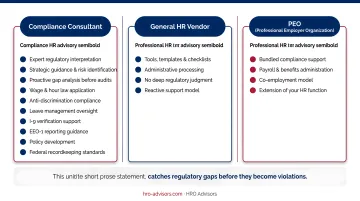
A strong consultant catches regulatory gaps before they become violations — not after an audit lands on your desk. Knowing what to ask upfront is how you tell the difference between a consultant who does that and one who doesn't.
Why Asking the Right Questions Matters Before You Hire
The Financial Stakes Are Real
The EEOC received 88,531 new discrimination charges in FY2024 — a 9% increase over FY2023 — and secured nearly $700 million in monetary relief. DOL civil money penalties jumped to $58.7 million in FY2025. These aren't abstract figures. They represent what employers pay when compliance breaks down.
The wrong compliance partner can actively make things worse by:
- Providing outdated guidance after regulatory changes
- Missing jurisdiction-specific requirements for multi-state workforces
- Leaving gaps in documentation that auditors exploit
"Full-Service" Doesn't Mean Anything Without Specifics
Many firms market themselves as full-service compliance providers but vary widely in actual depth. One firm may have deep I-9 and EEO-1 expertise but limited experience with multi-state wage and hour laws. Another may excel at policy documentation but have no real audit support capability.
Surface-level evaluation — cost, company size, brand recognition — won't surface these gaps. That's why the questions below matter.
When a PEO May Be a Better Fit Than a Consultant
Before committing to a standalone consultant, consider whether a Professional Employer Organization makes more sense for your situation. For small and mid-sized businesses, a PEO bundles multi-state wage and hour compliance, ACA administration, policy development, and proactive regulatory monitoring under one co-employment arrangement — often at lower total cost than piecing together separate vendors. HRO Advisors helps businesses compare PEO options side by side at no cost, which can clarify whether a consultant or a PEO is the right path forward.
Questions to Assess Expertise and Credentials
"What areas of HR compliance do you specialize in?"
Many firms list broad capabilities but have deep expertise in only a few areas. A consultant who claims equal fluency in I-9 audits, EEO-1 reporting, pay equity analysis, OSHA recordkeeping, and multi-state leave law is probably overstating. Ask them to name their top two or three areas of specialization — then match those against your highest-risk compliance areas.
"How long have you been doing this — and how have you adapted to recent changes?"
Enforcement priorities shift constantly, so experience across multiple regulatory cycles matters. A firm that's been through those cycles has tested frameworks; a newer one may be learning on your dime. Ask specifically how they handled a recent change — new state pay transparency laws, updated OSHA recordkeeping rules, or ACA reporting adjustments. Vague answers here are a warning sign.
"What certifications do your consultants hold?"
Credentials signal the ability to interpret complex regulations, not just administer paperwork. Key designations to look for:
- SHRM-CP / SHRM-SCP — operational and strategic HR, issued by SHRM
- PHR / SPHR — technical and senior-level HR, issued by HRCI
- JD or employment law background — particularly valuable for multi-state or litigation-adjacent work
Match credential level to your compliance complexity. A 200-person multi-state manufacturer needs SPHR or legal depth, not just an operational-level credential.
"Do you have experience in our industry or with employers our size?"
Federal compliance thresholds vary significantly by headcount and contract value. Key thresholds to know:
- EEO-1 reporting — required at 100+ employees (50+ for federal contractors)
- ACA employer mandates — apply at 50+ full-time equivalents
- VETS-4212 filing — triggered at $150,000+ in federal contracts
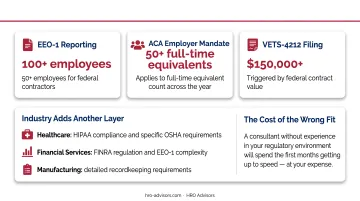
Industry adds another layer. Healthcare brings HIPAA and specific OSHA requirements; financial services add FINRA and EEO-1 complexity; manufacturing demands detailed recordkeeping. A consultant without experience in your regulatory environment will spend the first months getting up to speed — at your expense.
"Can you provide references from businesses similar to ours?"
References reveal how a consultant actually performs — not during the sales process, but when an audit notice arrives at 4 p.m. on a Friday. Ask specifically for references from clients who faced an audit, regulatory inquiry, or significant compliance challenge. How the firm handled that situation tells you more than any credential.
Questions to Evaluate Services, Scope, and Industry Fit
"Which specific compliance areas are included in your service?"
Don't accept "full-service compliance" as an answer. Ask for an explicit list. A thorough engagement should cover areas such as:
- I-9 management and audit readiness
- EEO-1 and VETS-4212 reporting
- Multi-state wage and hour compliance
- Pay equity analysis
- Employee handbook development and policy updates
- ACA, ERISA, and COBRA administration
- OSHA recordkeeping (where applicable)
Gaps in this list create blind spots — and those blind spots become audit findings.
"Do you offer proactive compliance planning or only reactive support?"
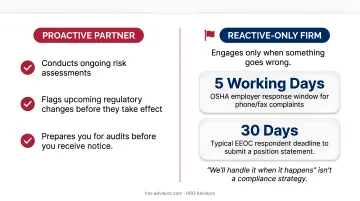
This is one of the most important questions you can ask. Proactive partners:
- Conduct ongoing risk assessments
- Flag upcoming regulatory changes before they take effect
- Prepare you for audits before you receive notice
Reactive-only firms engage when something goes wrong. Given that OSHA requires employers to respond to phone/fax complaints within 5 working days and EEOC respondents typically have 30 days to submit a position statement, "we'll handle it when it happens" isn't a compliance strategy.
"How do you handle multi-state and remote workforce compliance?"
With 34 states, territories, and districts setting minimum wages above the federal $7.25 rate — and 13 states plus D.C. running mandatory paid family leave programs — multi-state compliance is complex. A strong consultant develops tailored, jurisdiction-specific guidance.
When vetting their approach, ask:
- How do they track state law changes, and how quickly?
- Who reviews updates for accuracy before guidance reaches you?
- Have they worked with employers operating in your specific state footprint?
"Will you help develop or revise our HR policies and employee handbook?"
Auditors consistently flag outdated policies as a top finding. A consultant who identifies gaps but leaves remediation entirely to you has completed only half the job. Ask whether policy development and handbook reviews are included in scope or billed separately. Then ask what their process looks like for keeping documentation current as laws change.
"What does your technology or reporting infrastructure look like?"
Dashboards, compliance calendars, and deadline-tracking tools improve visibility into your obligations — but technology should enhance expert judgment, not replace it. Ask how their tools translate legal requirements into everyday HR practice, and what happens when the system flags an issue that requires a human call.
Questions to Test Communication, Accountability, and Support
"What are your response time commitments for urgent compliance issues?"
Get explicit commitments before you sign anything. Ask:
- What's the expected response time for an urgent inquiry?
- Who is my primary point of contact, and who covers when they're unavailable?
- What does escalation look like if an issue requires immediate legal input?
A firm that can't answer these questions specifically probably hasn't thought through its own processes.
"How do you keep clients informed of regulatory changes?"
Staying current is the job — not a bonus feature. Ask specifically:
- How do they deliver updates — client alerts, compliance calendars, scheduled briefings?
- Who reviews changes for accuracy before clients are notified?
- How quickly does notification happen after a new law takes effect or an enforcement priority shifts?
"What accountability do you assume if your guidance proves inaccurate?"
This question separates confident firms from evasive ones. A strong compliance partner will clearly define their responsibility if guidance errors contribute to a penalty or audit finding. Vague answers — "we do our best" or "you should always consult legal counsel" — suggest the firm isn't willing to own its work.
The answer tells you whether your consultant shares the risk — or just the advice.
"How does your service scale as we grow?"
A compliance partner should anticipate changes in your workforce size, geographic footprint, and regulatory exposure. Ask how their service model adapts when you cross a headcount threshold that triggers new federal obligations, expand into a new state, or add a federal contract.
If the answer is "we'd need to discuss a new engagement," that's a project vendor, not a compliance partner.
Red Flags to Watch For When Vetting an HR Compliance Consultant
The Generalist Trap
Be skeptical of consultants who claim expertise across every compliance area without being able to name specific specializations, credential holders on their team, or relevant client examples. Broad claims without specifics usually indicate shallow capability. If someone says they cover everything but can't tell you what they cover best, push harder.
Reactive-Only Relationships
A firm that only engages when problems arise — no proactive monitoring, no regulatory update process, no audit readiness work — isn't managing compliance. It's cleaning up after it. Real compliance support means catching issues before they become violations, not just responding when something breaks.
Vague Accountability Language
Watch for these specific signals during vetting:
- Deflects or gives vague answers when asked about liability for incorrect guidance
- No clear escalation procedure if a compliance issue arises on their watch
- Unwilling to discuss past audit outcomes or client situations where guidance was tested
- Contract language that protects them but doesn't define your recourse
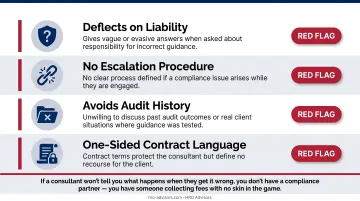
If a consultant won't tell you what happens when they get it wrong, you don't have a compliance partner — you have someone collecting fees with no skin in the game.
Frequently Asked Questions
What does an HR compliance consultant do?
An HR compliance consultant helps businesses interpret and apply employment regulations, manage audit readiness, maintain policy documentation, and stay ahead of federal and state regulatory changes. They function as a specialized extension of an internal HR team, providing expert judgment that most small to mid-sized companies can't cost-effectively maintain in-house.
How much does an HR compliance consultant typically cost?
Pricing varies widely based on service scope and engagement model (project, retainer, or hourly) with no standard industry benchmarks. For many small and mid-sized businesses, PEO solutions bundle equivalent compliance support into a per-employee monthly fee — often at lower total cost than hiring equivalent services separately.
What's the difference between an HR compliance consultant and a PEO?
An HR compliance consultant provides advisory services — audits, policy work, regulatory guidance — without taking on operational responsibility. A PEO co-employs your workforce and bundles compliance with payroll, benefits, and risk management, making it a broader operational solution rather than a pure advisory one.
How do I know if my business needs an HR compliance consultant?
Common triggers include rapid growth, multi-state expansion, recent regulatory changes in your industry, preparation for an audit, or internal HR capacity that hasn't kept pace with your workforce complexity. If your team is managing compliance reactively — handling issues after they arise rather than before — it's time to bring in outside expertise.
What certifications should I look for in an HR compliance consultant?
Look for SHRM-CP or SHRM-SCP (issued by SHRM), PHR or SPHR (issued by HRCI), or a legal background in employment law. These credentials signal regulatory interpretation skills — not just process administration — and should align with the complexity of your compliance needs.
How often should a business reassess its HR compliance partner?
At minimum, conduct an annual review. Reassess sooner following significant workforce growth, geographic expansion into new states, material changes in your regulatory environment, or any compliance incident that reveals gaps in your current partner's coverage.