Introduction
Retail is one of the most HR-intensive industries in the country. High turnover, seasonal hiring surges, complex wage and hour rules, and a predominantly hourly workforce create compliance exposure that most retail owners don't have time to manage properly.
The numbers reflect this pressure. The DOL's Wage and Hour Division recorded 1,058 retail compliance actions in FY2025, resulting in over $8.6 million in back wages and $3.6 million in civil penalties.
At the same time, retailers expected to hire between 265,000 and 365,000 seasonal workers in 2025 — an administrative burden few small HR teams can absorb cleanly.
The real question is whether that support should come from an internal team or an outside provider. This article breaks down both models so retail owners can make an informed decision based on their actual situation.
Key Takeaways
- In-house HR offers direct presence and cultural alignment, but carries high fixed costs and requires broad expertise
- PEO outsourcing gives small to mid-sized retailers multi-state compliance support, flexible seasonal staffing coverage, and access to enterprise-level benefits
- Retailers under 150 employees generally benefit more from outsourcing; larger chains with stable workforces may justify in-house HR
- Payroll, benefits administration, and compliance monitoring are the most commonly outsourced retail HR functions
- PEOs handle full co-employment HR support; ASOs offer administrative help for retailers who want to stay the employer of record
In-House HR vs. HR Outsourcing: Quick Comparison
The right choice depends on your store's size, seasonal staffing patterns, and compliance exposure. Here's how the two models stack up across the factors that matter most for retail operations:
| Dimension | In-House HR | HR Outsourcing (PEO) |
|---|---|---|
| Cost Structure | Fixed salary + benefits + overhead | Per-employee monthly/annual fee |
| Compliance Coverage | Dependent on staff expertise | Dedicated compliance specialists |
| Seasonal Scalability | Strained by headcount spikes | Built for variable workforce changes |
| Benefits Quality | Limited by purchasing power | Fortune 500-level plans via group rates |
| Administrative Burden | Falls entirely on internal staff | Shared with the PEO |
| On-Site Presence | Full-time, embedded | Remote, with on-call support |
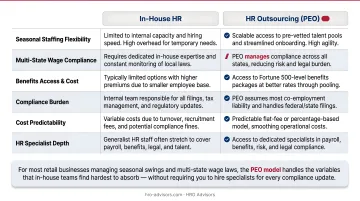
For most retail businesses managing seasonal swings and multi-state wage laws, the PEO model handles the variables that in-house teams find hardest to absorb — without requiring you to hire specialists for every compliance update.
What Is In-House HR for Retail?
In-house HR means the retail business directly employs its own HR staff to manage payroll, compliance, hiring, onboarding, and employee relations. It becomes relevant once a business grows past the point where the owner or store manager can handle people operations alongside everything else — usually around 50+ employees.
Core Advantages for Retail
- Floor presence: HR staff embedded in the operation build trust with frontline associates and can address issues before they escalate
- Cultural knowledge: Internal HR understands the store's norms, management style, and workforce dynamics firsthand
- Full data control: Sensitive employee records and policy decisions stay entirely within the business
Key Limitations
These advantages come with real trade-offs, especially for smaller retailers:
- HR generalists command significant salaries — BLS reports a median annual wage of $140,030 for HR managers, and the fully loaded cost (salary plus benefits and overhead) runs 1.25x–1.4x that figure
- A single HR hire rarely has deep expertise across payroll tax law, benefits administration, and compliance simultaneously
- Seasonal hiring spikes and multi-location growth quickly overwhelm a small internal team
- SHRM benchmarks an average of 1.7 HR staff per 100 employees, meaning a 50-person retail business needs less than one full-time HR person by headcount — but still faces full-time compliance obligations
When In-House HR Makes Sense
In-house HR works best for larger retail chains — generally 200+ employees — with:
- Stable, year-round staffing (not highly seasonal)
- The budget to hire actual specialists, not just a generalist
- Operations concentrated in one or two states
- HR needs deeply tied to day-to-day management and culture
That said, size doesn't determine everything. Certain functions almost always belong in-house, regardless of headcount:
- Culture development and employee relations
- Performance management and direct coaching
- Organizational strategy tied to business goals
What Is HR Outsourcing for Retail?
HR outsourcing means delegating some or all HR functions to a third-party organization. Three models are relevant for retail:
- PEO (Professional Employer Organization): Co-employment model where the PEO becomes a co-employer of record, handling payroll tax filings, workers' comp, benefits, and compliance while the retailer retains day-to-day management. Best for full-service HR support for small to mid-sized retailers
- HRO (HR Outsourcing): Task-specific outsourcing for retailers that need help in one area — payroll or background screening, for example — without a full-service arrangement
- ASO (Administrative Services Organization): Administrative outsourcing without co-employment. Suited for retailers with 50+ employees who want support while retaining their own EIN
Why PEOs Matter for Retail Specifically
The PEO model addresses several pain points that are particularly acute in retail:
Benefits access is a real competitive issue. Small retailers can't typically afford health, dental, vision, and 401(k) plans on their own. Through a PEO's group purchasing power, hourly employees gain access to enterprise-level benefits packages that independent retailers couldn't offer otherwise.
Workers' comp costs hit physical retail harder than most industries. Retail trade reported 3.0 nonfatal occupational injuries per 100 full-time workers in 2024 — well above the 2.3 private industry average. PEOs pool workers' comp exposure across their entire client base, which often brings rates down for retailers operating in high-risk environments.
Compliance exposure in retail is layered and location-dependent:
- FLSA overtime rules and ACA part-time tracking (30+ hours/week = full-time)
- Predictive scheduling ordinances in cities including New York, Chicago, Los Angeles, Seattle, and San Francisco
- State-specific leave laws that vary by jurisdiction
PEOs maintain dedicated compliance staff who monitor these requirements as they change.
What Retail Businesses Typically Outsource
- Payroll processing for variable shift schedules
- Benefits enrollment and administration for part-time and seasonal staff
- Compliance monitoring and regulatory updates
- Background screening
- Seasonal onboarding support
When Outsourcing Fits Best
HR outsourcing is especially effective for retailers with 10–150 employees who face:
- High turnover or significant seasonal staffing swings
- Multi-state compliance exposure
- Limited internal HR capacity
- A need for competitive benefits to attract and retain hourly workers
Real examples of where outsourcing solves concrete problems:
- A boutique chain expanding into a new state and navigating unfamiliar leave laws
- An apparel retailer onboarding 40 seasonal workers before the holiday rush
- A single-location retailer whose owner is personally running payroll while managing the floor
Not every PEO is built for retail. The right fit depends on the retailer's size, number of locations, seasonal headcount variability, and specific compliance exposure. HRO Advisors is a free PEO broker that compares up to 8 PEOs side-by-side — at no cost to the business. HRO Advisors is compensated by the selected provider, so the retailer's costs don't increase.
Which HR Approach Works Better for Retail?
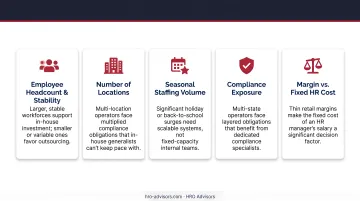
The honest answer: it depends on five factors specific to your retail operation.
- Employee headcount and workforce stability — larger, stable workforces support in-house investment; smaller or variable ones favor outsourcing
- Number of locations — multi-location operators face multiplied compliance obligations that in-house generalists can't keep pace with
- Seasonal staffing volume — retailers with significant holiday or back-to-school surges need scalable systems, not fixed-capacity internal teams
- Compliance exposure — multi-state operators face layered obligations that benefit from dedicated compliance specialists
- Margin vs. fixed HR cost — thin retail margins make the fixed cost of an HR manager's salary a significant decision factor
The Compliance Cost Reality
The DOL's retail enforcement data makes the stakes clear: 1,058 compliance actions and $8.6M+ in back wages in a single fiscal year. The FLSA allows recovery of back wages PLUS an equal amount in liquidated damages — meaning a single compliance failure can double the financial exposure.
Meanwhile, Korn Ferry reported 75.8% turnover for hourly in-store retail positions in 2022, up from 68% the prior year. Gallup estimates replacing an employee costs between one-half and two times their annual salary — and for an hourly retail workforce turning over at that rate, those costs compound fast.
Those compounding risks make the cost question impossible to ignore — and the numbers may surprise you.
The Cost Comparison
An HR manager's median annual salary runs $140,030 before benefits and overhead. For a 30-person retail business, that's a significant fixed cost against what are often single-digit operating margins.
By comparison, NAPEO's research puts the average PEO cost at $1,395 per worksite employee per year — with average annual cost savings of $1,775 per employee and a 27.2% ROI. HRO Advisors clients report savings of up to 40% on HR costs compared to in-house alternatives, with multi-location retailers typically seeing the most dramatic cost relief.
Decision Guide
Choose in-house HR if:
- You have 200+ employees with a stable, year-round workforce
- You can hire actual HR specialists, not a single generalist
- Operations are concentrated in one state with limited compliance complexity
- HR needs to be embedded in daily management decisions
Choose HR outsourcing (PEO) if:
- You operate with 10–150 employees and face high turnover or seasonal staffing swings
- Attracting hourly workers requires competitive benefits you can't currently offer
- You're expanding into new states
- Current HR is reactive — handling fires instead of building systems
A Retail HR Scenario: When Outsourcing Resolved a Real Crisis
Consider a multi-location specialty retailer with roughly 60 employees — a mix of full-time managers and part-time floor staff across two states. HR was managed by one generalist and the owner, who was personally reviewing payroll runs during the holiday season.
Three problems hit at once:
- Payroll errors during peak season triggered associate complaints and created compliance exposure
- A new predictive scheduling ordinance in one of their markets went into effect with minimal preparation time
- The HR generalist's entire week was consumed by administrative tasks, leaving zero bandwidth for recruiting or onboarding strategy
The business compared PEO providers and moved forward with one that had experience managing hourly, multi-state workforces. The results aligned with what NAPEO research documents for PEO clients broadly: 12% lower employee turnover, twice the growth rate of non-PEO businesses, and 50% lower odds of going out of business — outcomes driven largely by the combination of better benefits, consistent compliance, and reduced administrative drag on management.
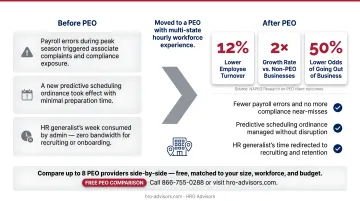
For this retailer specifically, the shift was concrete: fewer payroll errors, no more compliance near-misses, and the HR generalist's time redirected from filing and administration to actual recruiting and retention work.
Retail businesses in a similar position can use HRO Advisors' free PEO comparison service to evaluate up to 8 providers side-by-side, matched to their size, seasonal workforce, and budget — at no cost. Call 866-755-0288 or visit HRO Advisors to get started.
Conclusion
Neither model is universally better. Larger retailers with stable workforces, dedicated HR budgets, and the resources to hire real specialists can build effective internal teams.
Small and mid-sized retailers — particularly those with high turnover, seasonal staffing swings, or multi-state compliance exposure — will typically get more value, better coverage, and lower total cost from a PEO or outsourced arrangement.
The stakes are concrete either way. Compliance failures in retail generate real fines. High turnover costs real money in training and replacement. The inability to offer competitive benefits makes it harder to attract the hourly workforce retail runs on.
If outsourcing looks like the right direction, the next decision is which provider actually fits your headcount, payroll complexity, and benefit needs. HRO Advisors helps retail businesses compare up to eight PEO providers side-by-side — at no cost — so you can make that call with real numbers rather than guesswork.
Frequently Asked Questions
What is the difference between HR outsourcing and in-house HR for small retail?
In-house HR means the retailer employs its own staff to manage all people operations directly. HR outsourcing means delegating some or all of those functions to a third-party provider — such as a PEO, which assumes co-employer responsibilities for payroll, compliance, and benefits administration while the retailer retains day-to-day management control.
Is HR outsourcing cheaper than in-house HR for small retail?
For most small retailers, outsourcing is more cost-effective. The per-employee cost of a PEO is typically lower than the fully loaded cost of hiring even one internal HR specialist — and it includes access to better benefits, compliance coverage, and HR technology that would cost far more to build independently.
Can a small retail business outsource its HR responsibilities?
Yes — businesses of any size can outsource HR. PEOs are specifically designed for small to mid-sized businesses and can handle payroll, compliance, benefits, onboarding, and more, allowing small retail owners to focus on running the store rather than managing administrative obligations.
What HR functions should retail businesses keep in-house?
Functions tied to company culture, day-to-day performance management, strategic hiring decisions, and employee relations are generally better managed in-house. These require consistent face-to-face presence that an outside provider can't replicate — regardless of whether the retailer outsources administrative HR tasks.
How does a PEO help retail businesses with seasonal staffing?
A PEO can accelerate onboarding for large seasonal cohorts, manage payroll for variable hours and fluctuating headcount, and ensure compliance with temporary staffing regulations. This matters most during peak periods like the holiday season, when in-house teams are already stretched.
What should a retail business look for when choosing an HR outsourcing provider?
Prioritize experience with hourly and part-time workforce management, multi-state compliance capability, and scalable seasonal staffing support. Transparent pricing and verified retail industry experience matter too. Using a broker service that compares multiple providers side-by-side — like HRO Advisors — helps surface these criteria without requiring the retailer to vet each provider independently.