
The co-employment model works well in some situations. In others, it adds cost, complexity, and shared liability that owners never actually needed. The good news: there are solid alternatives, and the right one depends on what's actually driving your HR headache.
Key Takeaways
- PEO alternatives include ASOs, HR outsourcing firms, standalone payroll providers, HRIS platforms, and benefits brokers
- Dallas's right-to-work status and no state income tax give small businesses more flexibility in how they structure HR
- Each alternative covers a distinct HR function; your primary pain point determines the best fit
- Get itemized quotes from multiple providers before committing — pricing structures vary significantly
- HRO Advisors offers a free, no-obligation comparison of up to 8 providers for Dallas businesses
Why Dallas Small Businesses Are Exploring PEO Alternatives
A PEO is a third-party firm that becomes a co-employer of your workforce. It handles payroll, benefits, compliance, and HR administration — but in exchange, it shares legal employer status with you. That arrangement works well for many businesses. For others, it's the source of friction.
The Core PEO Pain Points
Common reasons Dallas owners start looking elsewhere:
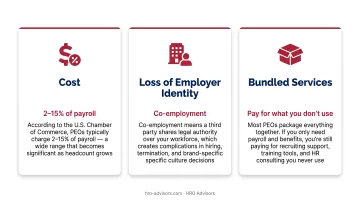
- Cost: According to the U.S. Chamber of Commerce, PEOs typically charge 2–15% of payroll — a wide range that can become significant as headcount grows
- Loss of employer identity: Co-employment means a third party shares legal authority over your workforce, which creates complications in hiring, termination, and brand-specific culture decisions
- Bundled services: Most PEOs package everything together. If you only need payroll and benefits, you're still paying for recruiting support, training tools, and HR consulting you never use
The Dallas Context
The DFW metro added 46,800 nonfarm jobs year over year through May 2025. That growth puts real hiring pressure on local small businesses — and raises the cost of getting HR wrong.
Texas also gives employers more structural flexibility than most states: it's a right-to-work state, it doesn't mandate workers' compensation for most private employers, and it has no personal income tax. That environment rewards businesses that take a more selective approach to HR rather than defaulting to the most comprehensive (and expensive) bundled option.
The alternatives below cover that full spectrum — from near-PEO substitutes that preserve most of the infrastructure to lean, software-first setups that give you direct control.
Top PEO Alternatives for Small Businesses in Dallas, TX
Five alternatives cover the full range of needs: Administrative Services Organizations (ASOs), HR outsourcing firms, standalone payroll providers, HRIS platforms, and benefits brokers. Each sits at a different point on the cost-vs.-control spectrum.
Administrative Services Organization (ASO)
An ASO delivers the same core services as a PEO — payroll processing, benefits administration, HR compliance, workers' comp coordination — but without co-employment. Your business retains its own Employer Identification Number (EIN), remains the sole legal employer, and keeps full authority over hiring and termination.
For Dallas businesses in financial services or professional services, this matters. Sharing employer status with a third party can create friction with clients, regulators, or internal culture norms. An ASO removes that friction while still offloading the administrative work.
| Factor | Detail |
|---|---|
| Best For | Established Dallas businesses (20–200 employees) that want outsourced HR without co-employment |
| Key Services | Payroll processing, benefits admin, compliance guidance, HR consulting, risk management |
| Typical Cost | Flat per-employee/month or % of payroll; U.S. Chamber reports ASOs charge $50–$250 per employee monthly |
HRO Advisors, based at 17250 Dallas Parkway, brokers ASO arrangements specifically for businesses that want to avoid co-employment while retaining full HR support.
HR Outsourcing Company (HRO)
HR outsourcing takes a modular approach: you select only the functions you want to hand off. Recruiting, onboarding, compliance training, benefits administration — each can be engaged independently, without bundling or co-employment.
This works well for Dallas businesses in retail, hospitality, or construction, where internal teams often handle some HR functions but need specialist backup in one or two specific areas. No need to pay for a full HR wrap when you just need help managing workers' comp compliance or scaling onboarding during a growth sprint.
| Factor | Detail |
|---|---|
| Best For | Dallas businesses with partial HR capacity needing targeted support in 1–3 areas |
| Flexibility | High — services are modular; pay only for what you select |
| Typical Cost | Per-service or per-project fees; more variable than PEO or ASO pricing |
Standalone Payroll Service Providers
When HR complexity is low and payroll accuracy is the primary need, a standalone provider may be all you need. These platforms handle payroll processing, automated tax filings, direct deposit, and year-end W-2s — nothing more.
Popular options used by Dallas micro-businesses include Gusto (starting at $49/month + $6/person), Paychex (custom pricing), and QuickBooks Payroll. These work well for operations with 1–15 employees where an owner or office manager can handle basic HR in-house.
Standalone payroll leaves compliance, benefits, and employee relations entirely in your hands — worth weighing before committing.
| Factor | Detail |
|---|---|
| Best For | Small Dallas businesses (1–15 employees) with straightforward payroll needs |
| Core Capabilities | Payroll processing, automated tax filings, direct deposit, year-end tax forms |
| Limitations | No coverage for HR compliance, benefits administration, or risk management |
HR Software / HRIS Platforms
HRIS platforms give businesses a self-managed hub for payroll, time tracking, onboarding, performance management, and benefits enrollment. For Dallas tech companies and knowledge-work firms where teams are comfortable with software, this approach offers the most visibility and control over HR data.
The catch: someone internally has to own the system and the compliance decisions that come with it. SHRM reports that HR software typically costs $5–$20 per employee per month, plus a base fee of $40–$100/month — affordable, but not hands-off. This option fits best when you have at least a part-time HR resource and want to scale without third-party employer entanglement.
| Factor | Detail |
|---|---|
| Best For | Dallas tech and professional services firms (10–50 employees) with an in-house HR resource |
| Platform Capabilities | Payroll, benefits admin, time tracking, onboarding, compliance alerts, reporting |
| HR Support Level | Low to moderate — tools and templates provided; compliance decisions stay with you |
Benefits Broker and Benefits Administration Platform
Many Dallas small businesses join a PEO primarily for one reason: access to group health insurance they couldn't otherwise afford. A dedicated benefits broker can solve that problem without co-employment.
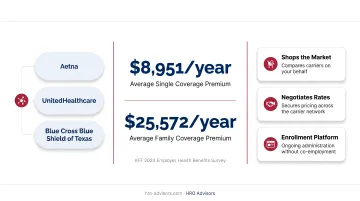
Through carrier networks that include Aetna, UnitedHealthcare, and Blue Cross Blue Shield of Texas, a benefits broker shops the market on your behalf, negotiates rates, and connects you with an enrollment platform for ongoing administration. According to the KFF 2024 Employer Health Benefits Survey, average employer-sponsored premiums run $8,951/year for single coverage and $25,572 for family coverage — figures where even modest rate negotiation has real impact.
HRO Advisors provides exactly this kind of comparison and brokering service, helping Dallas businesses evaluate whether a PEO or a standalone benefits arrangement better fits their cost and coverage goals.
| Factor | Detail |
|---|---|
| Best For | Dallas small businesses (5–50 employees) whose primary PEO driver is benefits access |
| What's Covered | Group health, dental, vision, 401(k), FSA/HSA administration, enrollment technology |
| Key Advantage Over PEO | No co-employment required; full employer authority retained |
How to Choose the Right PEO Alternative for Your Dallas Business
The most common mistake business owners make here is choosing based on price before identifying their actual problem. Cheap payroll software won't fix a compliance exposure. An ASO won't help if your only issue is benefits access.
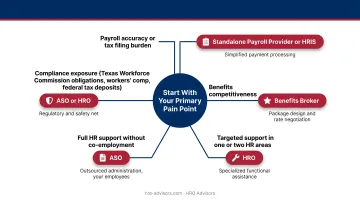
Start With Your Primary Pain Point
Ask yourself which of these best describes your situation:
- Payroll accuracy or tax filing burden → Standalone payroll provider or HRIS
- Compliance exposure (Texas Workforce Commission obligations, workers' comp, federal tax deposits) → ASO or HRO
- Benefits competitiveness → Benefits broker
- Full HR support without co-employment → ASO
- Targeted support in one or two HR areas → HRO
Key Evaluation Factors
Beyond the pain-point match, weigh these before committing:
- Headcount and growth trajectory: A 10-person company scaling to 50 needs a scalable managed service, not just software
- Texas-specific compliance: Workers' comp in Texas is optional for most private employers, but nonsubscribers carry notice and reporting obligations. Unemployment tax is owed to the TWC on the first $9,000 per employee per year. These aren't one-size-fits-all considerations
- If you already have someone handling HR part-time, HRIS or HRO fills the gaps. No internal HR at all points more clearly toward an ASO
- Pricing structure: Per-employee-per-month, percentage of payroll, and per-project fees all look different at scale. Request itemized quotes and ask directly about implementation fees, exit terms, and mid-year add-on costs
Use an Independent Comparison Process
HRO Advisors provides a no-cost, side-by-side comparison of 3–8 PEOs and HR alternatives, typically delivered within two weeks. There's no fee to your business — HRO Advisors is compensated by the provider you select and negotiates rates and contract terms directly with them before you commit.
Conclusion
A PEO works well for some Dallas small businesses — but it's far from the only option. An ASO delivers outsourced HR without co-employment. An HRO fills targeted gaps without bundling services you don't need. A benefits broker secures competitive health coverage on its own. And HRIS or standalone payroll handles the operational basics when that's all you actually need.
The right fit depends on your size, growth stage, how much internal HR capacity you already have, and which compliance risks actually apply to your business in Texas.
Before you sign anything, evaluate scalability and exit flexibility. Also confirm the provider understands Texas-specific requirements — these aren't identical to other states:
- TWC reporting and unemployment obligations
- Workers' compensation carrier choices (Texas doesn't mandate coverage)
- Right-to-work rules and their effect on employment agreements
Dallas small business owners who want unbiased guidance can reach out to HRO Advisors at 866-755-0288 or info@hro-advisors.com for a free consultation. The team compares providers side-by-side at no cost, so you can choose with full information rather than a single provider's sales pitch.
Frequently Asked Questions
What are alternatives to a PEO for small businesses in Dallas, TX?
The five main alternatives are Administrative Services Organizations (ASOs), HR outsourcing firms (HRO), standalone payroll providers, HRIS software platforms, and benefits brokers. The best fit depends on your headcount, industry, and whether your primary need is payroll, compliance, benefits access, or broader HR support.
What is the average ROI for small businesses that partner with a PEO?
NAPEO research reports a conservative 27.2% ROI from cost savings alone, with PEO users also experiencing 12% lower employee turnover and growing twice as fast as non-PEO peers. ROI varies significantly based on your current HR costs and employee count.
What is the difference between a PEO and an ASO?
Both deliver similar HR services (payroll, benefits, compliance), but an ASO does so without co-employment. Your business retains its own EIN and full employer liability, giving you more control over your employer brand and legal standing.
How much do HR outsourcing services typically cost for small businesses?
Pricing varies by model. ASOs typically run $50–$250 per employee per month according to the U.S. Chamber of Commerce, while HRIS platforms run $5–$20 per employee per month plus a base fee. Always request itemized quotes — implementation fees and contract terms vary widely across providers.
When should a Dallas small business consider leaving its PEO?
Common triggers include growing past 100 employees (where internal HR becomes cost-effective), PEO fees exceeding the value of services received, or the co-employment model creating friction with hiring decisions or employer brand identity.
Can a benefits broker replace a PEO for a small business in Texas?
A benefits broker can replicate a PEO's benefits access, including group health plans from major carriers, without co-employment. That said, it won't cover payroll, compliance, or HR administration. It's a strong partial alternative when your main reason for a PEO was insurance rates, not full HR outsourcing.