The workforce data tells the story clearly. According to the National Council of Nonprofits' 2023 Workforce Survey, 74.6% of surveyed non-profits reported job vacancies, with over half saying vacancies had increased since before the pandemic. Lean teams are already stretched. Adding complex HR compliance work on top of program delivery creates real operational risk.
Administrative Services Organizations (ASOs) offer a practical path forward. They handle the back-office HR functions — without requiring a co-employment arrangement — so non-profits retain full control while offloading the administrative burden.
This guide covers what ASOs actually are, why the model fits non-profits specifically, and which providers are worth evaluating today.
Key Takeaways
- ASOs manage HR administration (payroll, benefits, compliance) while the non-profit stays the sole employer of record — no co-employment required
- Non-profits face specific compliance triggers: FMLA at 50+ employees, ACA at 50+ FTEs, and federal grant labor documentation rules under Uniform Guidance
- Leading ASO providers for non-profits vary significantly in compliance depth, sector experience, and pricing — no single option fits every organization
- Provider selection should go beyond brand recognition — non-profit sector experience and compliance depth matter more than price alone
- Comparing multiple ASO providers side-by-side — with guidance from an independent broker — helps non-profits secure better terms without paying for the comparison
What Is an ASO and Why Do Non-Profits Need One?
The ASO Model Defined
An Administrative Services Organization is a third-party HR partner that handles payroll processing, benefits administration, compliance monitoring, and employee recordkeeping on behalf of an employer — while that employer retains full legal control over their workforce.
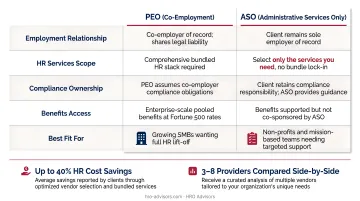
This is the key distinction from a PEO (Professional Employer Organization). A PEO enters a co-employment arrangement, sharing employer status with the client. An ASO does not. As Paychex explains, the ASO model lets the organization "retain total administrative employer status without a co-employment arrangement."
For non-profits, that distinction has direct consequences — grant compliance requirements and funder accountability depend on the non-profit remaining the employer of record.
Why Non-Profits Face Unique HR Pressure
The compliance environment alone creates significant risk for under-resourced teams:
- FMLA coverage kicks in at 50+ employees in 20+ workweeks — a threshold many growing organizations cross without realizing it
- ACA Applicable Large Employer rules require careful tracking of part-time and seasonal staff once you reach 50+ full-time equivalents
- Misclassifying hourly workers under FLSA can carry civil penalties up to $2,515 per repeated or willful violation
- Federal grant payroll records must accurately reflect work performed under Uniform Guidance (2 CFR 200.430) — gaps create audit exposure
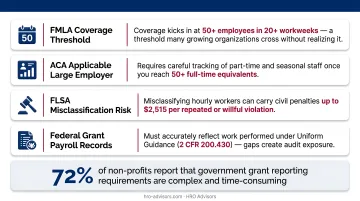
72% of non-profits report that government grant reporting requirements are complex and time-consuming. For organizations already stretched thin, that burden makes a strong case for dedicated HR support.
What an ASO Typically Covers
Core ASO services non-profits can expect to offload include:
- Payroll processing and tax filings
- Benefits administration and open enrollment support
- HR compliance monitoring (wage-and-hour, ACA, FMLA)
- Employee handbook and HR policy development
- Employee self-service HR technology platform
- Audit-ready payroll documentation for grant reporting
The 501(c)(3) Angle
Because the non-profit remains the employer of record under an ASO arrangement, there is no structural change to the organization's employment relationships. The IRS confirms that exempt organizations with employees remain responsible for federal tax withholding and FICA — and that responsibility stays with the non-profit even when payroll duties are outsourced.
The ASO model keeps that accountability intact, which matters for grant eligibility and funder relationships. Organizations should confirm the specifics of any arrangement with qualified legal counsel before proceeding.
Top ASO Solutions for Non-Profits
The five providers below were selected based on non-profit sector experience, HR service breadth, compliance capabilities, technology quality, and fit across a range of organization sizes.
Each entry includes a feature summary and ideal use case. Non-profits should weight pricing transparency and headcount fit heavily — those two factors narrow the field quickly.
Paychex / Oasis
Oasis Outsourcing was acquired by Paychex in 2018 and now operates as Paychex HR, one of the largest HR outsourcing platforms in the US. Paychex's 2025 annual report notes the company supports approximately 2.5 million worksite employees through its HR outsourcing solutions. Paychex maintains a dedicated non-profit HR and payroll service page, reflecting direct sector experience.
The strongest case for Paychex is its compliance infrastructure — particularly useful for non-profits managing multi-state staff or grant-funded positions where payroll rules vary by jurisdiction.
| Feature | Details |
|---|---|
| Key Services | Payroll, benefits administration, HR compliance, ACA reporting, state unemployment, wage-and-hour guidance, HR technology portal |
| Ideal Non-Profit Size | Small to large; Paychex serves employers across all headcount ranges |
| Pricing Model | Custom quote based on employee count and business needs; no published flat rate |
Insperity
Insperity is a nationally recognized HR outsourcing firm offering both PEO and non-PEO HR arrangements. Its non-PEO HR product, HRCore, covers payroll, compliance analytics, and employee self-service — and Insperity has served non-profits in healthcare, education, and social services, including a documented case study with HopeLink Behavioral Health.
Insperity's standout features include a dedicated HR specialist assigned per client and access to Insperity Premier, its self-service HR platform.
| Feature | Details |
|---|---|
| Key Services | HRCore payroll processing, compliance analytics, employee self-service, benefits administration, Fortune 500-level health plan access |
| Ideal Non-Profit Size | Small through large employers; official materials indicate service up to 5,000 employees |
| Pricing Model | Custom quote; no published ASO-specific pricing |
ADP Comprehensive Services
ADP is one of the world's largest HR technology and services companies. ADP Comprehensive Services is its managed HR/payroll offering for mid-market employers — and ADP explicitly positions it as distinct from ADP TotalSource, its PEO product. The client remains the sole employer of record. The platform serves government and education organizations and is built to handle the compliance complexity that comes with operating across multiple states.
ADP's coverage across all 50 states and direct integration with ADP Workforce Now makes it a strong fit for larger non-profits or those with multi-state operations.
| Feature | Details |
|---|---|
| Key Services | Payroll, ACA filing, COBRA administration, payroll tax reporting, talent management, compliance support, ADP Workforce Now integration |
| Ideal Non-Profit Size | Three documented bands: 25–149, 150–999, and 1,000+ employees |
| Pricing Model | Custom quote; no published per-employee rate for this tier |
TriNet HR Plus
TriNet offers both PEO and ASO arrangements, and TriNet HR Plus is explicitly identified as its ASO product. TriNet has a dedicated non-profit page covering foundations, social services, and advocacy organizations — and its HR Plus pricing page confirms a flat fee per employee per month structure, making budgeting more predictable.
Non-profits with stable headcounts and a preference for fixed, predictable costs will find the flat-rate pricing model easier to work into grant budgets and annual planning cycles.
| Feature | Details |
|---|---|
| Key Services | HR, payroll processing, payroll tax compliance, benefits administration, time and attendance, applicant tracking, HRIS, expense and performance management, mobile app |
| Ideal Non-Profit Size | Documented bands: 5–50, 51–250, and 251–1,000+ employees |
| Pricing Model | Flat fee per employee per month; varies by company size and selected services |
Infiniti HR
Infiniti HR is a specialized HR outsourcing firm offering both PEO and ASO services, with a particular focus on small to mid-sized employers. Its non-profit page explicitly references charitable organizations, foundations, mission-based teams, grant allocation, and compliance support — though its ASO-specific documentation is thinner than what Paychex, ADP, or TriNet publish.
The primary differentiator is flexibility: non-profits can select only the HR services they need rather than committing to a full-bundle arrangement.
| Feature | Details |
|---|---|
| Key Services | Payroll, benefits, workers' compensation, HR compliance, insurance/risk services, HR marketplace, customizable end-to-end HR services |
| Ideal Non-Profit Size | Small and mid-sized organizations; non-profit page references organizations of all sizes without a specific headcount range |
| Pricing Model | Customizable; no published per-employee rate; described as cost-effective and flexible |
How to Choose the Right ASO for Your Non-Profit
The most common mistake non-profits make: choosing an ASO based on brand recognition or the lowest per-employee cost, without verifying whether the provider actually understands the non-profit compliance environment. Price and name recognition are poor substitutes for sector-specific expertise.
What to Evaluate
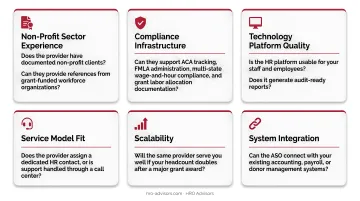
Before shortlisting any provider, assess them against these criteria:
- Non-profit sector experience — Does the provider have documented non-profit clients? Can they provide references from organizations with grant-funded workforces?
- Compliance infrastructure — Can they support ACA tracking, FMLA administration, multi-state wage-and-hour compliance, and grant labor allocation documentation?
- Technology platform quality — Is the HR platform usable for your staff and employees? Does it generate audit-ready reports?
- Service model fit — Does the provider assign a dedicated HR contact, or is support handled through a call center?
- Scalability — Will the same provider serve you well if your headcount doubles after a major grant award?
- System integration — Can the ASO connect with your existing accounting, payroll, or donor management systems?
Working with a Broker
Applying these criteria across five or more providers — gathering quotes, reviewing contracts, comparing service scopes — takes significant time. Most non-profit teams don't have it. An independent broker handles that process for you.
HRO Advisors works with non-profit organizations as a defined service vertical, providing free, no-obligation consultations that produce side-by-side provider comparisons. The firm is compensated by the selected provider, not by the client — meaning there's no cost to the non-profit for the advisory service.. Non-profits can reach HRO Advisors at 866-755-0288 or visit hro-advisors.com/non-profits to get started.
Frequently Asked Questions
What is the difference between an ASO and a PEO for non-profits?
An ASO manages HR administration on behalf of the non-profit, which remains the sole employer of record throughout. A PEO enters a co-employment arrangement, sharing employer status with the organization. For non-profits concerned about maintaining direct employer accountability for grant compliance or funder relationships, the ASO model preserves that control.
Will using an ASO affect our non-profit's 501(c)(3) tax-exempt status?
Because ASOs do not co-employ staff, the non-profit retains its employer of record status with no structural change to the employment relationship. The IRS confirms that exempt organizations remain responsible for federal payroll tax obligations even when those duties are outsourced — so tax-exempt standing is unaffected by the arrangement.
What HR functions does an ASO typically handle for a non-profit?
Core functions include payroll processing and tax filings, benefits administration and open enrollment support, HR compliance monitoring, employee handbook and policy development, and access to an HR technology platform for employee self-service and audit documentation.
How much can a non-profit save by partnering with an ASO?
HRO Advisors clients report savings of up to 40% on HR costs, though results vary by organization size and current HR setup. The primary cost driver is typically reducing or eliminating the need for in-house HR hires — the BLS puts median pay for HR managers at $140,030 annually, making outsourcing a meaningful lever.
Is an ASO or a PEO a better fit for a small non-profit?
Smaller non-profits with fewer than 50 employees often benefit more from a PEO arrangement, which provides better group benefits access and shared employer risk. Organizations with existing HR infrastructure that want to retain full employer control tend to prefer the ASO model — a broker conversation can quickly clarify which fits best.
How do we start comparing ASO providers for our non-profit?
Begin by documenting your current HR pain points, employee headcount, state presence, and budget range. Then work with a neutral broker like HRO Advisors to receive customized, side-by-side provider comparisons at no cost — skipping the time and effort of conducting that research independently.