Introduction
Nonprofits operate under a paradox most executive directors know well: the administrative demands of running an organization grow steadily heavier, while the budgets and staff available to handle them stay thin. Payroll, benefits enrollment, workers' compensation, multi-state tax filings, ACA reporting — none of this disappears just because your primary focus is mission delivery.
According to the National Council of Nonprofits' 2023 workforce survey, 74.6% of nonprofits reported job vacancies, with salary competition and budget constraints cited as the top barriers to filling them. Meanwhile, industry data puts the median nonprofit HR staffing ratio at just one HR staff member per 66 employees — leaving most organizations genuinely under-resourced for the compliance and benefits challenges they face.
Professional Employer Organizations (PEOs) have emerged as a practical answer to this pressure. What follows breaks down how the PEO model works, what nonprofits specifically gain from it, and how to identify the right provider for your organization's size, budget, and mission.
Key Takeaways
- Nonprofits retain full control over hiring, staff direction, and culture — a PEO simply becomes the employer of record for payroll taxes and benefits.
- Small nonprofits gain access to large-group health plans, retirement options, and HR infrastructure typically out of reach for lean teams.
- PEOs handle payroll, multi-state tax filings, workers' compensation, and ACA compliance.
- NAPEO research puts average annual PEO cost at $1,395 per employee, with average savings of $1,775 per FTE — a 27.2% ROI.
- HRO Advisors lets nonprofits compare up to 8 PEO providers side-by-side at no cost — no independent vetting required.
What Is a PEO and How Does the Co-Employment Model Work?
A Professional Employer Organization is a third-party firm that partners with an employer to co-manage HR, payroll, benefits, and compliance through a shared employment arrangement. According to NAPEO, PEOs pay wages and taxes under their own Employer Identification Number — meaning they take on formal employer-of-record status for administrative purposes while your team keeps doing the work they were hired to do.
There are currently 500+ PEOs operating in the U.S., supporting more than 4.5 million employees across 230,000+ client organizations. For nonprofits, that scale matters: it means proven infrastructure, negotiated benefit rates, and compliance expertise already built into the model.
Understanding the Co-Employment Relationship
Co-employment is a contractual agreement that divides employer responsibilities between your nonprofit and the PEO. The division works like this:
- Your nonprofit controls: Day-to-day management, hiring and firing decisions, compensation levels, performance reviews, organizational culture, and mission delivery.
- The PEO controls: Payroll processing, tax withholdings and filings, benefits plan enrollment, workers' compensation insurance administration, and regulatory filings.
The National Council of Nonprofits confirms this split explicitly: nonprofit staff technically become employees of both organizations, but the nonprofit retains authority over every operational decision that matters to leadership.
Co-employment does not mean giving up control. Your staff still reports to you, answers to your policies, and advances your mission — the PEO simply handles the administrative layer underneath.
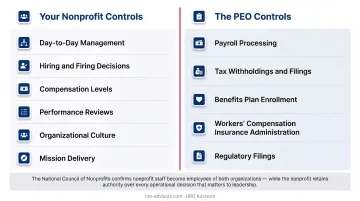
What PEOs Handle vs. What Nonprofits Control
| PEO Handles | Nonprofit Retains |
|---|---|
| Payroll processing and direct deposit | Hiring and firing authority |
| Federal, state, and local tax filings | Compensation-setting decisions |
| Workers' compensation administration | Staff supervision and direction |
| Benefits plan management and enrollment | Organizational culture |
| ACA and regulatory compliance filings | Program and mission delivery |
That division of responsibilities is formalized in the co-employment contract. Before signing, review it carefully — particularly the sections defining liability boundaries for compliance errors, since those terms vary significantly between providers.
Key PEO Services for Nonprofits
PEOs offer a bundled suite of services that goes well beyond basic payroll. For nonprofits that can't justify a full in-house HR team, a PEO effectively functions as that infrastructure.
Payroll and Tax Administration
Full-service payroll through a PEO covers:
- Wage calculation, direct deposit, and deduction management
- Overtime tracking and year-end W-2 and 1099 processing
- Automated federal, state, and local tax filings
- Multi-state payroll registration and compliance
Multi-state compliance deserves particular attention. Nonprofits expanding into new states face separate registration requirements, tax accounts, and compliance rules for each one. A PEO handles all of it automatically, removing the need to maintain those accounts independently.
Benefits Administration
Benefits access is where the co-employment model delivers its most tangible financial advantage. PEOs pool employees across all client organizations into large group plans — giving even nonprofits with fewer than 20 staff access to health, dental, vision, and life insurance rates they couldn't negotiate independently. NAPEO research found that PEO clients save an average of $654 per employee annually on health benefits alone, and about 26% of organizations that join a PEO add retirement plans and health coverage they didn't previously offer.
Typical benefits access through a PEO includes:
- Medical, dental, and vision insurance at group rates
- 401(k) retirement plans with employer-contribution flexibility
- FSA and HSA programs
- Short and long-term disability, critical illness, and other voluntary benefits
- Single enrollment portal for all benefit elections
Two due-diligence points worth flagging before you sign: nonprofits must accept the benefit carriers the PEO has contracted with, and if you exit the PEO later, re-establishing independent plans means re-enrolling employees, negotiating new rates, and rebuilding carrier relationships from scratch.
On 403(b) plans, there's an additional wrinkle. IRS rules restrict 403(b) sponsorship to eligible 501(c)(3) organizations and certain public institutions — a for-profit PEO cannot sponsor one on your behalf. If your nonprofit wants to offer a 403(b), confirm directly with any prospective PEO how that plan is structured and administered under the co-employment model.
HR Support and Compliance
HR management services through a PEO typically include:
- Employee handbook development and updates
- Onboarding workflows and offboarding guidance
- Performance management support and termination documentation
- Conflict resolution resources
On the compliance side, PEOs track changes to federal and state labor laws, manage ACA reporting, handle FMLA and ADA requirements, and flag regulatory updates before they become violations. For grant-funded nonprofits specifically, clean compliance records aren't optional — the HHS Grants Policy Statement confirms that noncompliant grant costs can be disallowed and must be repaid with non-federal funds, even after a grant closes.
PEO vs. Traditional Payroll: What Nonprofits Need to Know
Traditional payroll services process wages and handle tax withholdings. That's largely where the service ends. A PEO, by contrast, enters a co-employment relationship that includes HR management, benefits access, risk mitigation, and compliance support: a fundamentally broader scope of service.
Cost Structure Differences
Traditional payroll providers charge per employee or per paycheck. Costs stay predictable, but the nonprofit remains entirely responsible for sourcing benefits, managing compliance, and handling HR through separate vendors.
PEO pricing — which typically uses either a per-employee-per-month (PEPM) or percentage-of-payroll structure — appears higher upfront. But it bundles services that would otherwise require multiple separate vendors and significant internal staff time.
NAPEO's research shows how those bundled costs add up:
| Cost/Savings Metric | Per FTE Annually |
|---|---|
| Average PEO cost | $1,395 |
| Average total savings | $1,775 |
| HR salary and benefit savings | $965 |
| Health benefit cost savings | $654 |
| Workers' compensation savings | $66 |
| Net ROI | 27.2% |
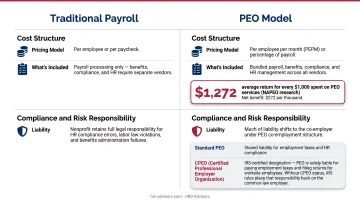
For every $1,000 spent on PEO services, average clients saved $1,272 — a net benefit of $272 per thousand.
That financial case becomes even stronger when you factor in risk. ### Compliance and Risk Responsibility
With traditional payroll, your nonprofit retains full legal responsibility for HR compliance errors, labor law violations, and benefits administration failures. With a PEO, much of that liability shifts to the co-employer.
The distinction is most pronounced with a CPEO (Certified Professional Employer Organization), an IRS-certified designation that makes the PEO solely liable for paying employment taxes and filing returns for worksite employees. Without CPEO status, IRS rules place that responsibility back on the common-law employer.
When Each Option Makes More Sense
- Traditional payroll fits stable, simple organizations with minimal multi-state exposure, robust in-house HR, and straightforward benefits needs.
- A PEO is the better fit for nonprofits that are growing, have remote or multi-state staff, face grant compliance requirements, or deal with seasonal staffing fluctuations.
Top Benefits of Using a PEO for Your Nonprofit
The clearest benefit is also the hardest to put a number on: reclaiming leadership time. Hours spent on payroll queries, benefits enrollment questions, and compliance research are hours not spent on programs, fundraising, or community impact. Two areas where this shift matters most — talent retention and compliance — are worth examining directly.
Talent Attraction and Retention
Salary competition was cited by 72.2% of nonprofits as a top barrier to filling vacancies. A PEO doesn't eliminate that challenge, but it gives nonprofits a real tool to compete on benefits — the one area where smaller organizations can offer something comparable to larger employers.
NAPEO data shows organizations using PEOs experience:
- 12% lower employee turnover compared to non-PEO employers
- 2x faster business growth
- 50% lower likelihood of going out of business
These figures come from the broader PEO-client population, not nonprofits exclusively. But the underlying mechanism — better benefits, more consistent HR practices, reduced administrative chaos — applies directly to the nonprofit talent problem.
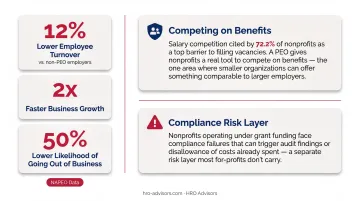
Talent is only half the equation. Nonprofits operating under grant funding face a separate layer of risk that most for-profits don't: compliance failures that can trigger audit findings or disallowance of costs already spent.
Compliance Confidence and Risk Reduction
Nonprofits spending $1 million or more annually in federal awards must undergo a single audit. Those with grants from HHS face disallowance risk on costs that don't meet compliance standards. FLSA violations — minimum wage and overtime failures — can result in back wages plus equal liquidated damages, plus civil money penalties for repeat offenses.
A PEO monitors evolving employment laws, manages required filings, provides guidance during audits or disputes, and flags regulatory changes before they create exposure. For organizations funded by grants that require clean compliance records, that proactive monitoring is worth as much as the cost savings.
How to Choose the Right PEO for Your Nonprofit
Not all PEOs are equipped to serve nonprofits well. Generic claims of "industry coverage" don't tell you whether a provider understands Form 990 reporting, grant compliance documentation, or the specific dynamics of mission-driven organizations.
Key evaluation criteria:
- CPEO certification from the IRS — confirms financial responsibility, tax compliance reliability, and that the PEO assumes primary liability for employment taxes
- ESAC accreditation — an independent verification of financial stability, ethical standards, and operational reliability; ESAC-accredited PEOs pay nearly 73% of all industry wages and must maintain audited financials and a surety bond
- Nonprofit-specific references — ask for clients comparable in size and mission type
- Grant compliance reporting — confirm the PEO can produce payroll and benefits documentation that supports grant reporting requirements
- 403(b) plan handling — if your organization is a 501(c)(3) and wants a 403(b), verify specifically how the PEO structures this
- Multi-state payroll capability — essential if you have staff across multiple states, each with distinct withholding and filing requirements
- Transparent pricing — request itemized quotes and ask directly about onboarding fees, ACA filing charges, and benefits administration add-ons
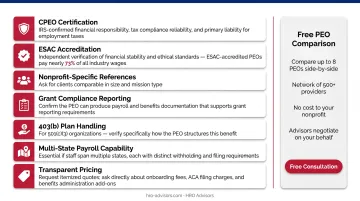
Working through this checklist across multiple providers takes time most nonprofits don't have. HRO Advisors offers a free consultation that compares up to 8 PEOs side-by-side on services, pricing, and nonprofit fit, drawing from a network of 500+ providers.
Their advisors gather data on your current HR costs, benefits needs, and compliance obligations, then negotiate with providers on your behalf. There's no cost to the nonprofit — HRO Advisors is compensated by the selected provider, so you get expert guidance without adding to your budget.
PEO Pricing for Nonprofits: What to Expect
PEO pricing follows two main models:
Per-employee-per-month (PEPM): A flat fee per employee regardless of compensation level. Easier to budget and plan around, particularly for nonprofits with predictable headcount.
Percentage of payroll: This scales with compensation levels, which can increase costs as salaries rise — but often works well for organizations with lower average wages.
The right model depends on your headcount, average compensation, and how much budget predictability matters to your fiscal cycle.
Factors that influence your total PEO cost:
- Number of employees
- Geographic footprint (single-state vs. multi-state operations)
- Scope of services (payroll-only vs. full HR bundle)
- Add-ons: recruiting support, training modules, specialized compliance tools
NAPEO's research puts average annual PEO cost at $1,395 per worksite employee, against average savings of $1,775 per FTE. For reference, the median nonprofit HR activities budget runs $1,020 per employee according to Nonprofit HR sector benchmarks — useful context for gauging your baseline HR spend before comparing quotes.
Once you have benchmark numbers in hand, the next step is pressure-testing provider quotes. Ask every PEO:
- Are there separate onboarding fees?
- Is ACA filing included or billed separately?
- What are the costs for adding or removing employees mid-year?
- Are nonprofit pricing discounts available?
Frequently Asked Questions
Can a nonprofit use a PEO?
Yes. 501(c)(3) and other nonprofit organizations can and do use PEOs. The co-employment model is fully compatible with nonprofit governance — your organization retains complete operational authority while the PEO manages payroll, tax filings, benefits, and compliance responsibilities.
What services does a PEO provide?
Core PEO services include full-service payroll and tax administration, benefits access and enrollment (health, dental, vision, retirement), HR management support, workers' compensation administration, and compliance monitoring — all delivered under the co-employment arrangement.
How does co-employment affect a nonprofit's control over its staff?
It doesn't remove authority from your leadership. All hiring, firing, compensation, and day-to-day management decisions stay with your organization. The PEO assumes employer-of-record status only for payroll taxes and benefits administration — not for operational decisions.
Can a PEO help our nonprofit with grant compliance and reporting?
Many PEOs offer reporting formats that support grant documentation, but coverage varies by provider. Ask prospective PEOs specifically about grant compliance reporting before signing — some include it as standard, others price it as an add-on.
How much does a PEO typically cost for a nonprofit?
Pricing follows either a per-employee-per-month or percentage-of-payroll structure. NAPEO research puts average annual PEO cost at $1,395 per employee, with average savings of $1,775 per FTE — often exceeding what nonprofits spend across separate payroll, benefits, HR, and compliance vendors.
What certifications should we look for when selecting a PEO?
Prioritize IRS CPEO certification, which confirms tax compliance reliability and means the PEO, not your organization, is primarily liable for employment taxes. ESAC accreditation independently verifies financial stability and operational standards. Both together represent the strongest baseline assurance available.