Introduction
Nonprofits run lean. A typical organization might have one part-time HR generalist covering 40+ employees — or none at all. According to the 2024 501 HR Survey, only 61% of nonprofits with payrolls over $1M reported having at least one dedicated HR professional. That leaves nearly 4 in 10 organizations managing payroll, worker classification, leave administration, and compliance through a patchwork of staff wearing multiple hats.
Compliance gaps accumulate quietly in that environment — outdated exempt classifications, unsigned handbook acknowledgments, volunteer arrangements that have never been formally documented — until a DOL inquiry, a funder review, or an employee complaint forces them into view.
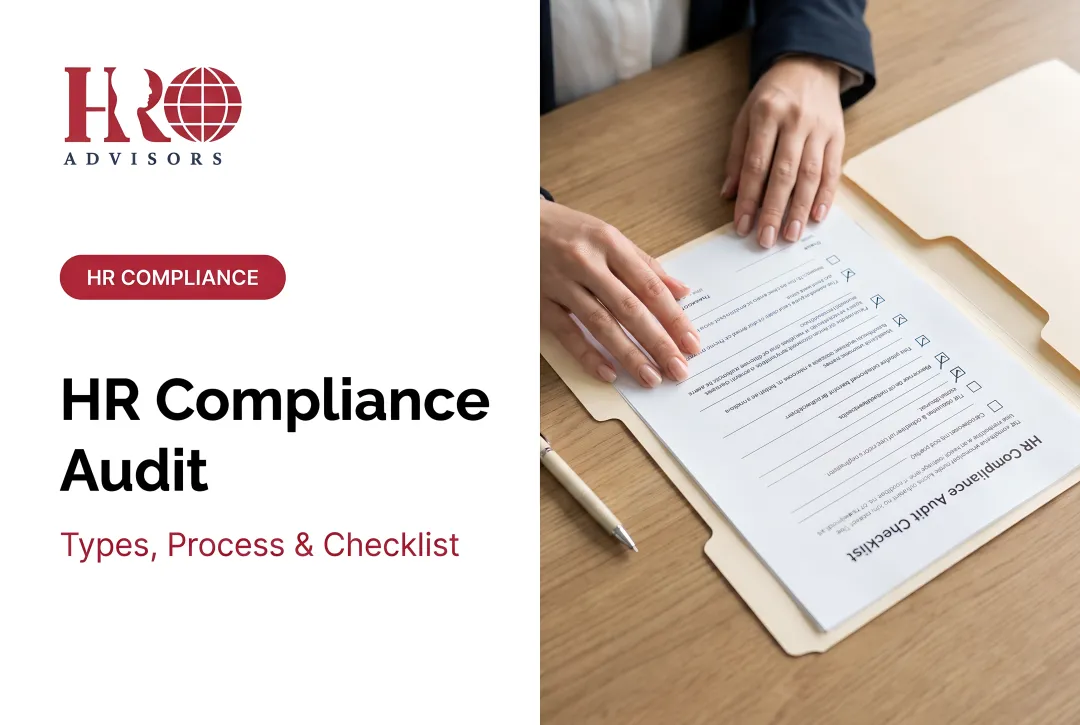
A nonprofit HR audit is the structured process that catches those gaps before they become expensive. This guide walks through every major audit category — employment law compliance, payroll accuracy, worker classification, benefits administration, and more — so your organization knows exactly where it stands and what to fix first.
Key Takeaways
- A nonprofit HR audit covers classification, wage and hour compliance, leave administration, recordkeeping, and HR policies — and whether they're consistently applied, not just documented.
- Nonprofits carry distinct risks: volunteer arrangements, stipended workers, grant-funded roles, and thin internal HR capacity.
- Conduct a full audit annually, plus targeted reviews after major organizational changes.
- Common gaps are structural: inconsistent manager practices, outdated classifications, and fragmented documentation.
- A PEO or HR support partner can address systemic gaps without adding headcount.
What Is a Nonprofit HR Audit (and Why It Matters)
A nonprofit HR audit is a structured review of an organization's people practices, policies, records, and operational processes. The goal isn't to confirm that certain forms exist — it's to identify where policy, payroll, and actual practice have drifted apart before those gaps create legal, financial, or reputational exposure.
How It Differs from a Financial Audit
These are often confused, but they serve different purposes:
- Financial audit — examines books, financial statements, and fund use; often required for 501(c)(3) organizations receiving federal funding
- HR audit — examines employment practices, workforce compliance, documentation integrity, and people operations
An organization can pass a financial audit and still have serious HR exposure — the two reviews simply don't overlap.
Why Nonprofits Face Heightened HR Risk
Nonprofits operate under a different kind of accountability than for-profit businesses. Funders, boards, and the public all have legitimate interests in how an organization manages its workforce. HR failures hit nonprofits harder than most. Common triggers include:
- A wage violation that goes public
- A misclassified worker who files a complaint
- A leave dispute that escalates into litigation
Each of these creates legal costs — but in a nonprofit, the damage extends further. They can undermine funder confidence and erode the leadership trust that mission-driven organizations depend on.
The DOL has publicly named nonprofits in wage enforcement actions, including a Pennsylvania nonprofit that paid nearly $45,000 in back wages to 80 employees after overtime violations. That's not a dramatic outlier — it's the kind of exposure that routine audits prevent.
Nonprofit HR Audit Checklist: Key Areas to Review
A meaningful HR audit verifies that processes are current, consistent, and defensible — not just that the right folders exist. The five areas below form the core of any nonprofit HR compliance review. Specific items will vary based on organization size, state, and workforce composition.
Employee Classification and Wage & Hour Compliance
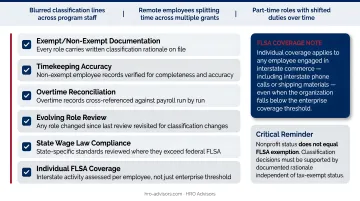
This is one of the highest-risk areas in any nonprofit audit. Many organizations have roles that blur classification lines: program staff with variable hours, remote employees splitting time across multiple grants, part-time workers whose duties have shifted over time.
Audit items to review:
- Exempt/non-exempt status documented for every role, with supporting rationale
- Timekeeping records for non-exempt employees, verified for accuracy
- Overtime records reconciled against payroll
- Classification decisions revisited for any role that has evolved since last review
- Compliance with applicable state wage laws, which may exceed federal FLSA standards
Individual FLSA coverage can apply even when an organization doesn't meet the enterprise coverage threshold — any employee engaged in interstate commerce, including interstate phone calls or shipping materials, may be individually covered. Don't assume nonprofit status equals FLSA exemption.
Worker Classification: Volunteers, Interns, and Independent Contractors
Nonprofits engage unpaid interns, stipended fellows, long-term volunteers, and contractors at rates higher than most other employers — and every one of those arrangements carries classification risk.
Audit items to review:
- All independent contractor agreements reviewed against IRS behavioral and financial control tests; note that DOL's 2024 final rule on IC classification took effect March 11, 2024
- Interns and fellows assessed against the DOL's primary beneficiary test (no single factor is determinative)
- Volunteers confirmed to be acting freely, without compensation expectation or coercion
- Paid employees not volunteering to provide the same services they are employed to perform
- All volunteer and intern arrangements documented with written agreements
- Stipends reviewed to confirm they don't inadvertently create an employment relationship
Volunteers in earned-revenue operations — gift shops, ticketed events, commercial activities — deserve a closer look. DOL guidance draws a clear line between charitable program volunteers and those supporting commercial activities run by a nonprofit.
HR Policies, Handbooks, and Acknowledgments
A handbook that hasn't been updated since the organization's founding, or that staff were never asked to acknowledge, provides limited legal protection and zero practical guidance.
Audit items to review:
- All employees have signed current handbook acknowledgment forms on file
- Policies reflect current federal and state law (anti-harassment, EEO, remote/hybrid work, timekeeping, leave, expense reimbursement)
- Conflict of interest policy is current and specifically addresses nonprofit governance obligations
- Leave policies address applicable state and local mandates by work location
- Manager behavior in practice aligns with what the handbook actually says
Once an organization's headcount approaches 15 employees, EEOC coverage activates for many federal anti-discrimination laws. The EEOC reported 88,531 new discrimination charges in FY2024 — a 9% increase over FY2023. Nonprofits are not exempt from those charges — mission-driven status offers no procedural shield when policies are absent or outdated.
Leave Administration and Benefits Compliance
Leave compliance is where multi-jurisdictional complexity hits hardest. According to the National Conference of State Legislatures, 20 states and D.C. now require paid sick or safe leave, and 14 jurisdictions have enacted mandatory paid family and medical leave programs — with more phasing in annually. If your employees work across multiple states, your leave audit needs to map to each work location, not just federal law.
Audit items to review:
- FMLA eligibility determinations and required notices provided (applies to organizations with 50+ employees in 20+ workweeks)
- State and local paid sick leave compliance confirmed for each work location
- Leave balances reconcile between HR and payroll systems
- ADA accommodation requests documented with records of the interactive process
- Leave tracking is centralized and accessible — not maintained in individual managers' inboxes
Onboarding, Employee Files, and I-9 Compliance
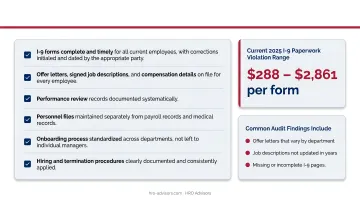
Inconsistent onboarding is where HR risk often begins. Offer letters that vary by department, job descriptions that haven't been updated in years, and missing I-9 pages are among the most common audit findings.
Audit items to review:
- I-9 forms complete and timely for all current employees, with corrections initialed and dated by the appropriate party
- Current 2025 I-9 paperwork violation range: $288 to $2,861 per form
- Offer letters, signed job descriptions, and compensation details on file for every employee
- Performance review records documented systematically
- Personnel files maintained separately from payroll records and medical records
- Onboarding process standardized across departments, not left to individual managers
How to Conduct a Nonprofit HR Audit: Step by Step
A real HR audit is a structured process that ends with a prioritized remediation plan. Without that structure, you're just gathering paperwork.
Step 1 – Define Scope and Assign Ownership
Decide whether this is a full audit or a targeted review of high-risk areas. Name a lead (internal HR staff, an external consultant, or a PEO partner) and identify which department managers will serve as information sources. For small nonprofits without dedicated HR staff, an external partner brings objectivity and benchmarking context that an internal review often can't provide.
Step 2 – Build the Questionnaire and Gather Documentation
The audit questionnaire is the roadmap. Collect documentation across every area in scope before drawing any conclusions.
Key document categories:
- Employee files (offer letters, job descriptions, signed acknowledgments)
- I-9 forms for all current employees
- Payroll records and timekeeping logs
- Leave tracking records and balance reconciliations
- Contractor agreements and classification documentation
- Handbook versions and acknowledgment signatures
- Benefits enrollment records
Step 3 – Review Practices Against Policy and Legal Standards
This is where structural gaps surface. Compare what documents say against how managers and employees actually operate. Common review activities include:
- Manager interviews to test whether written policies are understood and applied
- Cross-referencing payroll data against HR classification records
- Checking documentation dates against hire dates or policy effective dates
Step 4 – Benchmark, Identify Gaps, and Prioritize
Once gaps are identified, categorize findings by risk level to drive the right response timeline:
| Risk Level | Examples | Action Timeline |
|---|---|---|
| High | Wage violations, missing I-9s, misclassified workers | Address immediately |
| Medium | Outdated leave policies, unsigned acknowledgments | Schedule within 60-90 days |
| Operational | Inconsistent documentation, informal processes | Include in next cycle |
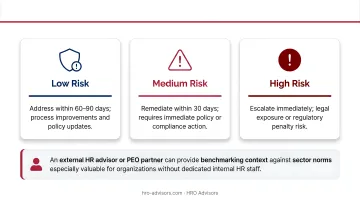
An external HR advisor or PEO partner can provide benchmarking context against sector norms , which is especially valuable for organizations without dedicated internal HR staff.
Step 5 – Create an Action Plan and Implement
The audit deliverable should be a written report with findings, risk ratings, owners, and deadlines. Identifying a problem and not acting on it increases legal exposure. Once an organization is aware of non-compliance, documented inaction is harder to defend than not having known in the first place.
The report is only half the work. Build an ongoing cadence to stay ahead:
- Quarterly: Spot-check high-risk areas (I-9s, payroll classifications, leave balances)
- Annually: Full audit across all HR functions
- Ongoing: Track remediation deadlines and confirm owners are closing gaps
Gaps accumulate between audits. A consistent cadence is what keeps them from compounding into larger exposure.
Common HR Gaps Nonprofits Discover (and When to Trigger an Audit)
The most common audit findings in nonprofits aren't dramatic violations. They're structural:
- Outdated exempt classifications — roles that evolved but were never reclassified
- Missing I-9 pages — especially for employees hired during growth periods or leadership transitions
- Unsigned handbook acknowledgments — policies distributed but never formally confirmed
- No documentation of accommodation requests — interactive process not recorded
- Contractor arrangements lacking written agreements — especially long-term contractors doing program work
- Leave tracking that exists on paper but can't be validated — balances that don't reconcile across systems
When to Trigger a Targeted Review Outside the Annual Cycle
An annual audit is the right baseline. But certain events warrant an immediate, targeted review:
- Rapid headcount growth (especially when crossing the 15-, 50-, or 100-employee thresholds)
- Hiring employees in a new state with different paid leave or wage law requirements
- Executive leadership turnover
- Implementing a new payroll or HRIS system
- Recurring employee relations complaints
- A new grant or funding arrangement with specific compliance conditions attached
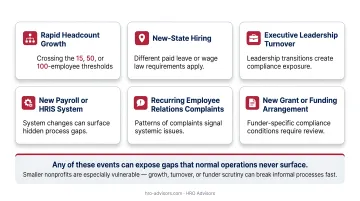
Any of these events can expose gaps that normal operations never surface. Smaller nonprofits are particularly vulnerable because informal processes tend to work fine with experienced staff and a stable team — but break down quickly under growth, turnover, or funder scrutiny. An audit doesn't just confirm that things are working today. It confirms they'll hold up when conditions change.
How HRO Advisors Can Help
When a nonprofit HR audit uncovers compliance gaps, worker classification issues, or benefits administration weaknesses, one of the most effective ways to address them structurally — without hiring additional staff — is partnering with a PEO.
HRO Advisors helps nonprofits find the right PEO partner from a network of over 500 providers at no cost to the organization. The free consultation includes a compliance baseline assessment — so if your nonprofit has already completed an audit and has a documented gap list, that information feeds directly into the matching process. No need to start over.
Through a PEO partnership, nonprofits can address the most common audit findings:
- Payroll administration and wage compliance infrastructure
- Benefits access at enterprise pricing — helping nonprofits compete for mission-driven talent
- Worker classification support and ongoing compliance monitoring
- HR policy and handbook review aligned with current law
- Multi-state leave law tracking as organizations expand geographically
Nonprofits that have gone through HRO Advisors' matching process report HR cost savings of up to 40% — freeing budget that goes back into programs, not paperwork.
For nonprofits working through post-audit action items, speed matters. HRO Advisors compares up to 8 PEO providers side-by-side, and the full process — from initial consultation to provider selection — typically wraps up in under two weeks. Call 866-755-0288, email info@hro-advisors.com, or schedule a free consultation to get started.
Frequently Asked Questions
Is an HR audit mandatory for all organizations?
HR audits are not legally required for most organizations, though specific reviews like I-9 audits or FLSA classification checks may be triggered by regulatory inquiries. Conducting voluntary audits is a recognized best practice and a signal of strong governance — particularly for nonprofits accountable to funders and boards.
What should be included in an HR audit?
Core areas include employee and worker classification, wage and hour practices, leave administration, HR policies and handbook currency, onboarding documentation, I-9 compliance, and reconciliation between HR and payroll records. Specific scope depends on the organization's size, state(s) of operation, and workforce composition.
How much should a nonprofit HR audit cost?
Internal audits have minimal direct cost but require significant staff time. External HR consultants charge by the hour or project scope. Working with a PEO often bundles ongoing compliance support into a single service model — HRO Advisors can match your nonprofit with the right PEO options at no cost to you.
How often should a nonprofit conduct an HR audit?
Annual full audits are the recommended baseline, with quarterly spot-checks of high-risk areas like classification, leave tracking, and I-9 currency. Organizations experiencing rapid growth, leadership changes, or geographic expansion should conduct targeted reviews outside the annual cycle.
Who should lead a nonprofit HR audit — internal staff or an outside consultant?
Internal staff can lead audits if they have sufficient HR expertise and can remain objective. Outside consultants bring independence and compliance expertise that's especially valuable for nonprofits without a dedicated HR team.
What are the most common HR compliance issues nonprofits face?
The most common compliance gaps include:
- FLSA misclassification of employees as exempt
- Improper treatment of volunteers and interns
- Incomplete or expired I-9 documentation
- Failure to track leave under state and local laws
- Outdated policies that no longer align with current law or practice