That's not just an HR problem. Every new hire means fresh payroll setup, new withholding configurations, and another round of tip credit documentation. Get it wrong — even once — and you're looking at IRS penalties, back wages, or a missed tax credit worth real money.
The decision between managing payroll in-house or handing it to an outside provider is one every restaurant operator faces eventually. This article breaks down the real costs, trade-offs, and decision factors so you can make the call that's right for your operation.
Key Takeaways
- Restaurant payroll carries compliance risks — tipped wages, FICA credits, and state-specific rules — that standard small-business payroll software doesn't fully address.
- In-house payroll works for small, stable operations; scaling up turns it into a compliance liability.
- Outsourced providers and PEOs handle tax filings, tip reporting, and compliance monitoring — cutting both error risk and admin time.
- The true cost of in-house payroll exceeds the software price once staff time and error corrections are counted.
- PEOs go beyond payroll, offering benefits administration and compliance coverage that reduces turnover in a high-churn industry.
In-House vs. Outsourced Payroll: Quick Comparison
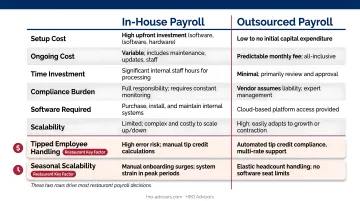
| Dimension | In-House Payroll | Outsourced Payroll |
|---|---|---|
| Weekly time investment | 2–10+ hours per pay period | Minimal — input hours/tips, provider handles the rest |
| Upfront cost | Software license ($50–$200/month) | Setup fee, then per-employee monthly fee |
| Ongoing cost | Staff time + software + error correction | $30–$100 per employee/month (varies by provider) |
| Compliance responsibility | Fully on the restaurant | Shared or transferred to provider |
| Tipped employee handling | Manual tracking; error-prone | Automated tip reporting and FICA credit tracking |
| Seasonal scalability | Difficult — requires manual reconfiguration | Easier — providers scale with headcount changes |
| Error risk | Higher — especially with tip calculations | Lower — automated validation and compliance checks |
For most industries, the comparison comes down to cost versus convenience. For restaurants, the two rows that actually drive the decision are tipped employee handling and seasonal scalability — tip miscalculations and summer staffing surges are precisely the scenarios where in-house systems tend to fail.
What Is In-House Payroll for Restaurants?
In-house payroll means the restaurant owner or a designated staff member handles everything: calculating wages, collecting tip declarations, running tax withholdings, filing quarterly returns, and processing direct deposits. Full responsibility for accuracy and compliance stays with the business.
The Restaurant-Specific Complexity Problem
A standard small business might have 10 salaried employees on a single pay rate. A 30-seat restaurant could have servers at tipped minimum wage, a floor manager on salary, line cooks at three different hourly rates, and a part-time dishwasher hired last Tuesday. Every pay period involves:
- Reconciling declared tips against POS data
- Calculating overtime across variable weekly schedules
- Applying the correct tipped minimum wage (which differs by state)
- Processing new hire paperwork — continuously, given industry turnover rates
- Filing tip reports for FICA purposes
Each of those tasks resets or multiplies with every staffing change — and restaurants have more staffing changes per month than almost any other industry.
Hidden Costs Operators Underestimate
Software subscription fees are easy to budget for. The costs operators miss are harder to see until they've already hit.
According to Paychex, roughly 40% of small businesses incur an average of $845 per year in IRS penalties from payroll errors — and that's before accounting for back-wage liability. The IRS Failure to Deposit Penalty alone ranges from 2% for deposits that are 1–5 days late up to 15% if not deposited after a formal IRS notice.
Add the staff hours spent collecting tip reports, correcting timesheet discrepancies, and preparing quarterly filings — and the true cost of in-house payroll routinely exceeds what operators expect.
When In-House Payroll Makes Sense
In-house payroll works when the circumstances are genuinely simple:
- Single location with fewer than 15–20 employees
- Flat hourly pay structure with minimal tip complexity
- Dedicated office manager with payroll experience and actual bandwidth
- Stable team with low turnover and consistent scheduling
When any of those conditions shifts — a second location, a seasonal hiring surge, a tip classification question, or the loss of whoever runs payroll — in-house management becomes genuinely difficult to sustain without errors or gaps.
What Is Outsourced Payroll for Restaurants?
Outsourced payroll means the restaurant provides inputs — hours worked, tip amounts, new hire data — and a third-party provider handles calculations, tax filings, deposits, and compliance reporting. That provider might be a payroll service bureau, an HR platform, or a Professional Employer Organization (PEO).
Why Outsourcing Fits Restaurant Complexity
Providers with hospitality experience understand the compliance landscape restaurants actually operate in. That includes:
- FICA tip credits under IRS Section 45B — employers can claim a credit on FICA taxes paid on employee tips that exceed the federal minimum wage threshold
- State tipped minimum wage variations — as of 2026, seven states prohibit a tip credit entirely (Alaska, California, Minnesota, Montana, Nevada, Oregon, and Washington), while 28 states require a tipped cash wage above the federal $2.13/hour floor
- Blended overtime for employees who work both tipped and non-tipped roles
- Tip allocation rules when declared tips fall below IRS thresholds
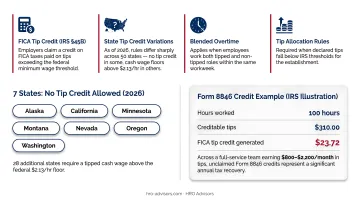
Many restaurants miss the FICA tip credit (Form 8846) entirely when managing payroll without specialist support. To illustrate the math: an employee working 100 hours with $310 in creditable tips generates a $23.72 credit based on the IRS's own example.
Across a full-service dining team with $800–$2,200 in monthly tips per employee, those credits add up to a real annual tax recovery — one that requires accurate tip tracking and proper Form 8846 filing to claim.
What Outsourced Payroll Covers
A full-service outsourced provider typically covers:
- Wage and hour calculations across multiple pay types
- Tip reporting and FICA credit documentation
- Direct deposit processing
- Federal, state, and local tax filing and remittance
- W-2 preparation and new hire reporting
- Integration with POS or time-tracking systems
PEOs: Outsourcing That Goes Further
Standard payroll outsourcing handles the numbers — a PEO goes further. Under a co-employment model, the PEO takes on compliance liability, benefits administration, workers' compensation, and HR support alongside payroll — which matters for restaurants trying to reduce turnover by offering competitive benefits packages.
HRO Advisors works as a PEO broker, helping restaurant operators compare 3–8 PEO providers side by side — evaluating cost, compliance capabilities, and hospitality-specific features. The process costs the restaurant nothing; HRO Advisors is compensated by the selected provider.
Common Concerns — Addressed
Restaurant operators often worry about losing visibility into payroll or being stuck with an error they can't fix quickly. Reputable providers address this directly:
- Real-time dashboards give operators full visibility into pay runs before they process
- Automated validation checks catch tip calculation errors before filing
- Error liability — many providers carry responsibility for penalties caused by their errors, offering accountability that a single in-house processor can't match
When Outsourcing Delivers Clear ROI
Outsourcing makes the most financial sense when:
- Multi-unit operators managing 30+ employees across locations need consistent compliance across different state rules
- High seasonal fluctuation (resort towns, event venues) requires rapid workforce scaling without reconfiguring payroll systems manually
- Prior compliance penalties have already cost the business money
- Newer operators want to focus on hospitality rather than back-office tax administration
- FICA credits have gone unclaimed because in-house tracking wasn't set up correctly
Which Approach Is Right for Your Restaurant?
The answer depends on where your operation sits right now — and where it's heading.
Decision Framework
Choose in-house if:
- You have a single location with under 15–20 employees
- Pay structure is simple — flat hourly, minimal tip complexity
- You have a dedicated person with real payroll experience and available time
- Your team is stable and turnover is low
Choose outsourced if:
- You operate multiple locations or have plans to expand
- Your staff includes tipped employees requiring FICA credit tracking
- Seasonal fluctuations create sharp changes in headcount
- Compliance penalties have already appeared on your books
- Your current "payroll person" is one resignation away from a crisis
The Real Cost Comparison
In-house payroll looks cheaper on paper — until you account for the hidden costs that don't show up on a monthly invoice.
Forbes reports that outsourced payroll services typically cost $20–$203 as a base fee plus $4–$22 per employee per month. Paychex benchmarks the range at $30–$100 per employee per month depending on service complexity.
Now weigh that against what in-house actually costs:
- Payroll software: $50–$200/month
- Staff time: hours per pay period that could go elsewhere
- Annual IRS penalty exposure: ~$845 average for small businesses that make errors
- Missed FICA tip credits: potentially hundreds to thousands in unclaimed tax recovery per year
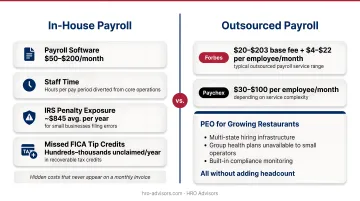
Those numbers shift the math considerably. For growing restaurants, outsourcing through a PEO goes further still — adding infrastructure for multi-state hiring, group health plans typically unavailable to small operators, and built-in compliance monitoring, all without adding headcount.
Real-World Scenario: When In-House Payroll Stops Working
Consider a three-location casual dining group with 65 employees. For three years, a single office manager handled payroll across all locations using spreadsheets and a basic software subscription. It worked — until it didn't.
The problems arrived in sequence: overtime calculations became inconsistent as employees started picking up shifts across locations. FICA tip credits went unclaimed because no one had set up Form 8846 tracking. Then the office manager gave two weeks' notice.
That last event nearly caused a missed payroll. The group's owner described it as the moment he realized the business had built a critical compliance function on a single person with no backup.
The decision to outsource came down to three factors: the cost of the near-miss, the realized penalty exposure from the tip credit gap, and the time burden that had ballooned to two full days per pay period.
After engaging a PEO with hospitality payroll experience, the outcome mirrored what Paychex documented in their Hunger Thirst Group case study: a restaurant group that reduced payroll processing from 3 days to 8 hours per pay period and saved $120,000 annually after moving to a managed HR platform.
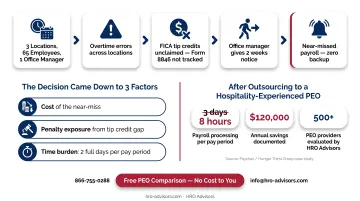
For restaurants with complex tip structures and growing teams, the ROI from outsourcing tends to arrive fast — primarily through time recovered, penalties avoided, and tax credits actually claimed.
If your restaurant is weighing this decision, HRO Advisors offers a free consultation to compare PEO and outsourced payroll options side by side. They evaluate options across more than 500 providers and deliver a side-by-side comparison with no cost to you. Call 866-755-0288 or email info@hro-advisors.com to get started.
Conclusion
Neither approach is universally better. For a single-location operator with a stable team and a knowledgeable office manager, in-house payroll remains manageable. The math shifts once you add tipped employees, variable shifts, multiple locations, or growth on the horizon. At that point, the compliance burden outpaces what most in-house setups can reliably handle.
The practical case for outsourcing comes down to outcomes. For operators managing that complexity, the benefits tend to be concrete:
- More accurate tip reporting and wage allocation
- Fewer IRS penalties from misclassified pay or late filings
- FICA tip credits that actually get claimed
- Time back from payroll reconciliation and back into running the floor
For most restaurant operators, that trade-off resolves clearly in favor of outsourcing. The harder question isn't whether to make the move — it's which type of provider fits the operation's size, structure, and growth plans. A PEO broker like HRO Advisors can compare payroll and HR providers side-by-side at no cost, which takes the guesswork out of that decision.
Frequently Asked Questions
What are the outsourcing trends in 2026?
PEO adoption is growing — NAPEO reports more than 200,000 businesses now use PEO services, with 14% of employers in the 20–499 employee range already enrolled. For restaurants, tip-related payroll complexity and tightening compliance requirements are pushing more operators toward outsourcing.
Is outsourced payroll worth it for a small restaurant?
It depends on your tip structure more than your headcount. Even a small restaurant with 10–12 tipped employees faces FICA credit tracking, state tipped wage compliance, and IRS tip reporting requirements — all of which are easy to mishandle in-house. For those restaurants, outsourcing often pays for itself through recovered credits and avoided penalties.
How do restaurants handle tipped employee payroll?
Restaurants must track declared tips, apply the correct tipped minimum wage (which varies by state), calculate FICA on tips above the minimum wage threshold, and file IRS Form 8846 to claim the tip credit. Outsourced providers with hospitality experience handle all of this automatically; in-house teams require specific setup and ongoing knowledge to do it correctly.
What are the biggest payroll compliance risks for restaurants?
The four most common: misclassifying tipped versus non-tipped roles, miscalculating overtime for variable-schedule employees, missing state wage law updates, and failing to claim the FICA tip credit. DOL enforcement actions in 2024 resulted in back-wage settlements ranging from $184,000 to over $823,000.
Can a PEO manage payroll for a restaurant?
Yes — PEOs are well-suited for restaurant payroll. Under a co-employment model, they handle payroll processing, tax compliance, tip reporting, and benefits administration. For multi-location operators or restaurants struggling with turnover and compliance, a PEO typically delivers more comprehensive coverage than a payroll-only service bureau.
What is the average cost of outsourcing payroll for a restaurant?
Pricing typically ranges from $30–$100 per employee per month for full-service outsourcing, depending on complexity and provider. The full ROI calculation should include time saved per pay period, IRS penalties avoided, and FICA tip credits recovered — not just the monthly service fee. When those credits and penalties are factored in, outsourcing frequently costs less than managing payroll in-house.