

The stakes are real. The DOL's Wage and Hour Division recovered more than $259 million in back wages for nearly 177,000 employees in FY2025 alone — and compliance failures by your HR provider can land squarely on your company's balance sheet. Price alone doesn't protect you from that exposure.
This guide covers four proven pillars for evaluating outsourced HR providers, the specific metrics that matter under each pillar, how to set benchmarks before signing, and what warning signs in KPI data actually mean.
Key Takeaways
- KPIs turn subjective provider comparisons into objective, data-driven decisions that protect your business before and after signing.
- The four evaluation pillars are: Cost Savings and ROI, Compliance and Risk Management, Service Quality and Responsiveness, and Employee Experience.
- Benchmarks belong in the contract, established before outsourcing begins — not after problems surface.
- Quarterly formal reviews, supported by monthly operational check-ins, catch underperformance before it becomes a costly problem.
Why KPIs Matter When Evaluating Outsourced HR Providers
Outsourcing HR is a significant operational commitment. Without measurable KPIs, there's no baseline to determine whether your provider is delivering genuine value or quietly draining budget without accountability.
The US regulatory environment makes this especially consequential. Between FLSA, ADA, FMLA, ERISA, and a patchwork of state labor laws, compliance failures by your outsourced HR provider don't stay with the provider — they fall on you.
The numbers reflect the exposure. The EEOC received 84,828 new discrimination charges in FY2025 and obtained $101.3 million in monetary relief through legal resolutions. The DOL's EBSA restored $1.4 billion to employee benefit plans in FY2025 alone. These aren't abstract risks.
That's exactly what makes measurable KPIs non-negotiable — both before and after you sign. KPIs serve two distinct functions:
- Pre-signing: Evaluation criteria for comparing multiple providers against objective performance standards
- Post-signing: Ongoing monitoring to ensure the provider continues delivering against contractual commitments
Both functions matter. A provider that looks strong in a sales presentation but refuses to commit to measurable targets is telling you something important before you've signed anything.
The Four Pillars of Effective KPIs for Outsourced HR Providers
No single metric tells the full story. A provider could have excellent payroll accuracy but poor employee satisfaction scores — or deliver on compliance while steadily inflating your benefits cost structure. The four-pillar framework ensures your evaluation covers the full scope of what an outsourced HR provider is responsible for.
| Pillar | What It Measures |
|---|---|
| Cost Savings and ROI | Financial value delivered vs. total outsourcing cost |
| Compliance and Risk Management | Legal protection, payroll accuracy, regulatory adherence |
| Service Quality and Responsiveness | Speed, accuracy, and consistency of day-to-day HR delivery |
| Employee Experience | Benefits satisfaction, HR accessibility, workforce impact |
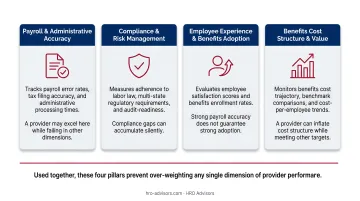
Each pillar captures a distinct dimension of provider performance. Used together, they prevent a common evaluation mistake: over-weighting one area — like cost — while missing red flags in others, like compliance gaps or low employee adoption of benefits.
KPIs for Cost Savings and ROI
HR Cost Reduction Rate
This metric tracks the percentage decrease in total HR-related costs — including internal labor, HR software, benefits administration, and compliance overhead — after outsourcing compared to before.
Before calculating this, define exactly what "total HR cost" includes. Without a consistent definition, pre- and post-outsourcing comparisons become meaningless. Set that definition before you sign.
Benefits Cost per Employee
A strong outsourced HR provider — particularly a PEO — should give you access to group health plans, dental, vision, and retirement benefits at rates smaller companies can't access independently. The gap is substantial in practice.
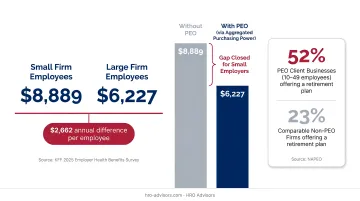
According to the KFF 2025 Employer Health Benefits Survey, workers at small firms (under 200 employees) contribute an average of $8,889 per year toward family coverage — compared to $6,227 at large firms. That's a $2,662 annual difference per employee. A PEO aggregates purchasing power across thousands of employees, closing much of that gap for smaller clients.
NAPEO data also shows that 52% of PEO client businesses with 10–49 employees offer a retirement plan, versus only 23% of comparable non-PEO firms.
Track benefits cost per employee before and after outsourcing. The delta is one of the clearest measures of a PEO's financial value.
Administrative Time Savings
Start by tallying the hours your team previously spent on tasks such as:
- Payroll processing and tax filings
- Benefits enrollment and open enrollment management
- Compliance filings and regulatory reporting
- Onboarding paperwork and new-hire administration
Compare that total to post-outsourcing hours. The difference is reclaimed leadership bandwidth — time that should go toward core business activities, not routine HR administration.
Convert those hours to a dollar value using your internal team's loaded labor cost. That gives your CFO a concrete number to weigh against outsourcing fees.
Return on Investment (ROI)
Calculate ROI as:
Total Benefits (cost savings + time savings + compliance risk avoidance) minus Total Outsourcing Costs
A 2019 NAPEO/McBassi study found an average 27.2% ROI for PEO clients, based on $1,775 in average annual savings per employee against $1,395 in average PEO costs. While that figure is several years old, it provides a useful directional benchmark. Evaluate ROI on a rolling 12-month basis — not just at contract renewal, when it's too late to course-correct.
KPIs for Compliance and Risk Management
Payroll Accuracy Rate
This is the percentage of payroll runs processed without errors — late payments, tax miscalculations, or incorrect deductions. Even small errors create FLSA exposure. The IRS's Failure to Deposit penalty alone starts at 2% for deposits 1–5 days late and reaches 15% after an IRS notice — and the IRS assessed over $117 million in federal tax deposit penalties in FY2025.
No single authoritative US benchmark for PEO payroll accuracy has been publicly verified. Treat 99%+ as a reasonable SLA floor, and require the provider to supply audited performance data to back any accuracy claim. Ask specifically what format that documentation takes — monthly reports, third-party audits, or error logs — before signing.
Compliance Incident Rate
Define this as the number of employment law violations, agency complaints (EEOC, DOL, state labor board), or audit findings within a measurement period. A well-performing HR provider prevents incidents proactively, not just reacts after the damage is done. That means regular policy updates, mandatory training, and continuous regulatory monitoring built into their standard process.
Track this quarterly. A rising incident rate over two or more consecutive periods is a systemic signal, not bad luck.
Onboarding and I-9 Compliance Rate
This metric measures the percentage of new hires whose onboarding paperwork — I-9 forms, tax withholding documents, state-required disclosures — is completed accurately and on time.
2025 DHS penalty adjustments set Form I-9 paperwork violations at $288 to $2,861 per violation. Knowingly employing unauthorized workers can reach $28,619 per violation on a third offense.
Your outsourced HR provider should maintain a near-perfect onboarding compliance rate — and document it. If they can't produce that data on request, treat it as a red flag.
Workers' Compensation Experience Modification Rate (EMR)
If your provider manages your workers' comp program, track your EMR over time. Per NCCI, the EMR is a multiplier applied to your premium:
- Below 1.00 — lowers what you pay
- Above 1.00 — raises it
A provider with strong safety protocols and proactive claims management should move your EMR downward over successive policy periods, which directly reduces your insurance costs. If it's flat or rising, ask why.
KPIs for Service Quality and Employee Experience
Time-to-Resolution for HR Queries
This measures how long it takes to fully resolve employee or manager HR questions — payroll discrepancies, benefits questions, onboarding issues, compliance inquiries. Your SLA should define tiered response times based on urgency:
- Same-day: Payroll errors, termination processing, compliance emergencies
- 24–48 hours: Benefits enrollment questions, manager policy inquiries
- 5 business days: General administrative requests
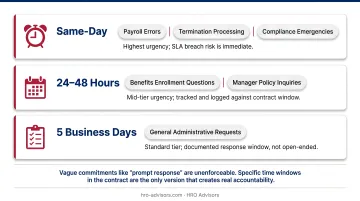
Vague commitments like "prompt response" are unenforceable. Specific time windows in the contract are the only version that creates real accountability.
Employee Satisfaction with HR Services
Survey employees at least semi-annually on the accessibility, responsiveness, and helpfulness of outsourced HR support. Keep surveys short — 5 to 8 questions maximum — and ask about specific touchpoints rather than general impressions:
- How long did it take to get your last HR question answered?
- Did you receive a complete answer on the first contact?
- How easy is it to access your benefits information?
Scores that stay flat or decline over time are meaningful signals. Gallup's research consistently links HR responsiveness to engagement and retention. Responsiveness from HR isn't a soft metric — it has measurable impact on whether employees stay.
Benefits Enrollment and Utilization Rate
High enrollment rates indicate your provider has made benefits accessible and well-communicated. Low utilization rates for health, retirement, or wellness programs suggest employees either don't understand what's available or can't access it effectively.
Both metrics reflect how well your provider executes on the employee-facing side of HR, not just the administrative backend. Processing benefits accurately without communicating them clearly is only half the job.
Watch for these common gaps:
- Low enrollment in wellness or supplemental benefits despite availability
- Employees unaware of retirement match thresholds
- Underutilization of EAP or mental health resources
Employee Turnover Rate
Turnover is a lagging indicator. It reflects the combined effect of HR quality, onboarding, benefits, and culture over time. Track it before and after outsourcing. NAPEO's 2024 white paper, covering data from more than 15,000 client businesses, found that businesses using a PEO have 12% lower employee turnover than comparable non-PEO firms.
High turnover in the period right after a new HR provider engagement may signal poor onboarding, benefits dissatisfaction, or insufficient HR support. Don't explain it away as coincidence. Investigate the connection directly.
How to Set Benchmarks and Review Performance with Your Provider
Establish Baselines Before Outsourcing Begins
Before signing any contract, document your current state:
- Total HR costs by category
- Payroll error frequency over the past 12 months
- Current employee turnover rate
- Employee satisfaction with existing HR support
- Onboarding completion accuracy rate
Without these baselines, you can't measure improvement — or deterioration. Post-outsourcing metrics need a comparison point to mean anything.
Build KPI Targets Directly into the SLA
Performance expectations should be contractually defined with specific, measurable thresholds and clear consequences for missing them. As HRO Today's governance guidance notes, SLAs are essential agreements based on KPIs that outline expected service levels, response times, and accountability.
Replace vague language with specifics:
- ❌ "High-quality payroll processing"
- ✅ "Payroll error rate not to exceed X% per quarter, with same-day correction for identified errors"
Include remedies — fee credits, escalation protocols, or termination triggers — for repeated non-compliance. Without defined remedies, providers face no real accountability for falling short.
Working with a PEO Broker During the Selection Process
Comparing providers against these KPI benchmarks is straightforward in theory — but time-consuming in practice. A PEO broker like HRO Advisors handles that comparison work directly, evaluating up to 8 providers side-by-side across cost, compliance, benefits, and service quality before any contract is signed.
The process starts with establishing your baselines (current HR costs, compliance requirements, benefits needs), moves through a full cost and coverage analysis, then into direct contract negotiation on your behalf. There's no fee to the client — brokers are compensated by the selected provider without increasing what you pay.
Red Flags: What Poor KPI Performance Signals
Not every missed metric is a crisis. But patterns matter. Watch for:
- Declining payroll accuracy across two or more consecutive periods
- Rising compliance incident rates that the provider attributes to "external factors"
- Employee satisfaction scores that don't improve despite repeated feedback
- Repeated SLA response time failures that the provider acknowledges but doesn't correct
These patterns indicate systemic problems — staffing issues, technology gaps, or operational breakdowns — not one-off mistakes. Two or three consecutive underperformance periods warrant a formal written performance review and documented remediation plan. Three or more may justify contract re-evaluation.
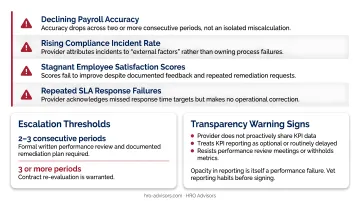
Beyond performance patterns, watch for a subtler warning: a provider that doesn't proactively share KPI data. A trustworthy HR provider welcomes performance review meetings and shares metrics without being chased down. If your provider resists transparency, treats KPI reporting as optional, or consistently delays sharing data, treat that opacity as a serious warning sign. Vetting a provider's reporting habits before signing is just as important as reviewing their service record.
Frequently Asked Questions
What are the key KPIs for evaluating outsourced HR service providers in the USA?
The most important KPIs span all four pillars: HR cost reduction rate, benefits cost per employee, payroll accuracy rate, compliance incident rate, time-to-resolution for HR queries, and employee satisfaction scores. These metrics cover financial value, legal protection, service delivery, and workforce impact.
How do you evaluate outsourced HR service providers in the USA?
Evaluation should start before signing: document your current baselines, define KPI targets in the SLA, and compare multiple providers' track records against those metrics. After onboarding, conduct monthly check-ins on operational metrics and formal quarterly business reviews against all four pillars.
What are the four pillars of effective KPIs for outsourced HR service providers?
The four pillars are Cost Savings and ROI, Compliance and Risk Management, Service Quality and Responsiveness, and Employee Experience. Each pillar targets a distinct accountability area — financial, legal, operational, and workforce — so no dimension goes unmeasured.
How often should you review KPIs with your outsourced HR provider?
Monthly check-ins should cover operational metrics: payroll accuracy, response times, and open issues. Quarterly business reviews assess all four KPI pillars against SLA benchmarks — and should include both your internal HR lead and a senior contact at the provider to keep accountability on both sides.
What is a good payroll accuracy rate for an outsourced HR provider?
No single authoritative public benchmark has been verified for US PEO providers specifically. A target of 99%+ is a reasonable SLA floor — but require the provider to supply audited performance data to support any accuracy claim they make. Build the minimum acceptable threshold into the contract.
Can a PEO broker help me compare HR service providers using KPIs?
Yes. HRO Advisors compares up to 8 providers side-by-side — including cost structure, compliance capabilities, and service quality — at no cost to the client. HRO Advisors is paid by the selected provider, with no markup to the client's pricing.