Introduction
The competition for skilled workers hasn't eased. The BLS JOLTS data for 2024 consistently tracked voluntary quits above 3 million per month, and Gallup found that 51% of U.S. employees were actively watching for or seeking a new job as recently as May 2024. Candidates aren't just comparing salaries anymore — they're scrutinizing benefits packages before they accept an offer.
Most employers understand this in principle. Fewer understand the full financial weight of getting it wrong: slower hiring, higher turnover, reduced productivity, and a weakening employer brand that compounds each problem over time.
What follows covers why employee health benefits function as a measurable business lever, and what specific, trackable advantages employers gain when their benefits strategy actually meets workforce needs.
Key Takeaways
- Health insurance consistently ranks among the top factors candidates evaluate before accepting a job offer.
- Replacing an employee costs between 0.5x and 2x their annual salary — strong benefits directly reduce that risk.
- 44% of employees who felt cared for through benefits reported greater loyalty to their employer (Mercer).
- Poor health costs U.S. employers $575 billion annually in lost productivity and missed work.
- Small and mid-size businesses can access Fortune 500-level health plans through PEO arrangements — competing directly with larger employers on benefits.
What Are Employee Health Benefits?
Employee health benefits are the health-related coverage and support an employer provides as part of total compensation. At minimum, this typically includes medical insurance. Competitive packages extend to dental, vision, mental health resources, and wellness programs.
These benefits don't exist in isolation. They sit alongside salary as one of the primary factors employees weigh when deciding whether to accept — or stay in — a role. According to AHIP's 2022 polling, employer-provided health coverage was important to 87% of employees when accepting a job and 84% when deciding whether to stay.
For most employees, health coverage isn't a nice-to-have — it's a deciding factor, which makes it a direct lever for talent retention.
The Access Problem for Smaller Businesses
Small and mid-size businesses face a structural disadvantage: insurers price plans based on risk and group size, so a 40-person company negotiating independently pays more for less coverage than a corporation with thousands of employees.
PEO arrangements solve this by pooling employees from hundreds of client companies under one umbrella — giving smaller businesses the same group purchasing power as large enterprises. HRO Advisors connects businesses to a network of 500+ PEO providers, including plans through major national carriers, so companies that couldn't previously afford competitive health coverage can access it at rates they couldn't secure on their own.
Three Business Advantages of Strong Employee Health Benefits
The advantages below aren't abstract. Each one maps to KPIs that HR leaders and business owners track and report on directly.
Advantage 1: Attracting Top Talent in a Competitive Labor Market
A strong health benefits package changes the math on hiring. Candidates evaluate total compensation, not just base salary, and a competitive health plan regularly offsets a slightly lower salary figure in the candidate's mind.
Glassdoor data shows that 63% of U.S. workers and job seekers cite benefits as a top factor when evaluating job ads — just behind salary at 67%. Roughly 60% say they strongly consider perks and benefits before accepting an offer. In industries like technology, life sciences, and financial services (sectors where HRO Advisors works regularly), health benefits can be the decisive factor when two salary offers are comparable.
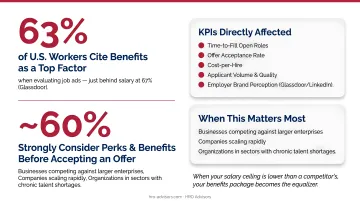
KPIs directly affected:
- Time-to-fill open roles
- Offer acceptance rate
- Cost-per-hire
- Applicant volume and quality
- Employer brand perception (Glassdoor/LinkedIn ratings)
When this matters most: Businesses competing against larger enterprises, companies scaling rapidly, and organizations in sectors with chronic talent shortages. When your salary ceiling is lower than a competitor's, your benefits package becomes the equalizer.
Advantage 2: Reducing Voluntary Turnover and Its True Costs
Turnover is expensive in ways most companies underestimate. Gallup estimates that replacing an employee costs between 0.5x and 2x their annual salary — higher for managers and specialists once you factor in recruiting, onboarding, lost institutional knowledge, and reduced team output during the gap.
Gallup also estimates U.S. voluntary turnover costs businesses $1 trillion annually and 42% of that turnover is preventable.
Health benefits are one of the clearest retention levers available. Mercer's Health on Demand research found that 44% of employees who felt cared for through benefits reported greater loyalty to their employer, compared to just 19% among those receiving poor benefits support. Employees with access to 10 or more benefits were 59% less likely to leave.
When employees leave, the workload falls on those who stay. That pressure drives disengagement, which drives further attrition. A weak benefits package doesn't just cost you the departing employee — it erodes your remaining team.
KPIs directly affected:
- Voluntary turnover rate
- Average employee tenure
- Cost-per-replacement
- HR time spent on offboarding and onboarding
- Team productivity during open role periods
When this matters most: High-burnout industries (healthcare, retail, hospitality, manufacturing), businesses with specialized talent that's difficult to replace, and SMBs where a single departure disproportionately disrupts operations.
Advantage 3: Driving Productivity and Day-to-Day Engagement
Health benefits don't just affect hiring and retention decisions. They shape how present and focused employees are every day they're at work.
The Institute for Health and Productivity Management estimates that poor health costs U.S. employers $575 billion annually and 1.5 billion days of lost productivity. For every $1 spent on health care benefits, another $0.61 is lost to illness and injury-related productivity impact.
JHU-linked research found that presenteeism — reduced output while physically at work — represents between 18% and 60% of total costs for certain conditions, often exceeding direct medical costs.
Mental health stands out. APA's 2024 Work in America Survey found that 91% of workers with employer mental health support reported job satisfaction, compared to 76% without it. The gap shows up directly in engagement scores, absenteeism rates, and output per employee.
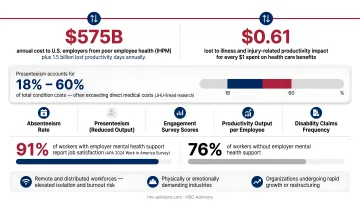
KPIs directly affected:
- Absenteeism rate
- Presenteeism (reduced productivity while present)
- Engagement survey scores
- Productivity output per employee
- Disability claims frequency
When this matters most: Remote and distributed workforces where isolation and burnout risk are elevated, industries with physically or emotionally demanding roles, and organizations that have recently undergone rapid growth or restructuring.
What Happens When Health Benefits Are Inadequate
There's a specific failure mode worth naming: many employers believe they're covered because they technically offer something. The problem is that "something" often doesn't match what employees actually need.
McKinsey's national employer and employee surveys found that 65% of employers said behavioral health was well or very well supported by their organization. Only 51% of employees agreed. That 14-point gap is where disengagement, attrition, and productivity loss steadily build.
The consequences compound across every part of the business:
- Hiring: Slower time-to-fill, higher offer rejection rates, smaller qualified applicant pools
- Retention: Higher voluntary attrition, especially among high performers with options
- Productivity: Disengaged employees, higher absenteeism, growing presenteeism costs (showing up but underperforming)
- Employer brand: Each bad exit makes the next hire harder and more expensive
The damage rarely shows up in a single quarter's numbers. Over time, though, the pattern becomes self-reinforcing: weaker benefits shrink the applicant pool, which drags down performance, which leaves less budget to improve benefits.
How to Get More Value From Your Health Benefits Strategy
Getting benefits right isn't about spending more — it's about spending strategically.
Three principles that separate effective benefits strategies from generic ones:
Benchmark against the market. SHRM, KFF, and Mercer publish annual employer health benefits surveys that let you compare your offering against industry norms. If you haven't benchmarked in two or more years, your competitors have probably moved ahead.
Find out what your workforce actually uses. Benefits employees don't access — or don't know how to access — deliver little to no retention value. Periodic surveys identifying gaps between what you offer and what employees experience are among the cheapest, highest-return HR investments.
Communicate clearly. Many companies have better benefits than employees realize, simply because the communication around enrollment and usage is weak. Clear, regular benefits communication is its own retention tool.
How PEO Access Changes the Equation for SMBs
For small and mid-size businesses, the challenge isn't always willingness — it's access. A 30-person company doesn't have the purchasing power to negotiate competitive group rates independently.
HRO Advisors' PEO brokerage model addresses this directly. By connecting businesses with PEO providers — who pool employees across hundreds of client companies — smaller businesses gain access to group health plans through major carriers at rates typically unavailable to them independently.
NAPEO data shows that 63% of new PEO clients reported lower health benefit costs after transitioning — with average savings of $654 per employee annually.
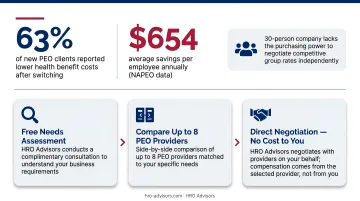
The process is straightforward: HRO Advisors conducts a free needs assessment, compares up to 8 PEO providers side-by-side, and negotiates directly with providers on the client's behalf. There's no cost to the business — HRO Advisors is compensated by the selected provider, so no advisory fee is layered on top.
Conclusion
Employee health benefits affect every stage of the talent lifecycle — from the first time a candidate reads your job posting to the decision a high performer makes five years in about whether to take a recruiter's call.
The advantages are measurable: faster hiring, lower turnover, higher daily engagement. Inadequate benefits carry their own price tag — perception gaps, preventable attrition, and productivity losses that accumulate steadily over time.
The most effective approach combines regular benchmarking, genuine attention to what your specific workforce values, and — for smaller businesses — access mechanisms like PEO arrangements that close the gap against competitors with larger HR budgets. Working with a PEO broker to compare providers side-by-side can surface plan options and pricing that most small employers wouldn't find on their own. Benefits strategy isn't a one-time decision; workforce expectations shift, and the companies that revisit their offerings regularly are the ones that stay competitive.
Frequently Asked Questions
What health benefits do employees value most?
Health insurance ranks highest, followed by mental health support, dental and vision coverage, and retirement contributions. The specific mix matters — a one-size-fits-all plan often fails to satisfy a workforce with diverse demographics and needs, reducing its actual retention value even when the coverage looks adequate on paper.
How much does high employee turnover actually cost a business?
Gallup estimates replacing an employee costs between 0.5x and 2x their annual salary, with the high end applying to managers and specialized roles. When you factor in recruiting, onboarding, lost productivity, and institutional knowledge loss, retention delivers some of the strongest returns on investment a company can make — often outpacing other operational spending.
Can small businesses realistically offer competitive health benefits?
Yes. Through PEO arrangements, small and mid-size businesses gain access to group health plans typically reserved for large corporations. PEOs pool employees across many client companies, giving smaller businesses the purchasing power they can't achieve independently — and NAPEO data shows 63% of new PEO clients see lower health benefit costs after the transition.
How do health benefits affect employee mental health and productivity?
APA's 2024 research found that 91% of workers with employer mental health support reported job satisfaction, versus 76% without it. Separately, IBI estimates poor health costs U.S. employers $575 billion annually in lost productivity — making access to mental health and preventive care a direct operational issue, not just a wellness initiative.
How often should a company review and update its benefits package?
Annual reviews tied to renewal cycles are the practical minimum. Supplement those with periodic employee surveys to identify gaps between what you offer and what employees actually experience. Letting benefits stagnate as workforce demographics shift gives competitors a meaningful advantage in recruiting and retention.
What is a PEO and how does it help with employee health benefits?
A Professional Employer Organization co-employs your workforce and pools employees across hundreds of client companies to negotiate group health insurance rates and plan options that smaller businesses can't access independently. HRO Advisors acts as a PEO broker — comparing up to 8 providers side-by-side and negotiating on your behalf, free of charge to your business.