
Introduction
Picking the wrong PEO doesn't just waste time — it can expose your business to tax penalties, compliance failures, and employee benefit gaps that take years to unwind. Yet most businesses approach the selection process reactively: a payroll problem flares up, HR gets overwhelmed, and someone starts Googling PEO options without a clear framework for evaluating what they find.
The PEO market includes more than 500 providers generating $414 billion in industry revenue, with significant variation in service depth, pricing models, and industry specialization. For small to mid-sized businesses without dedicated HR teams, navigating that variation without a structured approach is how costly mismatches happen.
This guide breaks down the five-stage PEO selection process, the key evaluation criteria that matter most, and how HR leaders and operations decision-makers can confidently identify the right provider for their specific needs in 2026.
Key Takeaways
- A PEO enters a co-employment arrangement with your business, handling payroll, benefits, compliance, and HR administration
- The selection process covers five stages: needs assessment, shortlisting, proposal review, finalist interviews, and contract negotiation
- ESAC accreditation and IRS CPEO status are the two baseline quality benchmarks — prioritize both
- A PEO broker like HRO Advisors provides side-by-side comparisons across multiple providers, free of charge
- Reassess PEO fit as your business scales — what works at 25 employees often won't at 200
What Is a PEO?
A Professional Employer Organization (PEO) enters into a co-employment arrangement with a business, taking on shared employer responsibilities for payroll, HR administration, benefits, and compliance.
Under this model, the PEO becomes the employer of record for tax and benefits purposes. Your employees are technically co-employed — the PEO handles the administrative employer functions while you retain full control over hiring decisions, day-to-day operations, and business direction.
Core Services PEOs Provide
Payroll and Tax Administration: PEOs process payroll, file employer taxes, and manage wage compliance across federal and state jurisdictions. IRS failure-to-deposit penalties range from 2% to 15% depending on how late the deposit is — a risk that transfers to the PEO once you're in a co-employment relationship.
Employee Benefits Management: PEOs pool employees from multiple client companies to access large-group health insurance plans. Only 61% of firms with 10 or more workers offered health benefits in 2025, meaning PEOs give smaller businesses access to coverage tiers they couldn't negotiate independently.
HR Compliance and Risk Management: The DOL administers more than 180 federal labor laws. PEOs monitor regulatory changes, manage workers' compensation, and handle employee relations issues — reducing your legal liability exposure without requiring a full in-house compliance team.
Why Businesses Use PEOs
NAPEO's 2024 research found that PEO clients consistently outperform non-client companies across key business metrics:
- 12% lower employee turnover compared to similar non-PEO businesses
- 4.3% employment growth year-over-year
- 50% less likely to go out of business than comparable non-clients
- $1,775 saved per employee per year on average, per NAPEO's ROI research
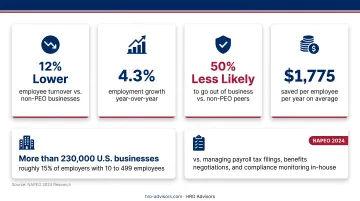
More than 230,000 U.S. businesses (roughly 15% of employers with 10 to 499 employees) currently use a PEO. Those numbers make sense when the alternative is managing payroll tax filings, benefits negotiations, and compliance monitoring in-house — all while trying to run a company.
The Step-by-Step PEO Selection Process
With 500+ providers in the market, the variance in service quality, pricing, and industry expertise is enormous. A structured approach prevents you from signing a multi-year contract with a provider that looked good on paper but doesn't fit how your business actually operates.
Step 1: Assess Your HR Needs and Pain Points
Start with an internal audit. Before evaluating any provider, you need a clear picture of where your current HR operations are breaking down and what you actually need fixed.
Your audit should cover:
- Pain points: payroll errors, benefits gaps, compliance concerns, administrative overload
- Must-haves vs. nice-to-haves: separate critical service needs from features that would be convenient
- Headcount and growth projections: a business adding 50 employees in 18 months has different PEO requirements than one with a stable 30-person team
- Geographic footprint: multi-state employers face layered compliance requirements that narrow the viable provider pool
- Employee demographics: workforce age, health utilization patterns, and benefits preferences all influence which plans make sense
This groundwork determines which PEO features matter most for your situation — and prevents you from being sold capabilities you don't need.
Step 2: Shortlist Qualified PEO Providers
With your needs defined, build an initial shortlist using these filters:
- Accreditation status: prioritize ESAC-accredited and IRS CPEO-certified providers (more on why in the next section)
- Industry specialization: a PEO with healthcare or construction experience will understand sector-specific compliance requirements that generalist providers miss
- State availability: confirm the PEO operates in every state where you have employees
- Budget range: establish a realistic range before entering conversations
This research phase is where most businesses lose time. HRO Advisors, a no-cost PEO broker based in Dallas, compresses this stage to roughly two weeks — their team accesses a network of 500+ providers and delivers a curated shortlist at no cost to the client.
Step 3: Request and Compare Proposals
A thorough PEO proposal should include:
- Itemized fee structure (all-in, not just the headline rate)
- Services included vs. available as add-ons
- HR technology platform details: HRIS, employee self-service portal, time tracking
- Benefits carrier options and plan tiers
The critical discipline here is standardization. Comparing proposals across different formats leads to apples-to-oranges conclusions. Use the same evaluation criteria for every provider, and if possible, use a side-by-side comparison tool to keep the analysis objective.
Step 4: Interview Finalists and Check References
Proposals outline what a PEO offers. The interview stage is where you test whether they can actually deliver. Ask finalists:
- Will you have a dedicated account manager or route to a call center?
- What is your average client size, and how does that compare to ours?
- What is your client retention rate?
- How are compliance updates communicated to clients — proactively or reactively?
- What does onboarding look like, and what's the typical timeline?
Then check references — specifically with clients in a similar industry or at a similar headcount. Service quality and responsiveness don't show up in proposals. Current clients will tell you what you actually need to know.
Step 5: Negotiate the Contract and Finalize Onboarding
Before signing, review these contract elements carefully:
- Termination clauses: notice periods, penalties, and exit conditions
- Liability allocation: who is responsible if a tax penalty or compliance failure occurs
- Service level agreements: response times, dedicated support commitments
- Fee escalation terms: how and when pricing can change after year one
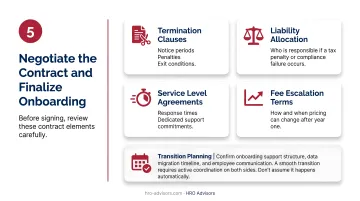
Transition planning is part of this stage too. Confirm the PEO's onboarding support structure, data migration timeline, and how they communicate the change to your employees. A smooth transition requires active coordination on both sides. Don't assume it happens automatically.
Key Factors to Evaluate When Choosing a PEO
No two PEOs are identical. The right fit depends on your industry, workforce size, geographic complexity, and where you are in your growth trajectory. These factors connect those variables to outcomes that matter.
Accreditation and Certifications
Two third-party benchmarks separate credible providers from the rest:
ESAC Accreditation: The Employer Services Assurance Corporation verifies financial stability, ethical business conduct, operational standards, and payment of wages, taxes, insurance premiums, and retirement contributions. Accredited PEOs must comply with more than 40 financial, ethical, and operational standards and submit to annual independent CPA audits. ESAC-accredited PEOs are backed by over $15 million in bonding.
IRS CPEO Certification: Under IRC Section 3511, a CPEO is treated as the sole employer of record for worksite employees — meaning the CPEO is solely liable for filing and depositing employment taxes on remuneration it pays. This provides clear liability protection for clients and eliminates the wage-base restart issue when switching providers mid-year.
Both credentials are verifiable online — ESAC through their accreditation lookup tool, and IRS CPEO status through the IRS public listings page.
Service Scope and HR Technology Platform
PEOs vary widely in their tech stack. Some offer a fully integrated HRIS with employee self-service, applicant tracking, time and attendance, and performance management. Others deliver basic payroll processing with minimal platform functionality.
Tech gaps create friction for your HR team and for employees trying to access pay stubs or benefits information. Before committing, confirm what's included in the base fee and what costs extra. At minimum, evaluate whether the platform covers:
- Employee self-service portal for pay stubs, benefits enrollment, and document access
- Time and attendance tracking with payroll integration
- Applicant tracking or onboarding workflows
- Reporting and analytics accessible without IT support
- API integrations with tools you already use (accounting software, scheduling systems)
Benefits Package Quality and Carrier Access
The depth of the benefits offering directly affects your ability to attract and retain employees — especially if you're competing against larger employers for talent. For businesses with 10 to 49 employees, NAPEO data shows that 52% of PEO users have a retirement plan versus only 23% of comparable non-PEO companies.
When evaluating benefits, look for:
- Name-brand health insurance carriers with nationwide network coverage
- Multiple plan tiers (not just one high-deductible option)
- 401(k) plans with low administrative fees
- Dental, vision, EAP, and voluntary benefits
- Consistent plan availability across all states where you operate
Compliance and Risk Management Expertise
Multi-state employers face layered requirements — wage and hour laws vary by state, FMLA thresholds differ, ACA reporting has its own deadlines, and OSHA standards shift by industry. The EEOC reported 88,531 discrimination charges in FY2024 with over $611 million in monetary relief — compliance failures carry real financial consequences.
The question to ask each finalist: do they proactively notify clients of regulatory changes, or do they wait for clients to ask? The difference between reactive and proactive compliance support can determine whether a new labor law catches you off guard.
Industry Experience and Scalability
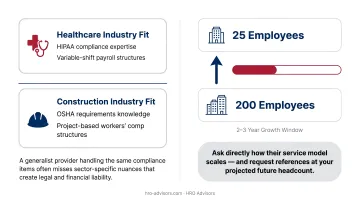
A PEO with healthcare experience understands HIPAA compliance and variable-shift payroll. One with construction expertise knows OSHA requirements and project-based workers' comp structures. A generalist provider handling the same compliance items often misses sector-specific nuances that create legal and financial liability.
Industry fit and growth capacity are connected. A PEO built for small businesses may not have the infrastructure, pricing model, or service capacity to support a company growing from 25 to 200 employees over two to three years. Ask directly how their service model scales — and request references at your projected future headcount.
Pricing Transparency and Total Cost of Ownership
PEOs use two primary pricing structures:
| Model | How It Works | Best For |
|---|---|---|
| Percentage of payroll | Fee calculated as % of gross payroll | Higher-wage workforces with smaller headcounts |
| Per-employee-per-month (PEPM) | Flat fee per employee regardless of salary | Lower-wage workforces with larger headcounts |
Secondary sources cite ranges of approximately $40–$200 PEPM or 2–12% of payroll, but actual pricing varies significantly by provider and service scope. Total cost of ownership requires looking beyond the headline rate.
Watch for these hidden cost risks before signing:
- Setup and onboarding fees
- Technology access fees charged separately from the service fee
- Year-end tax reconciliation fees
- Early termination penalties
- Out-of-scope charges for services you assumed were included
Always require a fully itemized fee schedule before signing. That's the only way to know the real cost before you're locked in.
How HRO Advisors Can Help You Find the Right PEO
HRO Advisors is a no-cost PEO broker that removes the complexity from the selection process. Their team collects your business data during a free consultation, identifies compatible providers from a network of 500+, and delivers side-by-side comparisons of up to 8 PEOs — all within approximately two weeks.
The service costs clients nothing. HRO Advisors is compensated by the provider you select, and their goal is straightforward: lower your total costs through direct negotiation, not add to them.
That cost-neutral model is paired with capabilities most SMBs can't access on their own:
- Free comparison of up to 8 PEO, ASO, payroll, and benefits providers — no obligation
- Enterprise-level benefits and Fortune 500 health plans typically out of reach for smaller businesses
- Up to 40% savings on HR costs through direct provider negotiation
- Industry-specific matching across 13 verticals, from healthcare to construction
- One-on-one advisory support from former industry insiders, through implementation
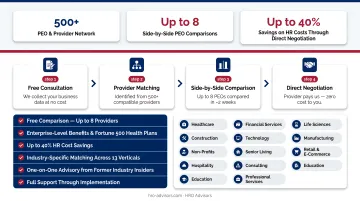
For businesses in sectors where generic PEOs routinely fall short — healthcare, financial services, life sciences, construction — getting matched to a provider with real experience in your regulatory environment can mean the difference between a PEO that fits and one that creates new compliance headaches.
Conclusion
The right PEO isn't the largest brand or the most frequently advertised — it's the one that aligns with your industry's compliance requirements, your workforce's benefits expectations, and your company's growth trajectory over the next three to five years.
Selecting a PEO is the beginning of a partnership, not a one-time procurement decision. Cost-efficiency, service quality, and compliance performance should be reviewed annually. As businesses grow, the provider that fit well at launch may not have the infrastructure or pricing model to scale with you.
Build in that re-evaluation habit from day one — so you're making proactive decisions rather than managing avoidable disruptions.
If you're still weighing your options, HRO Advisors offers a free, no-obligation consultation that compares up to eight PEO providers side-by-side. There's no cost to you, and it takes the guesswork out of one of the more consequential HR decisions your business will make.
Frequently Asked Questions
What are the steps and qualifications for the PEO selection process?
The process involves five stages: needs assessment, shortlisting, proposal comparison, finalist interviews, and contract review. As a baseline qualification standard, look for PEOs with ESAC accreditation or IRS CPEO certification — both are verifiable through public online tools.
What is the difference between a PEO and a PO?
A PEO (Professional Employer Organization) enters a co-employment relationship and takes on shared employer responsibilities for payroll, benefits, and compliance. A PO (Purchase Order) is an unrelated procurement document — the two are completely unrelated. If you're comparing HR models, the relevant alternatives to a PEO are staffing agencies or employer of record (EOR) services.
How long does the PEO selection process typically take?
A thorough process — from initial needs assessment to contract signing — typically takes four to eight weeks. Working with a PEO broker compresses the research and comparison phases significantly; HRO Advisors delivers side-by-side comparisons within approximately two weeks of the initial consultation.
What certifications should I look for when choosing a PEO?
The two most important credentials are ESAC accreditation and IRS CPEO certification. ESAC verifies financial stability and ethical standards across more than 40 operational benchmarks; CPEO status provides specific tax liability protections and filing assurances for your business.
How much does a PEO typically cost?
PEOs typically charge either 2–12% of gross payroll or a flat per-employee-per-month fee ranging from $40–$200, depending on service scope. That cost must be weighed against real savings: NAPEO research estimates businesses save roughly $1,775 per employee per year through reduced benefits costs, lower HR headcount needs, and avoided compliance penalties.