Introduction
School administrators manage one of the most complex workforces in any industry. A single institution might employ salaried teachers on 10-month contracts, hourly substitutes, part-time coaches, contracted specialists, and grant-funded staff — each with different pay rates, tax classifications, and benefit eligibilities.
Layered on top of that: union contracts, state certification requirements, FLSA overtime rules, ACA reporting, and FMLA tracking. Miss any one of these, and the consequences range from payroll corrections to state funding penalties.
HR and payroll systems exist to handle exactly this complexity. This article covers what those systems actually fix in a school environment, the specific advantages they deliver, and what schools risk by operating without them.
Key Takeaways
- School payrolls are among the most complex to process manually — errors average $291 each and a 1,000-employee organization spends roughly 29 workweeks annually fixing them
- Compliance failures carry real financial consequences: one Illinois school district paid $111,516 in back wages and penalties for overtime violations alone
- Centralized HR systems reduce the data fragmentation that slows hiring and makes performance tracking inconsistent
- Manual HR processes compound costs: time lost to data re-entry and compliance reports comes directly at the expense of students and staff
- Schools can access full HR and payroll infrastructure through a PEO partnership, often at lower cost than licensing standalone software
What Are HR and Payroll Systems for Schools?
HR and payroll systems for schools are integrated platforms that manage the full employment lifecycle within a single system. Core functions typically include:
- Recruitment and onboarding workflows
- Payroll processing and tax compliance
- Attendance and leave tracking
- Benefits administration
- Compliance monitoring
- Performance management
They apply across K-12 public and private schools, charter schools, independent learning centers, and multi-campus districts. Anywhere a school manages a diverse workforce with varying pay structures, schedules, and compliance obligations, these systems replace the combination of spreadsheets, paper files, and disconnected tools that most institutions start with.
The National Center for Education Statistics (NCES) defines staff records as spanning salary, benefits, and banking data through licensure, certification, and evaluation history — all active in daily workforce management from hire to separation. An integrated HR and payroll system consolidates that entire scope, cutting manual data entry and reducing the compliance gaps that disconnected tools tend to leave behind.
Key Advantages of HR and Payroll Systems for Schools
Advantage 1: Automated Payroll for a Complex, Multi-Type Workforce
School payrolls don't fit a simple template. A single institution may simultaneously process:
- Salaried teachers on 10-month contracts
- Hourly substitutes whose hours vary weekly
- Part-time coaches paid by season
- Contracted specialists with different tax classifications
- Grant-funded staff with separate deduction rules
Managing that manually — cross-referencing spreadsheets, calculating deductions, applying the right tax treatment — is where errors happen. And they happen often. According to EY's 2022 HR Processing Risk and Cost Survey, one in five payrolls contains errors, with each error costing an average of $291 and a 1,000-employee organization spending 29 workweeks annually on corrections.
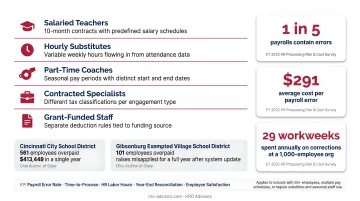
The K-12 record is consistent with that. The Ohio Auditor of State found that Cincinnati City School District overpaid 561 employees by $413,449 in a single year. A separate audit found Gibsonburg Exempted Village School District overpaid 101 employees after a payroll system update misapplied raises for a full year instead of one semester.
Automated payroll processing eliminates the manual cross-referencing that produces these errors. Salary calculations run off predefined contract terms, hours flow in from attendance data, and deductions apply automatically — including for substitute teachers whose hours change week to week.
KPIs this affects:
- Payroll error rate
- Time-to-process per pay cycle
- HR labor hours per cycle
- Year-end reconciliation time
- Employee satisfaction
When it matters most: Schools with 50+ employees, multiple pay schedules running simultaneously, or regular use of substitutes and seasonal staff.
Advantage 2: Compliance Across Multiple Regulatory Frameworks
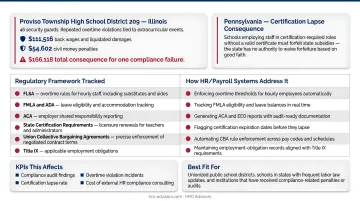
Schools operate under a uniquely dense compliance environment. At any given time, a single institution must track:
- FLSA — overtime rules for hourly staff, including substitutes and aides
- FMLA and ADA — leave eligibility and accommodation tracking
- ACA — employer shared responsibility reporting
- State certification requirements — licensure renewals for teachers and administrators
- Union collective bargaining agreements — precise enforcement of negotiated contract terms
- Title IX — applicable employment obligations
Any single gap in this creates financial and legal exposure. Proviso Township High School District 209 in Illinois agreed to pay $111,516 in back wages and liquidated damages to 46 security guards for repeated overtime violations related to extracurricular events — plus $54,602 in civil money penalties. That's a $166,000 consequence for one compliance failure.
Overtime violations aren't the only exposure. Pennsylvania's consequences for certification lapses are equally direct: schools employing someone in a certification-required role without a valid certificate must forfeit state subsidies, and the state has no authority to waive the forfeiture based on good faith.
HR and payroll systems address this by automating the tracking that prevents these failures:
- Flagging certification expiration dates before they lapse
- Enforcing overtime thresholds for hourly employees automatically
- Generating ACA and EEO reports with audit-ready documentation
- Tracking FMLA eligibility and leave balances in real time
KPIs this affects:
- Compliance audit findings
- Certification lapse rate
- Overtime violation incidents
- Cost of external HR compliance consulting
Best fit for: Unionized public school districts, schools in states with frequent labor law updates, and institutions that have received compliance-related penalties or audits.
Advantage 3: Centralized Workforce Management From Hiring Through Performance
Beyond payroll, schools need to manage the entire employee lifecycle — hiring, onboarding, professional development, performance reviews, and separations. Most institutions spread these processes across disconnected tools or handle them manually.
The result: duplicated data, delayed onboarding, missed review cycles, and no clear picture of workforce health.
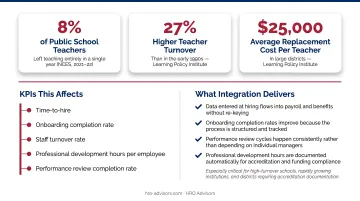
According to NCES data based on 2021-22 follow-up surveys, 8% of public school teachers left teaching entirely in a single year, with private school attrition at 12%. The Learning Policy Institute reports that teacher turnover is approximately 27% higher than in the early 1990s, with replacement costs averaging $25,000 per teacher in large districts.
Integrated HR systems reduce that attrition risk. When hiring, onboarding, professional development, and performance management run through a single platform:
- Data entered at hiring flows into payroll and benefits without re-keying
- Onboarding completion rates improve because the process is structured and tracked
- Performance review cycles happen consistently rather than depending on individual managers
- Professional development hours are documented automatically for accreditation and funding compliance
KPIs this affects:
- Time-to-hire
- Onboarding completion rate
- Staff turnover rate
- Professional development hours per employee
- Performance review completion rate
When it matters most: Schools experiencing high teacher turnover, growing institutions adding staff rapidly, and districts that must document professional development for accreditation or state funding purposes.
What Happens When HR and Payroll Systems Are Missing
Schools that rely on manual processes or disconnected tools face a predictable set of problems — and they compound over time.
Payroll errors become recurring. Without automated calculation, substitutes' hours get miscalculated, deductions get missed, and tax withholdings end up wrong. Each error requires investigation, correction, and follow-up communication — and repeated errors erode staff trust in ways that take much longer to repair than the original mistake.
Compliance gaps go undetected until they're violations. No one manually monitors every certification expiration date, overtime threshold, and FMLA eligibility window simultaneously. Things get missed. By the time they surface, they're already penalties.
Without structured applicant tracking and onboarding workflows, schools simply can't move fast enough to compete for available candidates. NCES data shows that 74% of public schools reported difficulty filling at least one teaching vacancy with a fully certified teacher entering 2024-25 — with lack of qualified candidates (64%) and too few applicants (62%) already topping the list. Slow hiring processes make a tight market worse.
The scaling problem compounds all of this. A school managing 30 employees manually can function — poorly, but it functions. Scaling to 80 employees with the same processes doesn't create proportionally more work; it multiplies it. Manual HR infrastructure wasn't designed to grow, and at a certain point, it stops keeping up entirely.
How Schools Get the Most Value from HR and Payroll Systems
The technology alone doesn't deliver outcomes. Implementation decisions and ongoing management determine whether a system reduces administrative burden or simply adds another tool to maintain.
Three practices separate schools that get real results from those that don't:
- Map your pain points first. Identify the specific failures — payroll error rate, missed certification renewals, slow onboarding — and configure the system around those priorities. Activating every feature at once diffuses focus and delays time-to-value.
- Keep the system current. Update staff records when contracts change, act on compliance alerts, and audit payroll configurations when regulations shift. A system that's configured once and then ignored returns a fraction of its potential.
- Evaluate a PEO if in-house HR capacity is thin. Many schools — particularly small-to-mid-sized institutions without dedicated HR staff — access the full infrastructure most cost-effectively through a Professional Employer Organization. A PEO bundles payroll processing, compliance support, and benefits administration under a single co-employment arrangement, typically at a lower cost than licensing standalone software and staffing it internally.
HRO Advisors works with schools and education organizations to identify and compare PEO providers. Their process starts with a free consultation, collects data on workforce structure and compliance needs, and produces a side-by-side comparison of up to eight providers drawn from a network of 500+.
The comparison is typically completed in under two weeks. HRO Advisors is compensated by the provider the school selects, so there's no cost to the school — and their negotiation process is designed to lower total HR costs, not add to them.
For schools that want to retain direct employer status rather than enter a co-employment arrangement, an ASO (Administrative Services Organization) delivers the same functional components — payroll, compliance, benefits — without shared employer responsibilities.
Conclusion
The real operational value of HR and payroll systems for schools shows up in day-to-day outcomes that compound over time:
- Payroll errors stop recurring
- Certification lapses get caught before they trigger penalties
- Hiring cycles move faster with less administrative back-and-forth
- Performance data becomes consistent across departments, not manager-dependent
These advantages compound as schools grow. A school managing 40 staff manually today will face a fundamentally different operational problem at 100 staff — and the HR infrastructure that supports that growth needs to be in place before the complexity arrives, not after.
Treat these systems as ongoing infrastructure. Their impact depends on consistent use, regular auditing, and willingness to act on the data they surface.
Frequently Asked Questions
What are the core features of an HR and payroll system for schools?
The primary modules include employee data management, automated payroll processing, attendance and leave tracking, compliance monitoring, benefits administration, and recruitment and onboarding tools. The best systems integrate all of these in a single platform so data entered at hiring flows through to payroll, benefits, and performance without manual re-entry.
Are HR and payroll systems suitable for small private schools?
Yes — many systems and PEO arrangements are designed to scale down to smaller institutions. Smaller schools often benefit most because they lack dedicated HR staff, making automation a multiplier on limited administrative capacity rather than a supplement to an existing team.
How do these systems help schools manage substitute teachers and part-time staff?
These systems handle variable-hour employees by tracking actual hours worked against predefined pay rates, automating overtime calculations, and applying the correct benefit eligibility rules for each employment type — eliminating the complexity of running a mixed workforce through a single payroll process.
How do HR and payroll systems keep schools compliant with labor laws?
Through automated compliance alerts for certification expirations, real-time leave eligibility tracking, overtime threshold monitoring, and audit-ready documentation. This reduces the manual burden of staying current with federal, state, and union requirements — and catches issues before they become violations.
What is the difference between an HRMS and a PEO for schools?
An HRMS is software a school licenses and manages internally — it gives you tools to administer HR functions yourself. A PEO is a co-employment arrangement where a third party handles payroll, benefits, and compliance on the school's behalf, typically including HR technology as part of the service.
How long does it typically take to implement an HR and payroll system in a school?
Cloud-based platforms can be configured in a few weeks; fully integrated systems across a larger district may take several months. Phased rollouts that start with payroll and compliance tracking get schools up and running fastest, with additional modules layered in afterward.