For HR outsourcing specifically, that gap matters. Payroll errors trigger IRS penalties. Missed compliance deadlines create employer liability. Benefits enrollment failures land on employees — and ultimately on you. The IRS is clear that even when you outsource payroll duties to a third party, you generally remain responsible for the withheld taxes and employment tax obligations.
That's why Service Level Agreements (SLAs) aren't a formality to review after the deal closes. They're the most reliable evaluation tool you have before you commit — a direct window into how a vendor operates, what they're willing to commit to in writing, and what happens when they fall short.
This article breaks down exactly what to look for.
Key Takeaways
- An SLA defines what an HR outsourcing vendor is contractually required to deliver — and at what measurable standard
- Vague SLA language is a red flag; vendors unwilling to commit to specific KPIs rarely perform consistently
- Strong SLAs cover six criteria: scope, payroll accuracy, compliance guarantees, response times, reporting, and penalty clauses
- SLAs are negotiable documents — push back on vague language before signing
- Working with a PEO broker lets you compare multiple vendors' SLAs side by side — before committing to any one provider
What Is an SLA in HR Outsourcing?
An SLA (Service Level Agreement) in HR outsourcing is a formal document that specifies expected performance levels, deliverables, responsibilities of both parties, and remedies for non-performance. It's the contract layer that turns promised service quality into an enforceable standard.
SLAs vs. KPIs — Not the Same Thing
The distinction matters practically. According to HRO Today, KPIs are the metrics used to measure performance — things like payroll processing accuracy, system uptime, and first-time resolution rate. SLAs are the contractual thresholds those KPIs must hit, with defined consequences if they don't.
A vendor can track KPIs without an SLA. That's just internal reporting. An SLA turns those metrics into enforceable commitments.
Why HR Outsourcing SLAs Carry More Weight
In most vendor relationships, a service failure is an inconvenience. In HR outsourcing, it's a liability. Common exposure points include:
- Payroll tax deposit errors — IRS penalties start at 2% for deposits 1–5 days late, climbing to 15% for amounts unpaid after IRS demand
- ACA reporting failures — per-return penalties of $340 or more
- Benefits administration errors — ERISA violations that fall on the plan sponsor, not the administrator
In each case, the employer absorbs the cost unless the SLA explicitly assigns liability to the vendor.
That's the core problem with weak SLAs: they let vendors define success on their own terms while you carry the regulatory risk.
Key SLA Criteria for Evaluating HR Outsourcing Vendors
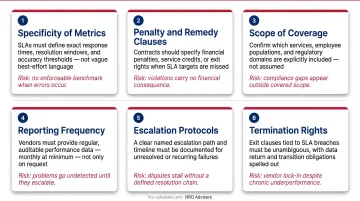
SLAs vary enormously in quality. Some are rigorous and enforceable. Others are vague enough to be useless when something goes wrong. These six criteria help you tell the difference, and each connects directly to measurable business risk.
Service Scope and Specificity
The SLA must clearly define which HR functions are covered. Payroll processing, benefits administration, compliance filings, onboarding support — each should have its own defined deliverables, including frequency, format, and the party responsible.
Vague scope language is one of the most common sources of outsourcing disputes. "We handle HR" is not a service commitment. "We process payroll by [date] each cycle, file federal and state tax deposits within [X] business days, and administer open enrollment within [X] weeks" is.
What to look for:
- Named HR functions with explicit coverage definitions
- Deliverable format and frequency per service area
- Clear separation of client responsibilities versus vendor responsibilities
- Exclusions listed explicitly, not buried in footnotes
Payroll Accuracy and Processing Timeliness
A general commitment to "accurate payroll" means nothing enforceable. The SLA needs a specific accuracy standard — something like a target error rate per pay cycle — so there's an objective threshold against which performance can be measured.
The federal Department of the Interior's HR shared-services SLA targets 99.8% payroll accuracy and 99.9% timely payroll disbursements. It's a federal internal benchmark, not a universal private-sector standard, but it gives you a reference point for what a serious payroll commitment looks like.
KPIs to look for in this section:
- Payroll error rate per cycle
- First-time approval rate
- Number of off-cycle corrections per period
- Submission-to-processing turnaround time
Vendors who resist putting these numbers in writing are telling you something important about their confidence in their own operations.
Compliance and Regulatory Guarantees
HR vendors take on significant compliance responsibilities: payroll tax filings, ACA reporting, state labor law adherence, data privacy. Any lapse creates liability that falls on the employer, not just the vendor.
The penalty exposure is concrete. IRS failure-to-deposit penalties start at 2% and reach 15%. ACA information return penalties for returns due in 2026 run $60–$680 per return, with no cap for intentional disregard. DOL civil money penalties for willful FLSA wage violations can hit $2,515 per violation.
What a strong compliance SLA should include:
- Explicit coverage of federal and state compliance obligations by name
- Defined timelines for implementing regulatory updates (new minimum wages, leave laws, etc.)
- Data security and confidentiality standards
- Clarity on which party bears liability when a compliance failure occurs
Response and Resolution Timeframes
When a payroll error surfaces on payday, or a benefits enrollment doesn't process before a coverage deadline, vendor response time isn't abstract. It directly affects your employees and your operations.
"We respond in a timely manner" is not an SLA. Specific hours or business days are. The Johns Hopkins HR/Payroll Shared Services SLA targets same-day email acknowledgment, phone calls answered within 20 seconds, and a 24-hour resolution window. That's an internal benchmark, but it shows exactly what specificity looks like in practice.
Structural elements to evaluate:
- Tiered response time targets by issue severity (critical vs. routine)
- Escalation protocols when first-line support can't resolve
- Maximum resolution timeframes in hours or business days
- Root-cause analysis requirements for repeat failures
SHRM's vendor governance guidance reinforces that SLAs should clarify how and when to escalate problems, not leave it to the client to figure out mid-crisis.
Reporting Cadence and Transparency
Without regular performance data, you won't know your vendor is underperforming until the problem is serious. The SLA should require structured reporting that puts the data in your hands on a predictable schedule.
HRO Today's HR outsourcing governance framework recommends a three-tier cadence:
- Monthly: Performance dashboard tracking KPIs versus targets
- Quarterly: Service review meetings between vendor and client stakeholders
- Annual: Strategic review of past results and future service development
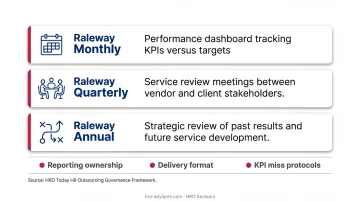
Confirm that the SLA also specifies who owns the reporting process, what format reports are delivered in, and what happens when KPIs are missed — not just when they're hit.
Penalty, Remedy, and Exit Clauses
An SLA without consequences for non-performance is a wish list. The presence (and specificity) of penalty clauses is one of the clearest signals of vendor accountability.
Legal commentary from Lexology notes that service credits are a common remedy for SLA failures in outsourcing arrangements, but warns that if they're designated as the sole remedy, other remedies including termination may be precluded. That makes this section worth reading carefully.
What to look for:
- Financial service credits tied to specific missed thresholds (not just "we'll make it right")
- A clear process for logging and contesting performance failures
- Termination-for-cause rights triggered by repeated SLA breaches
- A data transition and exit plan that protects you if the relationship ends
The Deloitte Outsourcing Handbook recommends that contracts include exit requirements in service definitions and service credits proportional to the actual impact of performance deterioration. If a vendor won't agree to both, that tells you how seriously they take their own commitments.
How to Use SLAs to Compare and Shortlist HR Outsourcing Vendors
Build a Scoring Rubric Before You Start
Request SLA drafts or term sheets from each vendor on your shortlist. Then map each one against the same six criteria above using a consistent scoring rubric. This creates an objective comparison rather than one driven by whoever gave the best presentation.
SHRM advises keeping SLAs to a manageable number of individual metrics and reviewing them frequently — the same principle applies here. You're not looking for the longest SLA; you're looking for the most specific and enforceable one.
Negotiate — Don't Just Evaluate
SLAs are not fixed documents. Treat any vendor who presents their SLA as non-negotiable with skepticism. Vendors who are confident in their own performance are generally willing to commit to specific thresholds.
When reviewing a draft SLA, push back on:
- Vague language — ask for explicit KPI targets instead
- Missing penalty clauses — request them before signing
- Generalized response timeframes — pin down exact hours and business days
NAPEO's 2024 tracking survey found that customer service responsiveness ranks among the top factors business decision makers consider when evaluating PEO relationships — making it worth negotiating explicitly, not just hoping for.
Involve the Right Internal Stakeholders
Payroll, HR, legal, and finance each interact with different parts of an HR outsourcing relationship. Each should review the SLA before you finalize any vendor selection. A compliance clause that satisfies HR may fall short of what your legal team needs. A reporting cadence that works for operations may not give your CFO the visibility they require.
Know Your Benchmark Gap
Once your stakeholders have weighed in, the final gap to close is knowing whether the terms you're reviewing are actually competitive. Most businesses evaluating HR outsourcing vendors for the first time have no reference point for what a strong SLA looks like. Without industry benchmarks, it's easy to accept below-standard terms simply because you don't know what to ask for.
Working with a broker who has reviewed hundreds of vendor agreements gives you that baseline — so you're negotiating from knowledge, not guesswork.
How HRO Advisors Can Help
HRO Advisors is a PEO broker based in Dallas, TX, that specializes in helping small to mid-sized businesses evaluate, compare, and select HR outsourcing vendors. During the vendor comparison phase, that cross-vendor perspective matters — most businesses approach this market for the first time without a baseline for what good terms or fair pricing actually look like.
The matching process draws on data across more than 500 PEO providers to build a shortlist of 3–8 vendors aligned to your workforce size, compliance profile, and industry. Those vendors are then compared side by side across costs, services, compliance features, and benefits quality. The provider you select compensates HRO Advisors — at no added cost to you.
Key differentiators relevant to SLA-based vendor selection:
- Matches vendors across high-compliance industries including financial services, life sciences, senior living, technology, and manufacturing
- Negotiates directly with providers to secure better rates and contract terms on your behalf
- Compares up to 8 PEO providers side by side with detailed cost and coverage analysis
- Free consultation with no obligation to commit
For questions about SLA-specific evaluation or to start a comparison, contact HRO Advisors at 866-755-0288 or info@hro-advisors.com.
Conclusion
Choosing an HR outsourcing vendor isn't primarily a question of price or brand recognition. It's a question of whether the vendor is willing to put their performance commitments in writing — with specific, measurable, enforceable standards attached.
SLA review is also not a one-time activity. Schedule formal reviews at minimum quarterly, and revisit the full agreement annually to ensure standards stay aligned with your workforce growth, geographic footprint, and any changes in applicable labor regulations. The vendor relationship evolves — and your SLA should evolve with it.
If you're still in the vendor selection phase, comparing providers side-by-side before signing any agreement is the most effective way to pressure-test SLA quality across the market. A broker like HRO Advisors can run that comparison across multiple PEO and HR outsourcing providers at no cost to you, giving you a clearer baseline for what strong contractual commitments actually look like.
Frequently Asked Questions
What is an SLA in HR outsourcing?
An SLA (Service Level Agreement) in HR outsourcing is a formal contractual document that defines the performance standards, deliverables, and responsibilities an HR vendor must meet — including the consequences if those standards aren't achieved.
What types of SLAs are used with HR outsourcing vendors?
HR outsourcing arrangements typically use a master SLA governing the overall relationship, service-specific agreements for functions like payroll or benefits administration, and tiered structures that apply different standards based on issue severity. Many vendors combine these into one document.
How do SLAs relate to contracts with HR outsourcing vendors?
The SLA is typically incorporated into the vendor contract as an addendum or schedule. It specifies the KPI thresholds, reporting requirements, and remedy mechanisms that apply throughout the engagement — making general contract language measurable and enforceable.
How often should SLAs be reviewed for HR outsourcing vendors?
KPIs should be reviewed monthly via dashboard reporting. Quarterly reviews should involve key stakeholders from both sides. An annual strategic review should reassess whether SLA terms still align with current business needs and regulatory requirements.
What happens when an HR outsourcing vendor fails to meet SLA standards?
Consequences depend on the remedy clauses in the SLA. These may include financial service credits, mandatory corrective action plans, or — for repeated breaches — the right to terminate the contract for cause. All three options should be present in the SLA before you sign.
What KPIs should be included in an HR outsourcing SLA?
The most important KPIs include payroll error rate, on-time payroll processing rate, first-time resolution rate for employee inquiries, response time by issue severity tier, compliance filing accuracy, and system uptime if the vendor provides an HR technology platform.