This guide covers what employer compliance and risk management actually mean, the five key areas every employer must monitor, how to build a functional compliance program, and how to address the challenges that trip up most businesses.
Key Takeaways
- Employer compliance means following federal, state, and local employment laws — risk management means catching threats before they become violations.
- Five areas drive most compliance exposure: employment law, workplace safety, payroll/wage-hour rules, employee benefits, and data privacy.
- Effective compliance programs combine risk assessments, written policies, staff training, regular audits, and clear reporting channels.
- Non-compliance creates layered costs: fines, litigation, back-pay awards, and reputational damage.
- Many businesses partner with a Professional Employer Organization (PEO) to consolidate compliance responsibilities across HR functions.
What Is Employer Compliance and Risk Management?
Employer compliance is an organization's obligation to follow every law, regulation, and standard governing how it hires, compensates, manages, and separates employees. That includes federal statutes like the Fair Labor Standards Act (FLSA), Family and Medical Leave Act (FMLA), Americans with Disabilities Act (ADA), and Title VII of the Civil Rights Act — plus the state and local employment laws that often go further than federal minimums.
Employer risk management is the proactive process of identifying, assessing, and mitigating workforce-related threats before they materialize — legal liability, workplace safety incidents, payroll errors, benefits violations, and regulatory penalties.
How Compliance and Risk Management Work Together
Compliance is largely reactive: it responds to existing laws and requirements. Risk management is forward-looking: it anticipates where exposures exist before an investigator or plaintiff finds them first. The two functions reinforce each other. Strong compliance programs reduce risk directly, while effective risk management surfaces compliance gaps before they become violations. Organizations that treat them as separate functions — or ignore one entirely — leave themselves exposed to regulatory penalties, costly litigation, and audit findings that could have been avoided.
The 5 Key Areas of Employer Compliance
Failure in any one of these areas can trigger penalties, investigations, or lawsuits. Here's what each requires.
Employment Law and Anti-Discrimination
Federal anti-discrimination laws enforced by the EEOC — including Title VII, the ADA, the Age Discrimination in Employment Act (ADEA), and the Pregnancy Discrimination Act — require employers to maintain a workplace free from unlawful discrimination and harassment. Many states layer additional protections on top of federal minimums.
The scale of exposure is significant. In FY 2024, the EEOC received 88,531 new discrimination charges — a 9.2% increase over FY 2023 — and secured $243.2 million in benefits through administrative enforcement alone. By FY 2025, total EEOC recovery climbed to nearly $660 million.
Key compliance requirements in this area include:
- Maintaining written anti-discrimination and anti-harassment policies
- Conducting regular manager training on EEOC-protected classes
- Documenting complaints and investigations consistently
- Reviewing state-specific protections, which often exceed federal minimums
Workplace Safety (OSHA)
OSHA requires employers to identify hazards, provide safety training, maintain injury and illness records, and post required notices. The financial stakes are significant: serious violations can now carry penalties up to $16,550 per violation, while willful or repeated violations can reach $165,514 per violation.
Employers in construction, manufacturing, and healthcare face the highest OSHA exposure. Participating in OSHA's Voluntary Protection Programs (VPP) or maintaining a written Injury and Illness Prevention Program can meaningfully reduce both citation risk and workers' compensation costs.
Payroll, Wage, and Hour Laws
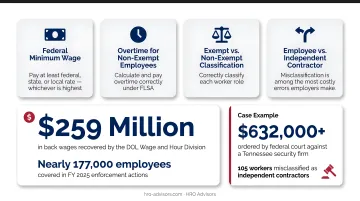
FLSA compliance spans four core obligations:
- Paying at least federal minimum wage (or applicable state/local rate)
- Calculating and paying overtime for non-exempt employees
- Correctly classifying workers as exempt vs. non-exempt
- Distinguishing employees from independent contractors
Misclassification is among the most common — and most expensive — errors employers make.
In FY 2025, the DOL's Wage and Hour Division recovered $259 million in back wages for nearly 177,000 employees. One example: a federal court ordered a Tennessee security firm to pay more than $632,000 to 105 workers misclassified as independent contractors.
Employee Benefits Compliance
Applicable large employers (ALEs) must comply with ACA employer mandate requirements and file Forms 1094-C and 1095-C annually. IRS penalties under Section 4980H apply when coverage isn't offered or doesn't meet minimum standards:
- 4980H(a) penalty: $3,340 per full-time employee (annualized, 2026)
- 4980H(b) penalty: $5,010 per affected employee (annualized, 2026)
ERISA governs retirement plan administration, and COBRA requires continuation coverage offers to eligible employees. Both ERISA and COBRA obligations tie directly into recordkeeping requirements — which brings us to the fifth area.
Data Privacy and Recordkeeping
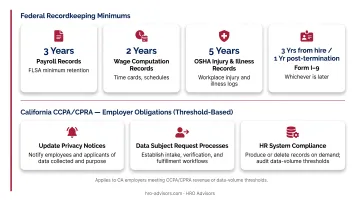
Employers are required to protect employee personal data — Social Security numbers, health information, payroll data — and to retain records according to federal minimums:
- Payroll records: 3 years (FLSA)
- Wage computation records (time cards, schedules): 2 years
- OSHA injury and illness records: 5 years
- Form I-9: 3 years from hire date or 1 year after termination, whichever is later
California's CCPA/CPRA extends data privacy rights to employees and job applicants of businesses meeting specific revenue or data-volume thresholds. Employers meeting those thresholds must update privacy notices, establish data subject request processes, and ensure HR systems can produce or delete records on demand.
Key Employer Compliance Risks and the Real Cost of Non-Compliance
Compliance failures don't produce a single fine and go away. They create layered costs: direct penalties, legal defense fees, back-pay awards, mandatory remediation, and operational disruption — before you factor in reputational damage.
Wage and Hour Violations
DOL audits, employee complaints, and class-action lawsuits most commonly stem from unpaid overtime, tip violations, and worker misclassification. Wage and hour cases are among the most heavily litigated employment matters, and they scale quickly — DOL's $259 million FY 2025 back-wage recovery involved nearly 177,000 workers.
OSHA Citations
A single serious OSHA citation can cost up to $16,550. Multi-violation inspections can produce six-figure penalties, mandatory abatement plans, and ongoing regulatory scrutiny. Industries with physical work environments — construction, manufacturing, senior living — carry the highest citation rates. A documented safety program is your clearest line of defense against citations and repeat inspections.
Harassment, Discrimination, and Retaliation Claims
EEOC charges expose employers to financial settlements, mandatory policy changes, and public scrutiny. The most common root causes: inadequate training, inconsistent policy enforcement, and poor documentation. Retaliation charges are now the single most common charge type — 42,301 retaliation-based charges were filed in FY 2024 across all statutes.
ACA and Benefits Non-Compliance
The 4980H penalty math adds up fast. An ALE with 100 full-time employees that fails to offer qualifying coverage faces potential 4980H(a) penalties exceeding $334,000 annually.
ERISA violations carry serious costs of their own. The DOL's Employee Benefits Security Administration recovered $1.4 billion in FY 2025 through enforcement actions and informal complaint resolution, closing 878 civil investigations — 63% of which produced monetary results or corrective action.
Reputational and Operational Risk
Financial penalties are measurable. Reputational damage is harder to quantify but often more lasting. Employers found non-compliant — especially in harassment, wage theft, or safety — face difficulty recruiting, experience higher turnover, and erode internal trust.
For businesses operating across multiple states, risk compounds further. Each layer of geography adds its own requirements:
- State-specific minimum wage and overtime rules
- Paid leave mandates that vary by jurisdiction
- Local ordinances layered on top of federal baseline requirements
How to Build an Employer Compliance and Risk Management Program
The goal is to move from reactive firefighting to a proactive posture. Here's a practical framework any employer can adapt.
Step 1: Conduct a Compliance Risk Assessment
Start by auditing your current obligations and gaps. Map out every applicable federal, state, and local law based on your:
- Industry and operational risk profile
- Employee headcount (determines ACA, FMLA, and other thresholds)
- Geographic footprint (triggers state-specific obligations)
Identify where current practices fall short. That gap list becomes your roadmap for building out policies, training, and monitoring — in that order.
Step 2: Develop and Document Policies and Procedures
Every identified compliance area needs a documented policy — accessible to employees, clear on expected behavior, and tied to specific legal requirements. A formal employee handbook reviewed by legal counsel is non-negotiable.
Without documentation, policies are unenforceable. In a regulatory audit or employment claim, undocumented practices offer little defense.
Step 3: Train Employees and Managers
Training must be role-specific:
- Managers: Lawful hiring practices, progressive discipline, leave administration, and accommodation requests
- All employees: Harassment prevention, safety protocols, and data handling procedures
Annual-only training is rarely sufficient in high-risk areas like harassment prevention or workplace safety. Build in refreshers when regulations change or incidents occur.
Step 4: Implement Monitoring, Auditing, and Reporting Systems
Ongoing monitoring keeps the program functional between formal audits. This includes:
- Regular payroll audits for classification and overtime accuracy
- OSHA recordkeeping reviews
- Benefits eligibility verification
Anonymous reporting channels — hotlines, complaint forms — are essential. Employees need a way to surface concerns without fear of retaliation. Without them, problems stay hidden until they become claims.
Step 5: Review and Update Continuously
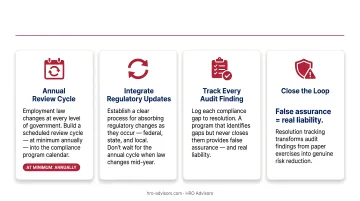
Employment law changes constantly at every level of government. The compliance program needs a scheduled review cycle — at minimum annually — plus a clear process for integrating regulatory updates as they occur. Track every audit finding to resolution. A program that identifies gaps but never closes them provides false assurance — and real liability.
Common Challenges Employers Face with Compliance
Three barriers trip up most employers:
Keeping pace with regulatory change: Employment laws shift frequently at federal, state, and local levels. Littler's employment law roundup identified dozens of new laws taking effect January 1, 2026 alone, and HR Dive notes that employers now face an increasingly fractured state-law patchwork.
Limited HR staff and expertise: Small and mid-sized businesses rarely have the dedicated legal and compliance resources that large enterprises maintain. This gap is where compliance failures concentrate — and where the financial costs hit hardest.
No centralized tracking system — Without tools to document, monitor, and update compliance activities across multiple functions, gaps go undetected until something breaks.
Multi-state employers face compounding complexity. State wage laws, paid leave mandates, and local ordinances all stack on top of federal requirements — and managing that manually isn't realistic. Most growing businesses haven't yet built the systematic tools and processes needed to stay ahead of it. That's precisely where structured HR support makes the most difference.
How a PEO Can Simplify Employer Compliance and Risk Management
A Professional Employer Organization (PEO) enters into a co-employment arrangement with a business, taking on substantial compliance and HR administrative responsibilities. The employer retains control over day-to-day operations and workforce decisions; the PEO handles the regulatory infrastructure.
PEOs in HRO Advisors' network manage a broad range of compliance functions on behalf of client employers, including:
- ACA reporting (Forms 1094-C and 1095-C)
- ERISA and COBRA administration
- Multi-state payroll tax compliance
- OSHA recordkeeping and safety program support
- Employee handbook development and updates
- EEO-1 reporting
- Workers' compensation management
The compliance value of PEO partnerships extends beyond administration. PEOs monitor regulatory changes and update policies accordingly — meaning clients stay current even as laws shift. For multi-state employers, this ongoing monitoring capability alone can prevent the kind of patchwork compliance failures that generate the most exposure.
That risk reduction translates into measurable business outcomes. According to NAPEO research, PEO clients experience 12% lower annual turnover and are significantly less likely to go out of business than comparable non-client businesses.
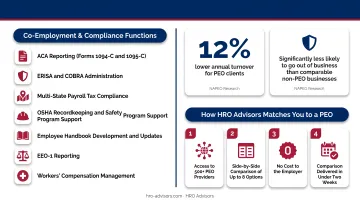
HRO Advisors helps businesses identify and compare PEO providers matched to their specific industry, size, and compliance needs. The process is straightforward:
- Access to 500+ PEO providers for broad market coverage
- Side-by-side comparison of up to 8 options — covering costs, services, and compliance capabilities
- No cost to the employer — HRO Advisors is compensated by the selected provider
- Finalized comparison delivered in under two weeks
For businesses managing multi-state workforces or navigating industry-specific regulations, that kind of structured comparison removes a lot of guesswork.
Frequently Asked Questions
What does compliance and risk management do?
Compliance ensures an organization meets all legal and regulatory obligations governing employment. Risk management identifies and mitigates threats before they cause financial or operational harm. Together, they protect businesses from penalties, litigation, and reputational damage.
What are the 5 key areas of compliance?
For employers, the five core areas are: employment law and anti-discrimination, workplace safety (OSHA), payroll and wage/hour laws, employee benefits compliance (ACA, ERISA, COBRA), and data privacy and recordkeeping.
What are the 5 P's of risk management?
The 5 P's are: Predict (identify risks), Prevent (implement controls), Prepare (develop response plans), Protect (safeguard assets and people), and Perform (monitor and measure outcomes).
What are the biggest compliance risks for employers?
Wage and hour violations, OSHA citations, employment discrimination and retaliation claims, ACA non-compliance penalties, and worker misclassification are the most common and costly employer compliance failures.
How can small businesses manage employer compliance without a dedicated HR team?
Small businesses can leverage HR technology, outsource specific compliance functions, or partner with a PEO — which assumes compliance responsibilities under a co-employment model, giving small employers access to legal and HR expertise they couldn't otherwise afford. A PEO broker can simplify the search by comparing multiple providers side-by-side at no cost to the business.