
A PEO (Professional Employer Organization) is the service provider that co-employs your workforce and handles HR functions directly. A PEO broker is the independent advisor who helps you find, compare, and negotiate with PEOs on your behalf. Confusing the two — or skipping the broker step entirely — can mean signing with the wrong provider, overpaying, or missing better options in the market.
This article breaks down exactly what each does, when each makes sense, and how to decide which path is right for your business.
Key Takeaways
- A PEO co-employs your workforce and manages payroll, benefits, compliance, and HR administration directly
- A PEO broker compares multiple PEOs on your behalf — typically at no cost to you
- Going direct to a single PEO limits your market visibility — a broker provides side-by-side comparisons across providers
- Brokers are particularly useful for businesses navigating PEO selection for the first time, operating in regulated industries, or managing tight HR budgets
- The two aren't competing services — a broker helps you choose the right PEO
PEO vs. PEO Broker: Quick Comparison
| Dimension | PEO (Direct) | PEO Broker |
|---|---|---|
| Role | Co-employer delivering HR services | Independent advisor matching you with PEOs |
| Employment Relationship | Enters co-employment agreement with your business | No employment relationship — advisory only |
| Cost to Employer | Ongoing fee based on payroll or per-employee rate | Typically free — compensated by the selected PEO |
| Scope of Services | Payroll, benefits, compliance, workers' comp, HR admin | Needs assessment, provider comparison, negotiation, onboarding support |
| Market Access | Limited to one provider's offerings | Access to multiple vetted PEOs compared side-by-side |
| Ongoing Support | Varies by provider | Broker may continue advocating post-placement |
What Is a PEO?
A Professional Employer Organization enters a co-employment agreement with your business. Under this arrangement, the PEO becomes the employer of record for payroll and benefits purposes, processing wages under its own EIN, filing employment taxes, and issuing W-2s. You retain full day-to-day control over your employees, culture, and operations.
According to NAPEO, co-employment is a contractual allocation of employer responsibilities between the client and the PEO, defined by the client service agreement.
The IRS does not formally recognize the term "co-employer" for federal tax purposes, but it does recognize Certified Professional Employer Organizations (CPEOs) under IRC Section 3511, treating them as the employer for federal employment tax purposes.
What PEOs Actually Handle
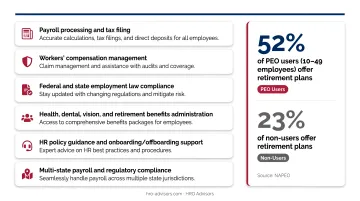
A full-service PEO typically covers:
- Payroll processing and tax filing
- Health, dental, vision, and retirement benefits administration
- Workers' compensation management
- HR policy guidance and onboarding/offboarding support
- Federal and state employment law compliance
- Multi-state payroll and regulatory compliance
The practical advantage of pooling comes through benefits. By aggregating employees from hundreds of client companies, PEOs gain buying power with insurance carriers that individual small businesses can't match. NAPEO reports that 52% of PEO users with 10–49 employees offer retirement plans, compared to just 23% of non-users — a gap that reflects real access differences, not just cost.
Who Uses PEOs
NAPEO's 2025 client data shows that 50% of PEO clients have 10–49 employees, and another 35% have fewer than 10. The typical NAPEO-stated range is 10–150 employees. Most are businesses that need HR infrastructure without the cost of building an internal department.
PEO clients span multiple industries, with Professional/Technical Services (19%), Construction (12%), Healthcare (9%), and Manufacturing (9%) leading the mix.
NAPEO also reports that businesses using PEOs grow twice as fast, see 12% lower employee turnover, and are 50% less likely to go out of business than comparable non-PEO businesses, though these are industry-reported figures.
What Is a PEO Broker?
A PEO broker is an independent specialist who helps businesses evaluate, compare, and select the right PEO from the broader market. They act as an advisor — not a vendor — with no vested interest in promoting one provider over another.
There's no formal regulatory definition of "PEO broker," but NAPEO's PEO Insider describes them as advisors who help businesses navigate a marketplace of 500+ PEO providers and match clients to specialized providers for niche industries.
What a Broker Does in Practice
The process typically looks like this:
- Needs assessment — Gather current HR costs, benefits requirements, compliance obligations, workforce structure, and growth objectives
- Provider comparison — Analyze multiple PEOs simultaneously across pricing, service scope, compliance features, and benefits quality
- Side-by-side output — Present a structured comparison of 3–8 providers so you can evaluate options clearly
- Negotiation — Work directly with providers to secure competitive rates and favorable contract terms
- Onboarding support — Guide the transition to the selected provider
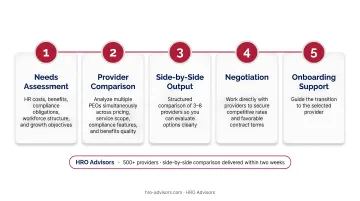
HRO Advisors, for example, follows this exact three-step methodology — collecting data, running the numbers across 500+ providers, and negotiating on the client's behalf. The full comparison is typically delivered within two weeks.
The Cost Structure
PEO brokers are generally compensated through a referral fee or commission paid by the PEO that's ultimately selected — meaning the employer pays nothing for the service. HRO Advisors confirms this model directly: their service is free to the business client, and the provider-paid compensation is disclosed openly.
That provider-paid compensation does create a potential conflict of interest — one worth asking about directly. A broker who shows you the full analysis across multiple providers, rather than steering you toward one, is demonstrating that the comparison is honest.
When a Broker Adds the Most Value
PEO brokers are particularly useful for:
- Companies evaluating PEOs for the first time, without prior market knowledge
- Businesses switching from an underperforming or overpriced PEO
- Industries with specialized compliance requirements — healthcare (HIPAA), construction (OSHA), financial services (FINRA/SEC), nonprofits (ACA/Form 990)
- Organizations operating across multiple states, where compliance varies by jurisdiction
- Any business that wants to verify it's getting competitive rates before signing a multi-year contract
Which Approach Is Right for Your Business?
This isn't really an either/or choice. A PEO broker helps you select a PEO — so using a broker doesn't replace the PEO relationship. The real question is: do you go direct to a single PEO, or do you use a broker to compare multiple PEOs before committing?
Here's how to think about it:
Choose to Go Direct If…
- You already have strong familiarity with a specific PEO and a reliable referral from a trusted source
- You've previously used a broker to narrow your options and are ready to move forward
- Your HR needs are straightforward and your business operates in a single state with standard compliance requirements
Use a PEO Broker If…
- You're evaluating PEOs for the first time and don't know where to start
- You're unsure which pricing structure or features to prioritize
- You operate in a niche industry with specific compliance requirements
- You're currently with a PEO but suspect you're overpaying or not getting adequate service
- You want competitive market data before committing — without spending weeks on vendor calls
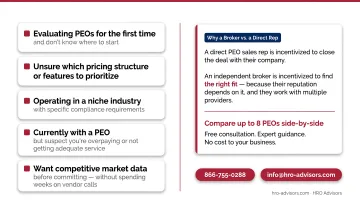
That last point matters more than it might seem. A direct PEO sales rep is incentivized to close the deal with their company. An independent broker is incentivized to find the right fit — because their reputation depends on it, and they work with multiple providers.
HRO Advisors offers a free consultation where you can compare up to 8 PEOs side-by-side, with expert guidance and no cost to your business. Call 866-755-0288 or email info@hro-advisors.com to get started.
Conclusion
A PEO gives small and mid-sized businesses the HR infrastructure and benefits buying power they'd otherwise need to be much larger to access. A PEO broker ensures that the PEO you choose is the right fit for your specific size, industry, and budget — not just the first option you encounter.
For most businesses evaluating PEOs for the first time, engaging a broker first is low-risk, no-cost, and improves your odds of finding a long-term partner that actually fits. HRO Advisors offers free, no-obligation PEO comparisons — matching your business with vetted providers across 500+ options so you can make the right call with confidence, not guesswork.
Frequently Asked Questions
Why would I use a PEO?
Businesses use PEOs to outsource payroll, benefits administration, compliance, and HR management — gaining access to large-group health plans and seasoned HR expertise without building an in-house team. For small businesses especially, the pooled buying power and compliance support often justify the cost many times over.
How do PEO brokers get paid?
PEO brokers are typically compensated through a referral fee or commission paid by the PEO provider you ultimately select — meaning employers usually pay nothing for the broker's service. Always confirm the compensation structure upfront to understand how a broker is positioned relative to different providers.
What is the difference between a PEO and a PEO broker?
A PEO is the service provider that co-employs your workforce and manages HR functions directly. A PEO broker is the independent advisor who helps you compare and select the right PEO from the broader market — they are not the employer and do not deliver HR services themselves.
How much does a PEO typically cost?
PEO fees are structured as either a percentage of total payroll or a flat per-employee-per-month rate, varying by company size, services included, and geographic complexity. Requesting itemized, unbundled quotes is the most reliable way to compare true costs across providers.
Is a PEO broker worth it for small businesses?
For small businesses unfamiliar with the PEO market, a broker can save significant time, help avoid costly mismatches, and negotiate better rates — with no out-of-pocket cost. The low-risk, no-cost structure makes it a practical starting point for businesses new to the PEO market.
Can a business switch PEOs if the relationship isn't working?
Switching PEOs is possible but involves transition complexity around payroll, benefits continuity, and employee data. A PEO broker can help manage the transition, vet new providers, and build a plan designed to minimize disruption — with contract terms and service benchmarks set from the start.