
That competition creates a real problem. Managing payroll, benefits, compliance, and HR administration without a dedicated team costs owners something they can't get back: time. According to older NAPEO research, small business owners spend roughly 25–35% of their time on employment-related paperwork — hours pulled directly from revenue-generating work.
This guide covers what a PEO is, why Atlanta businesses are adopting them, what services they provide, what Georgia-specific compliance looks like, what it costs, and how to choose the right provider.
Key Takeaways
- A PEO enters a co-employment arrangement with your business, handling payroll, benefits, and compliance while you retain full operational control
- Small businesses gain access to Fortune 500-level benefits at group rates unavailable to companies under 50 employees
- NAPEO research shows average savings of $1,775 per employee per year — a 27.2% ROI based on cost savings alone
- Georgia-specific compliance rules around E-Verify, workers' comp, and ACA thresholds are areas where a PEO adds direct risk protection
- Comparing multiple PEOs side-by-side before committing is essential — pricing, benefits quality, and service depth vary significantly
What Is a PEO and How Does It Work?
A Professional Employer Organization (PEO) is a firm that enters a co-employment relationship with your business. Under this arrangement, the PEO becomes the "administrative employer" — handling payroll processing, tax filings, benefits administration, and compliance obligations under its own Employer Identification Number (EIN). You remain the "worksite employer," keeping full authority over hiring decisions, compensation, daily management, and business strategy.
The Co-Employment Model Explained
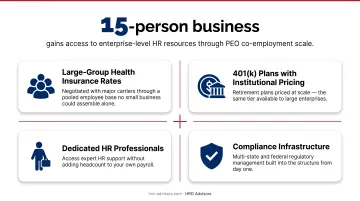
The co-employment structure works because it lets a PEO aggregate employees from hundreds of client companies into a single large pool. That scale makes available resources a 15-person business simply can't access on its own:
- Large-group health insurance rates negotiated with major carriers
- 401(k) plans with institutional pricing
- Dedicated HR professionals without adding headcount to your payroll
- Compliance infrastructure built for managing multi-state and federal obligations
What a PEO Is NOT
- A PEO does not take ownership of your business or make operational decisions
- A PEO does not hire or fire your employees — that authority stays with you
- A PEO is not a staffing agency supplying temporary labor
- A PEO is not the same as traditional HR outsourcing, which typically handles individual services in isolation
NAPEO defines co-employment as a contractual allocation of employer responsibilities: your business directs the workforce while the PEO manages the administrative infrastructure behind it.
Why Atlanta Small Businesses Are Turning to PEOs
A Competitive Labor Market with No Easy Shortcuts
The Atlanta-Sandy Springs-Roswell metro area had 3,136,200 total nonfarm jobs as of June 2025, according to the Bureau of Labor Statistics. The Atlanta Regional Commission projects employment across the 21-county region to grow by 22% between 2020 and 2050.
For a small business in Atlanta's fintech corridor, healthcare sector, or hospitality economy, that growth means competing for talent against organizations with fully staffed HR departments, robust benefits packages, and dedicated recruiting teams.
The Benefits Gap Is Real
KFF data shows only 51% of firms with 10–24 workers offered health benefits, compared to 97% of firms with 200+ workers. That gap doesn't just hurt recruiting — it contributes to turnover in markets where employees have real options.
PEOs fix this by pooling employees across many client companies, giving small businesses access to group health, dental, vision, and retirement rates that reflect buying power far beyond what any single employer could negotiate alone.
Scaling Triggers New Compliance Obligations
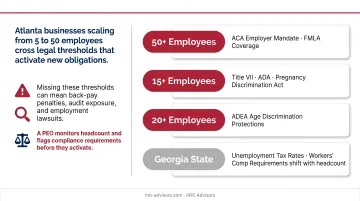
Atlanta businesses scaling from 5 to 50 employees don't just get busier — they cross legal thresholds that activate new federal and state obligations. Common triggers include:
- 50+ employees: ACA employer mandate and FMLA coverage kick in
- 15+ employees: Title VII, ADA, and Pregnancy Discrimination Act apply
- 20+ employees: ADEA age discrimination protections take effect
- Georgia state filings: Unemployment tax rates and workers' comp requirements shift as headcount grows
Missing these thresholds can mean back-pay penalties, audit exposure, and employment lawsuits. A PEO monitors headcount and flags compliance requirements before they activate, giving you time to prepare rather than react.
Core PEO Services That Benefit Atlanta Small Businesses
Payroll Administration and Tax Compliance
Payroll errors don't stay small — missed deadlines and miscalculations trigger IRS penalty notices fast. A PEO handles the full payroll stack:
- Federal and Georgia state payroll tax withholding and remittance
- W-2 and 1099 preparation and filing
- Off-cycle payroll runs for bonuses or terminations
- Direct deposit management and employee self-service portals for pay stubs
- Automated tax calculations that reduce manual error
Having a PEO's payroll infrastructure in place removes the risk of manual errors and missed deadlines — leaving you with one less liability to manage.
Employee Benefits Administration
Through the co-employment structure, small Atlanta businesses gain access to:
- Medical, dental, and vision plans from major carriers at group rates
- 401(k) retirement plans with competitive investment options
- Life and disability insurance
- Voluntary benefits including FSAs, HSAs, and wellness programs
According to the NAPEO ROI white paper, businesses using PEOs save an average of $1,775 per employee per year — largely driven by the difference between large-group and small-group benefit pricing.
HR Administration and Compliance Support
A PEO also covers the day-to-day HR infrastructure most small businesses lack the bandwidth to build in-house:
- Employee handbook creation and policy development
- Onboarding and offboarding workflows
- Performance management frameworks
- Job description development
- Access to certified HR professionals for employment questions
For Atlanta businesses competing for talent in a tight labor market, structured onboarding and clear policies reduce early turnover — and keep you on the right side of Georgia employment law from the start.
Risk Management and Workers' Compensation
Georgia requires workers' compensation coverage for any business with three or more employees — full-time or part-time. A PEO manages:
- Workers' comp insurance through group coverage (typically at lower rates than individual policies)
- Safety program development and OSHA compliance
- Claims management and return-to-work coordination
Because PEOs pool employees across their entire client base, their workers' comp buying power is far greater than what a 10- or 20-person Atlanta business can access on its own — often producing meaningfully lower premiums, especially in higher-risk industries like construction or manufacturing.
Georgia-Specific Compliance: What Every Atlanta Small Business Must Know
Growing businesses in Atlanta face a layered compliance environment. Here's what matters most:
E-Verify Requirements
Georgia law requires every public employer to use E-Verify for new hires. For private employers, the mandate applies to businesses with more than ten employees — and to any business performing work under a public contract, regardless of size.
A PEO automates the E-Verify workflow, maintains documentation, and monitors compliance — so missed filings don't turn into government audits or lost contract eligibility.
Workers' Compensation
The Georgia State Board of Workers' Compensation requires coverage for employers regularly employing 3 or more persons, part-time or full-time. Below three employees, no coverage is required — but most growing Atlanta businesses cross that threshold faster than expected.
Group workers' comp coverage through a PEO satisfies this requirement and typically costs less than a standalone policy for a small business.
Minimum Wage Nuances
Georgia's state minimum wage is $5.15 per hour, but with limited exceptions, the federal FLSA rate of $7.25 per hour applies to most workers. For Atlanta businesses with remote employees in other states — think hybrid teams with staff in Tennessee, Florida, or North Carolina — minimum wage obligations vary by location. A PEO tracks those location-based requirements automatically.
Federal Thresholds That Catch Growing Businesses Off Guard
As Atlanta businesses scale, several federal obligations activate at specific headcount thresholds:
| Threshold | Obligation |
|---|---|
| 3+ employees | Georgia workers' compensation required |
| 20+ employees | COBRA continuation coverage required |
| 50+ employees (or FTEs) | ACA employer mandate applies |
| 50+ employees within 75 miles | FMLA eligibility activates |
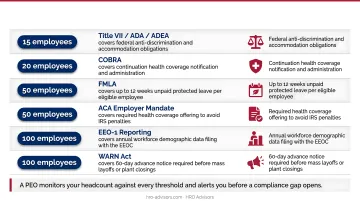
These thresholds sneak up on fast-growing businesses. A good PEO monitors headcount against each trigger and alerts owners before a compliance gap opens — not after a notice arrives.
How Much Does a PEO Service Cost?
Pricing Models
PEOs generally price their services two ways:
- Per Employee Per Month (PEPM): A flat fee per employee, regardless of compensation level
- Percentage of payroll: A rate applied to total gross payroll
NAPEO's 2019 ROI research reported an average PEO cost of $1,395 per employee per year as a historical benchmark — though current market pricing varies based on several factors and is best obtained through direct quotes.
What Drives Your Specific Cost
Pricing isn't uniform across providers or industries. Key variables include:
- Employee count — fewer employees often means a higher per-employee rate
- Industry risk profile — a construction firm pays differently than a professional services company
- Scope of services — basic payroll administration vs. full benefits and HR support
- Benefits plan selection — richer health plans increase total cost but also improve recruiting outcomes
- Geographic complexity — multi-state operations add compliance overhead
The ROI Argument
The relevant question isn't what a PEO costs — it's what you're spending without one. Consider what PEO fees offset:
- Salary and overhead for in-house HR staff
- Premium inflation on individually purchased health plans
- Compliance penalties from missed regulatory deadlines
- Turnover costs from below-market benefits
No two PEOs quote identically for the same business. Comparing detailed, itemized proposals — covering administrative fees, benefits costs, and implementation charges — is the only reliable way to determine which provider delivers the best return for your specific situation.
How to Choose the Right PEO for Your Atlanta Business
Evaluation Criteria That Matter
With over 500 PEOs operating in the US, the differences between providers are significant. When comparing options, focus on:
- Georgia compliance expertise — can they handle E-Verify, state payroll tax, and workers' comp under Georgia rules?
- Benefits depth — what carriers and plan structures are available, and at what cost?
- Pricing transparency — is the fee structure flat PEPM or payroll percentage, and what's included vs. billed separately?
- Dedicated support model — do you get a dedicated HR advisor or a shared call center?
- Accreditations — IRS Certified PEO (CPEO) status limits employment tax liability exposure; ESAC accreditation confirms financial and operational reliability, backed by more than $15 million in surety bond coverage
Why Independent Comparison Matters
No PEO prices identically, and no two offer the same benefits packages or service depth. Requesting itemized quotes from multiple providers — and understanding exactly what each fee covers — is essential before entering a co-employment agreement.
The challenge is that gathering, interpreting, and negotiating those quotes takes time most Atlanta small business owners don't have. That's where HRO Advisors comes in.
How HRO Advisors Simplifies the Process
HRO Advisors is a PEO broker that handles this process for Atlanta small businesses at no cost. Their three-step approach:
- Collect your current HR costs, benefits needs, workforce structure, and compliance obligations
- Compare up to 8 PEO providers side-by-side across cost, coverage, and compliance capabilities from a network of more than 500 PEOs
- Negotiate directly with shortlisted providers to secure the best rates and terms before presenting final options
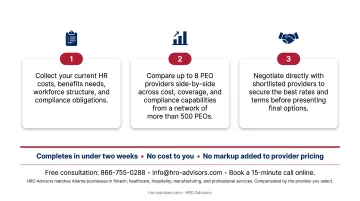
The entire process typically completes in under two weeks. HRO Advisors is compensated by the provider you ultimately select — with no fee to you and no markup added to the provider's pricing.
HRO Advisors matches Atlanta businesses in fintech, healthcare, hospitality, manufacturing, and professional services to providers equipped for their specific compliance requirements. A free, no-obligation consultation is available by calling 866-755-0288, emailing info@hro-advisors.com, or booking a 15-minute call online.
Frequently Asked Questions
What is a PEO for small businesses?
A PEO is a firm that enters a co-employment agreement with a small business, taking on administrative HR responsibilities — payroll, benefits, taxes, and compliance — while the business owner retains full control over daily operations, hiring, and management decisions.
How much does a PEO service cost?
NAPEO's historical benchmark puts average PEO costs at roughly $1,395 per employee per year, though current pricing varies by company size, industry, location, and services selected. Requesting itemized quotes from multiple providers is the most reliable way to determine your actual cost.
What is the average ROI for small businesses using a PEO?
The NAPEO ROI white paper puts average savings at $1,775 per employee per year — a 27.2% ROI on cost savings alone. PEO clients also grow twice as fast, see 12% lower turnover, and are 50% less likely to go out of business.
Does a PEO take control away from my Atlanta business?
No. Under co-employment, you retain complete authority over hiring, firing, compensation, daily operations, and business strategy. The PEO only manages administrative employer functions — payroll, benefits enrollment, tax filings, and compliance support.
What Georgia-specific compliance issues does a PEO handle?
A PEO handles E-Verify requirements, workers' compensation insurance (required at 3+ employees in Georgia), state and federal payroll tax filings, ACA employer mandate tracking at 50+ FTEs, and FMLA and COBRA administration. Businesses with remote workers also get support monitoring applicable minimum wage rules across locations.
How do I find the right PEO for my Atlanta small business?
Define your top HR priorities, then request itemized quotes from multiple providers. Verify CPEO and ESAC accreditations before signing anything. Working with a free PEO broker like HRO Advisors lets you compare up to 8 providers side-by-side at no cost, without spending weeks on research yourself.