The stakes are real. This decision affects how payroll taxes get filed, what health benefits your employees can access, who holds employer liability, and how much compliance risk you carry. For a 20-person company without an HR team, those aren't abstract concerns.
This guide breaks down exactly how each model works, where they differ, and how to determine which one fits your business.
Key Takeaways
- A PEO enters a co-employment arrangement, becoming the employer of record for tax and benefits purposes while you retain full operational control
- An ASO provides outsourced HR support without co-employment — your business stays the sole employer throughout
- The key distinctions come down to employer liability, benefits sponsorship, and which EIN payroll taxes are filed under
- PEOs suit small to mid-sized businesses without dedicated HR staff who want comprehensive support and shared compliance responsibility
- If your business already has HR infrastructure in place, an ASO delivers targeted administrative support without altering your employer-of-record status
PEO vs. ASO: Quick Comparison
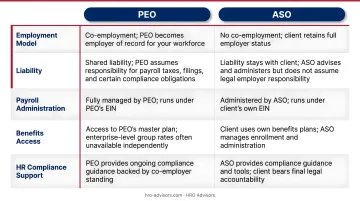
The table below breaks down the five dimensions that matter most when choosing between a PEO and an ASO. Pay close attention to the employment model and liability rows — those differences shape everything else.
| Dimension | PEO | ASO |
|---|---|---|
| Employment Model | Co-employment; PEO becomes employer of record for tax/admin purposes | Standard client-vendor relationship; client remains sole employer |
| Benefits Access | PEO sponsors pooled plans — small businesses access large-group health coverage not available independently | Client sponsors own plans; ASO administers them but provides no pooled group access |
| Payroll Tax Filing | Filed under the PEO's Federal EIN | Filed under the client's EIN; full tax liability stays with the employer |
| Liability & Risk | PEO shares certain administrative and employment-related risks through co-employment | Client retains full legal and financial employer liability |
| Cost Structure | 2%–12% of total payroll or $40–$150 per employee per month | $50–$250 per employee monthly for selected services |
What Is a PEO?
A Professional Employer Organization is a third-party HR provider that enters a co-employment arrangement with your business. The PEO becomes the employer of record for administrative and tax purposes: it files payroll taxes under its own Federal EIN, sponsors benefits plans, and takes on shared compliance responsibility. You retain full control over hiring, firing, performance management, and day-to-day operations.
The most common misconception: that a PEO "takes over" your employees. It doesn't. The client business directs all workforce decisions. The PEO handles the administrative and compliance-heavy side of being an employer.
What a PEO Typically Handles
- Payroll processing and tax filing under the PEO's EIN
- Workers' compensation coverage and claims management
- Access to pooled large-group health, dental, life, and 401(k) plans
- HR compliance support across federal, state, and local requirements
- Employee relations support across the full employment lifecycle
The Benefits Access Advantage
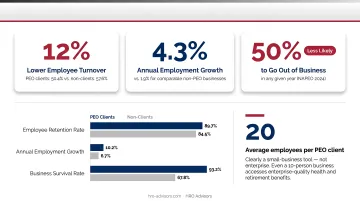
Because a PEO pools employees across all its client companies, even a 10-person business can access health insurance and retirement plan quality typically reserved for enterprise employers. According to NAPEO's 2024 research, PEO clients had 12% lower employee turnover than comparable non-clients (50.4% vs. 57.6%), grew employment at 4.3% annually versus 1.9% for non-clients, and were 50% less likely to go out of business in any given year.
The average PEO client has 20 employees — this is clearly a small-business tool, not an enterprise one.
IRS-Certified PEOs (CPEOs)
The IRS certifies certain PEOs as Certified Professional Employer Organizations (CPEOs) under Internal Revenue Code Section 7705. To qualify, a PEO must meet financial responsibility, organizational integrity, tax compliance, and bonding requirements.
The practical benefit for clients: the IRS holds a CPEO solely liable for paying federal employment taxes on remuneration paid to worksite employees. That's an additional layer of protection that standard PEOs don't carry.
Best Fit for a PEO
- Small businesses (under 100 employees) without a dedicated HR team
- Companies expanding into new states with varying compliance requirements
- Businesses struggling with rising health insurance costs
- Organizations that want to reduce employer-side liability exposure
- Fast-growing companies where HR complexity is outpacing internal capacity
What Is an ASO?
An Administrative Services Organization provides outsourced HR support — payroll processing, benefits administration, compliance guidance, and HR reporting — under a standard client-vendor agreement. There is no co-employment. Your business remains the employer of record at all times.
The model works on an à la carte basis. Businesses select which HR functions to outsource and manage everything else internally. That flexibility is the ASO's core appeal: targeted support without the structural commitment of co-employment.
The Liability Distinction
The biggest practical difference between an ASO and a PEO is who carries the legal risk. With an ASO, the client retains full responsibility for employment law compliance, workers' compensation, and all employment-related legal exposure. The ASO provides administrative support and guidance — but does not share liability. If a wage-and-hour claim lands in your lap, it's yours to manage.
One Common Point of Confusion
Before going further, one terminology note worth flagging: "ASO" also appears in health insurance, where it refers to "Administrative Services Only" plans — a self-funded arrangement where the employer pays claims directly and contracts with a third party for claims processing only. That's an unrelated context. Throughout this article, ASO refers specifically to the HR outsourcing model.
Best Fit for an ASO
- Mid-sized businesses (typically 25+ employees) with an existing internal HR manager or team
- Companies with established insurance broker relationships they want to keep
- Organizations that need support with specific functions like payroll or compliance reporting without changing their legal employer structure
- Businesses large enough to negotiate their own group benefits
Which HR Service Is Right for Your Business?
The decision comes down to three questions: How much HR infrastructure do you already have? How much compliance risk are you comfortable carrying? And can you access competitive benefits on your own?
Choose a PEO If:
- Your business has no dedicated HR function
- You're spending significant time on HR administration instead of running your business
- You want access to competitive health benefits without enterprise-level headcount
- You're hiring across multiple states and compliance complexity is increasing
- You want a partner to share employer-side risk — not just advise on it
Choose an ASO If:
- You have experienced HR staff managing compliance and employee relations
- You need help with specific tasks like payroll or benefits admin but want to retain full employer control
- You have existing carrier or broker relationships you want to preserve
- Your company is large enough to negotiate its own group benefits independently
Two Scenarios Worth Considering
30-person tech startup, hiring across five states, no HR department: Compliance obligations multiply fast. New state registrations, varying workers' comp requirements, and the inability to offer competitive health benefits create real recruiting and legal exposure. This matches the profile NAPEO's data identifies as the strongest PEO fit: more than 85% of PEO clients have fewer than 50 employees.
75-person professional services firm with an HR director and established carrier relationships: What they need isn't a structural overhaul. An ASO delivers relief from payroll processing and benefits administration overhead without disrupting what's already working.
The Transition Question
Switching from an ASO to a PEO is a natural progression as businesses grow and HR complexity increases. Some providers offer both models, which can make the transition smoother (same vendor, different structure). According to U.S. Chamber data, 69% of small businesses spend more per employee on regulatory compliance than larger businesses, often the trigger that pushes growing companies from an ASO toward a PEO model.
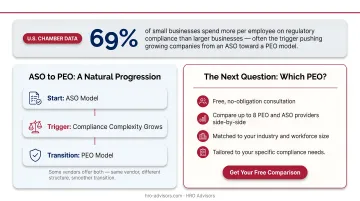
If a PEO is the right fit, the next question is which one. HRO Advisors offers a free, no-obligation consultation that compares up to 8 PEO and ASO providers side-by-side, matched to your industry, workforce size, and specific compliance needs.
Conclusion
Neither model is universally better. A business without HR infrastructure, rising compliance complexity, or competitive benefits gaps will typically find more value in a PEO. One with a functioning HR team that needs targeted administrative support may be well served by an ASO.
Cost savings, compliance protection, and access to better benefits all follow from matching the right model to your situation — not the other way around.
HRO Advisors offers free, expert guidance to help you find that fit. Contact them at 866-755-0288, at info@hro-advisors.com, or through their online scheduling tool.
Frequently Asked Questions
What is the difference between an ASO and a PEO?
The core difference is the employment relationship. A PEO co-employs your workers and becomes the employer of record for tax and benefits purposes. An ASO provides HR administrative support — payroll, benefits, compliance — without co-employment, so your business remains the sole employer throughout.
Is a PEO more expensive than an ASO?
PEOs generally cost more upfront, but the value calculation should include access to better group benefits, shared compliance risk, and time savings. NAPEO's research puts average PEO ROI at 27.2% annually, which means the higher fee often pays for itself — particularly for small businesses.
Do I lose control of my employees if I use a PEO?
No. Co-employment does not transfer workforce control. Your business still directs all hiring, firing, performance management, and daily operations. The PEO handles only the administrative and tax-related employer responsibilities under its own EIN.
Can a small business benefit from a PEO?
Yes — the average PEO client has about 20 employees, and more than half have fewer than 50. Small businesses gain access to HR expertise, large-group benefits, and compliance support that would otherwise cost far more to build in-house.
Can a company switch from an ASO to a PEO later?
Yes, and it's a natural progression as businesses grow and HR complexity increases. Some providers offer both models, making the transition smoother — you can move from ASO to PEO without changing vendors entirely.
How do I know which HR outsourcing model is right for my business?
The right model depends on your internal HR capacity, your appetite for employer liability, and whether you can access competitive benefits on your own. A free consultation with HRO Advisors can map those factors to the model that fits — no obligation required.