
The good news: switching PEOs is manageable when you approach it as a structured project rather than a vendor swap. The risks aren't in the switch itself — they're in poor timing, skipped preparation, and choosing the wrong replacement.
This guide covers the clear signals it's time to leave, what to do before you notify your current provider, a step-by-step transition process, and the variables that determine whether the switch goes smoothly.
Key Takeaways
- Switching PEOs requires a structured exit — not just signing a new contract
- Audit and export your HR data before notifying your current PEO — not after
- January 1 is the cleanest transition date; mid-year switches create tax complications
- FSA balances and employee deductibles are at risk during mid-year benefits transitions
- A PEO broker can compare up to 8 providers side-by-side — at no cost to your business
Signs It's Time to Switch PEOs
The decision to switch PEOs rarely comes from a single moment. More often, it's a pattern: recurring payroll errors, a rotating cast of account reps, benefit plans your employees have quietly stopped using.
Service failure signals worth taking seriously:
- Payroll errors that recur despite escalation
- Slow or inconsistent response times from your account team
- Compliance questions that go unanswered or get generic responses
- Technology that doesn't connect with your existing HRIS, ATS, or accounting tools
- Benefits plans that no longer fit your workforce's needs or expectations
Growth-driven triggers are different in character. If your company has expanded into new states where your current PEO isn't licensed, or you're approaching international hiring, that's a structural mismatch — not a service issue. A separate financial concern also emerges at scale: NAPEO data shows that PEOs are most commonly used by businesses with 10–499 employees, with 50% of clients having 10–49 employees. As companies grow well beyond that range, the per-employee cost model warrants a fresh financial review.
Not every frustration warrants a full exit. Before committing to a switch, determine whether the problem is fixable through escalation or rooted in a structural gap your current PEO simply can't close.
What to Do Before Switching PEOs
Preparation before notifying your current PEO is the most important phase of the entire process. Once you signal intent to leave, system access may be restricted and the relationship becomes transactional.
Decide: Switch PEOs or Exit the Model Entirely
There are three paths forward, each with different timelines and cost structures:
| Path | Best For | Complexity |
|---|---|---|
| Switch to a new PEO | Service/cost issues; still want co-employment | Moderate |
| Move to an ASO | Want HR admin support without co-employment | Moderate |
| Build in-house HR | Sufficient scale and internal capacity | High |
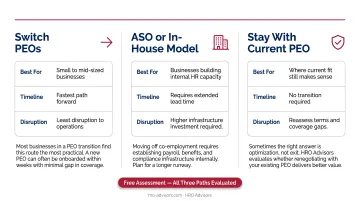
For most small to mid-sized businesses, switching PEOs is the fastest path with the least disruption. Moving to an ASO or in-house model requires more lead time and internal infrastructure. HRO Advisors can assess all three paths — including whether staying with your current PEO actually makes the most sense given your situation.
Review the Current PEO Contract
Pull the contract before doing anything else. Key clauses to identify:
- Notice period — Public contract examples (including Paychex's published PEO terms) show 30 days' notice as a documented example, though notice requirements are contract-specific and vary by provider
- Termination method — Whether notice must be submitted in writing, by certified mail, or through a specific portal
- Early termination fees — Some contracts use per-employee formulas; others apply flat cancellation charges
- Data return obligations — Paychex's terms, for example, explicitly require clients to download their data before termination since access may end
Missing these details before notifying the provider can trigger unexpected fees and accelerate a timeline you're not ready for. That timeline pressure makes the next step urgent.
Conduct a Data Audit
Before migration, cross-reference your records for completeness:
- Employee records and personal information
- Payroll histories and year-to-date totals
- Tax withholding records
- Benefits enrollment data and carrier documentation
This step consistently takes longer than expected. Catching gaps or discrepancies before migration avoids payroll errors and benefits enrollment failures after go-live.
Build a Transition Timeline and Team
Work backward from your target go-live date and assign owners for each milestone in a project management tool. Core roles: HR lead, finance lead, and a dedicated point of contact with the incoming PEO. The U.S. Chamber of Commerce notes that transitioning off a PEO typically takes four to six months from start to finish.
How to Switch PEOs: A Step-by-Step Process
Step 1: Document What's Not Working and Define Requirements
Before evaluating replacements, build a specific list of failures with your current provider — categorized by service quality, technology, cost, compliance support, and benefits. Then convert that list into a requirements document.
Without that specificity, you'll end up evaluating new providers against a fuzzy standard — and risk repeating the same problems.
Step 2: Research and Compare New PEO Providers
When evaluating candidates, check for:
- CPEO certification — The IRS maintains a public CPEO listing updated quarterly; CPEO status matters for federal employment-tax treatment during transitions
- ESAC accreditation — ESAC-accredited PEOs meet financial, ethical, and operational standards; nearly 73% of PEO industry wages are processed through ESAC-accredited providers
- Pricing structure — PEO pricing typically runs $40–$150 per employee per month or 2%–12% of payroll; verify exactly which model applies and what's included
- Industry experience — A PEO with deep experience in your sector handles compliance nuances differently than a generalist
- Client retention and responsiveness — Ask for retention rates and response-time commitments, not just sales promises
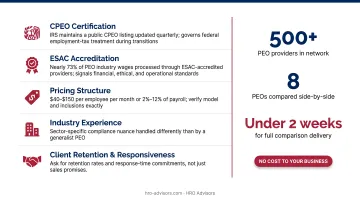
Working with a broker like HRO Advisors shortens this phase considerably. Their team compares up to 8 PEOs side-by-side — drawn from a network of 500+ providers — at no cost to the business, with the full comparison typically delivered in under two weeks. Their compensation comes from the provider you select, with no markup passed to you.
Step 3: Finalize the New PEO Agreement and Transition Plan
Once you've selected a replacement:
- Sign the co-employment agreement
- Request the new PEO's documented transition plan in writing
- Confirm the go-live date and lock it in
- Clarify exactly what the new PEO's implementation team handles versus what falls to you
A quality PEO assigns a dedicated transition team — and if they can't name who that is during the sales process, treat it as a warning sign.
Step 4: Send the PEO Termination Letter
The termination letter should include:
- The effective termination date
- Confirmation that the notice period complies with your contract
- A request for a final account statement and all employee data
- A request for written acknowledgment of receipt
Send it via a traceable method — certified mail or a tracked email with read receipt — so there's no ambiguity about when notice was given.
Step 5: Execute the Data Migration and Benefits Transition
At this stage, the new PEO configures its HRIS, coordinates data migration, runs parallel payroll tests, and sets up benefits enrollment — all before go-live. While their team handles the technical lift, your primary job is employee communication:
- Notify staff of benefits changes with enough lead time to make decisions
- Explain new enrollment steps clearly
- Address concerns about mid-year deductible resets and FSA balances directly — don't leave employees to figure this out on their own
Step 6: Monitor the Transition and Close the Prior Relationship
After go-live:
- Verify the first payroll run line by line
- Confirm tax withholding accuracy
- Check that benefits claims are processing under the new carrier
- Solicit employee feedback within the first two weeks
- Send a formal closing letter to the former PEO confirming the relationship is terminated, all financial obligations are settled, and requesting written confirmation
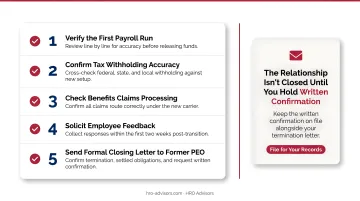
The prior relationship isn't officially closed until you hold that written confirmation — keep it on file alongside your termination letter.
Key Factors That Affect Your PEO Transition
Timing: Calendar Year vs. Mid-Year Switch
Timing is one of the most consequential decisions in the process.
January 1 is the cleanest option. The Social Security wage base (set at $184,500 for 2026) resets, state unemployment insurance (SUI) wage bases reset, and benefits plan years align. Nothing carries over in a way that requires reconciliation.
Quarter starts (April 1, July 1, October 1) are a reasonable compromise — simpler than mid-year but not as clean as January.
Mid-year switches are possible, but they require a specific plan. Federal CPEO predecessor-successor rules under Section 3511 address wage-base continuity when a CPEO contract starts or terminates — if your current or incoming PEO isn't CPEO-certified, those protections don't automatically apply. State SUI wage base rules are state-specific and need to be verified individually.
Benefits Continuity: FSAs, Deductibles, and Retirement Plans
Mid-year switches create specific benefits risks:
- FSAs — IRS Publication 969 confirms health FSAs are generally use-it-or-lose-it. Unused FSA funds are not portable between employer plans; employees should use their balances before the transition date
- Deductibles — Employees who have already met deductibles under the current carrier may face a reset under new carriers. No official federal source guarantees automatic deductible credit carryover during mid-year employer plan changes
- Retirement plans — If the business participates in a multiple employer plan (MEP) through the current PEO, a replacement must be designated. Per IRS and DOL guidance, retirement plan blackout notices must be sent at least 30 days, but no more than 60 days, in advance of the blackout period
Data Integrity and Migration Quality
Benefits issues and payroll errors often share the same root cause: bad data. The accuracy of transferred records directly determines the quality of your first payroll run and benefits enrollment under the new PEO. A pre-switch data audit is what catches these problems before they become employee complaints.
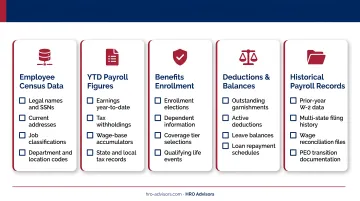
The audit should cover:
- Employee census data (names, SSNs, addresses, job classifications)
- YTD payroll figures, tax withholdings, and wage-base accumulators
- Benefits enrollment elections and dependent information
- Outstanding garnishments, deductions, or leave balances
- Historical payroll records the new PEO needs for W-2 reconciliation
Common Mistakes When Switching PEOs
Most PEO transitions don't fail because of a bad provider choice. They fail because of avoidable missteps in the process itself. Here are three mistakes that consistently cause problems:
1. Switching Mid-Year Without a Tax Plan
A mid-year switch can reset FICA and SUI wage bases depending on CPEO status and state rules, creating duplicate tax exposure. This isn't hypothetical — it's a structural outcome of how payroll tax reporting works across employers. If possible, time your transition to align with January 1 or a state-specific wage base reset date.
2. Tipping Off Your Current PEO Too Early
Once you signal intent to leave, data access may become restricted and the provider's cooperation turns transactional. Before sending any termination notice:
- Pull copies of all payroll records, tax filings, and benefits documentation
- Finalize your next provider arrangement and confirm your go-live date
- Complete your contract review, including termination clauses and notice periods
3. Underestimating Employee Communication
Employees care about their benefits, paystubs, and retirement accounts. A switch that goes unannounced — or is poorly explained — generates confusion and erodes trust. Build a clear communication plan before go-live, not after. A brief FAQ document sent to staff two to three weeks ahead can head off most concerns.
Frequently Asked Questions
How do you get out of a PEO?
Review the contract termination clause, provide formal written notice within the required period, and arrange for employee data transfer. Most transitions follow a clear sequence: notice, data transfer, new provider onboarding, and payroll cutover.
How do you choose the right replacement PEO?
Key criteria include industry-specific experience, pricing transparency, benefits quality, HRIS capability, and CPEO or ESAC accreditation. Working with a PEO broker to compare multiple providers at once (rather than running sequential demos) saves time and often surfaces better pricing.
What does "changed PEO" mean?
It refers to a business that has transitioned from one PEO to another — shifting the co-employer relationship, associated tax filings, and benefits carriers from the outgoing provider to the incoming one.
What is the best time of year to switch PEOs?
January 1 is optimal because wage bases and benefits plan years reset cleanly. The start of a quarter (April 1, July 1, or October 1) is a viable alternative that still simplifies the payroll tax transition compared to switching mid-quarter.
How long does a PEO transition take?
Once a new provider is selected, implementation typically runs 30–60 days. From identifying the need to switch through post-switch stabilization, the full process generally spans four to six months.
What are the tax implications of switching PEOs mid-year?
A mid-year switch can reset FICA and SUI wage bases, potentially creating duplicate tax obligations based on each PEO's CPEO status. Exiting the PEO model entirely doesn't automatically require a new EIN; the IRS ties that requirement to ownership or structural changes, not payroll arrangement changes.