
Introduction
Picture this: your CFO is approving payroll, your office manager is handling new hire paperwork, and your founder is fielding employee complaints — all while the actual work of running the business sits waiting. Nobody dropped the ball. HR simply outgrew the systems you built around it.
Recognizing the right moment to outsource HR makes a real difference. Act too soon and you add friction without solving anything. Wait too long and you're absorbing compliance penalties, losing candidates to better benefits packages, and watching turnover costs compound quarter after quarter.
Below are the five clearest operational signs your company is ready to make the move — and what it costs to ignore them.
Key Takeaways
- HR outsourcing delivers the most value when it solves a specific operational problem — not just as a theoretical efficiency play
- The five readiness signals span cost, time, compliance, talent, and growth capacity — and companies typically show more than one at once
- Delaying action compounds the problem: compliance gaps widen, costs accumulate, and employee frustration builds
- Outsourcing doesn't mean surrendering control — administrative HR can be outsourced while culture and strategy stay in-house
- A PEO broker helps you evaluate multiple providers objectively — so you choose the right fit, not just the first option
Why the Timing of HR Outsourcing Matters
Outsourcing HR too early — before clear pain points exist — creates cost and complexity without meaningful return. Outsourcing too late means absorbing penalties, turnover costs, and operational drag that were entirely preventable.
HR complexity doesn't scale evenly. A team of 10 can manage with shared responsibilities. But specific legal thresholds change the picture fast:
- 15 employees: ADA and Title VII protections apply, per EEOC guidance
- 50 employees: FMLA coverage kicks in for private employers, per the DOL, and ACA Applicable Large Employer status begins, per the IRS
Each threshold adds new legal obligations. Without someone specifically accountable for tracking them, compliance gaps open — and typically go unaddressed until an audit or claim forces the issue.
The cost of waiting is measurable. The DOL's Wage and Hour Division recovered more than $259 million in back wages for nearly 177,000 employees in FY2025 alone.
Under the FLSA, violations can trigger back wages plus an equal amount in liquidated damages, with a lookback window extending to three years for willful violations. For most small businesses, that's an exposure they don't discover until it's already too late to avoid it.
The 5 Signs Your Company Is Ready to Outsource HR
Sign 1: HR Responsibilities Have Become Everyone's Second Job
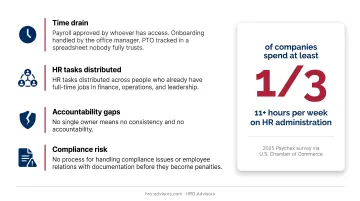
You know this pattern. Payroll gets approved by whoever has access. Onboarding is handled by the office manager when they have time. Employee complaints land with the founder. PTO is tracked in a spreadsheet nobody fully trusts.
There's no HR function here — just a loose collection of tasks distributed across people who already have full-time jobs.
According to a 2025 Paychex survey reported by the U.S. Chamber, one-third of companies spend at least 11 hours per week on HR administration. That's time being pulled from finance, operations, and leadership — functions that actually drive revenue.
Beyond the time drain, distributed HR creates accountability gaps. No single owner means no consistency, no one positioned to catch a compliance issue before it becomes a penalty, and no process for handling employee relations with any kind of fairness or documentation.
Sign 2: In-House HR Costs Are Consuming a Disproportionate Share of the Budget
Before deciding whether to hire internally, look at the real cost. The median annual salary for a human resources manager in the U.S. was $140,030 as of May 2024, according to the Bureau of Labor Statistics. Add benefits, HR software, employment law counsel, training, and compliance tools — and a single qualified hire represents a significant budget commitment before they've resolved a single issue.
For small and mid-sized businesses, outsourcing through a PEO typically delivers the equivalent of a full HR team at a fraction of that cost. Research published by NAPEO estimates average PEO cost savings at $1,775 per employee annually, with savings coming from internal HR salaries, health benefits, external HR expenditures, and workers' compensation — producing an estimated 27.2% ROI. (Note: this data is from 2019; treat as directional, not current pricing.)
The relevant comparison is PEO cost versus the true all-in cost of adequate in-house HR coverage — not PEO cost versus doing nothing.
Sign 3: Compliance Requirements Are Catching You Off Guard
Employment law doesn't sit still. Federal wage rules, state leave mandates, ACA reporting, pay transparency requirements, workplace safety standards — the list of obligations that apply to your business changes constantly, and it changes differently depending on which states you operate in.
For most small businesses, keeping pace with all of it is a full-time job that isn't assigned to anyone.
The consequence pattern is predictable: companies discover compliance gaps only after a penalty is issued, an audit is triggered, or an employee files a complaint. By that point, the exposure is already real.
Under the FLSA, back wages are recoverable for up to two years — three for willful violations — and employees can add liquidated damages and attorney fees on top.
Common compliance gaps that catch businesses off guard:
- Misclassifying employees as contractors
- Missing state-specific leave law updates
- Incomplete ACA reporting at the 50-employee threshold
- Wage and hour errors in overtime calculations
- Outdated employee handbook policies
If nobody owns this proactively, it defaults to reactive damage control.
Sign 4: You Can't Compete for Talent on Benefits
Smaller companies often lose candidates not on salary, but on benefits. The gap comes from purchasing power, not spending intent.
BLS data from March 2025 shows exactly how wide the disparity runs:
| Benefit | Fewer than 100 employees | 500+ employees |
|---|---|---|
| Medical care access | 59% | 90% |
| Retirement plan access | 59% | 90% |
| Dental care | 30% | 70% |
| Vision care | 21% | 44% |
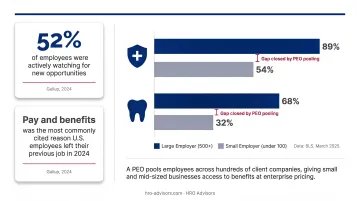
A PEO closes this gap by pooling employees from hundreds of client companies, giving small and mid-sized businesses access to benefits at enterprise pricing. For companies in competitive hiring markets — technology, life sciences, financial services, consulting — this single factor regularly changes the outcome of an offer.
Gallup's data confirms benefits are on candidates' minds: Pay and benefits was the most commonly cited reason U.S. employees left their previous job in 2024, and 52% of employees were actively watching for new opportunities.
Sign 5: Growth Plans Are Being Held Back by HR Infrastructure
Growth creates HR complexity that informal systems can't absorb. Common friction points include:
- Multi-state payroll compliance when hiring across jurisdictions
- Onboarding at volume without a repeatable, documented process
- Benefits administration that varies by state or employee classification
- Industry-specific regulatory requirements that emerge at scale
A spreadsheet and a part-time office manager are built for steady-state operations, not rapid expansion.
When HR becomes a bottleneck rather than an enabler, the question shifts from "should we outsource?" to "how quickly can we make the transition?"
A 2024 NAPEO-commissioned study found that PEO clients grew employment at 4.3% annually versus 1.9% for comparable non-clients, had 12% lower annual turnover, and were 50% less likely to go out of business. The study was commissioned, so treat the figures as directional — but the pattern is consistent: professional HR infrastructure during growth phases improves outcomes across hiring, retention, and business continuity.
What Happens When You Wait Too Long
Once the signs are visible, the most common response is rationalization. Business owners recognize the signs and plan to address them "when things slow down" or "after the next hire." Those timelines rarely materialize.
Each month of delay adds to the accumulated exposure:
- Compliance penalties from missed regulatory updates — costs that compound as FLSA and ACA obligations grow with headcount
- Turnover costs from benefits gaps or inconsistent onboarding experiences — Gallup estimates replacing an employee costs between one-half and two times their annual salary
- Payroll errors that erode employee trust and trigger complaints
- Staff burnout in whoever is managing HR informally — often a finance or operations person who shouldn't be doing it
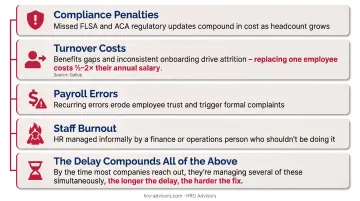
By the time most companies reach out for help, they're dealing with several of these simultaneously. The longer the delay, the harder the fix — and the more it costs to get there.
When Outsourcing HR Might Not Be the Right Fit
HR outsourcing isn't the right answer for every situation — and recognizing when to keep things in-house matters just as much as knowing when to hand them off.
In-house HR likely makes more sense when:
- You already have a well-staffed internal HR team with strong, working systems
- Your HR processes involve proprietary workflows or highly sensitive information that requires exclusive internal control
- Your headcount and operational complexity are minimal
A hybrid model is also worth considering. Outsourcing high-volume administrative functions — payroll processing, benefits administration, compliance monitoring — while retaining internal ownership of culture, conflict resolution, and strategic workforce planning is a practical arrangement many growing companies use. HRO Advisors works with businesses in this situation, running side-by-side comparisons of PEO and ASO providers to identify which functions make sense to outsource and which are better kept in-house.
How to Take the Next Step When You're Ready
Recognizing the signs is step one. The next step is choosing the right type of provider — and that decision matters.
Three main models to understand:
- PEO (Professional Employer Organization): A co-employment arrangement where the PEO becomes employer of record, giving you access to pooled benefits and shared compliance liability. Best fit for small to mid-sized businesses wanting comprehensive HR support.
- ASO (Administrative Services Organization): Handles administrative HR functions without co-employment. A practical option for businesses that want operational support while keeping full employer status in-house.
- HRO (HR Outsourcing): A broader term covering any arrangement where an external provider manages specific HR functions — no co-employment required. More common for larger businesses selecting targeted services.
With 500+ PEOs operating in the U.S., pricing, contract terms, service depth, and industry fit vary significantly. Selecting the wrong partner means switching costs on top of already elevated HR overhead — so the comparison process matters as much as the final decision.
HRO Advisors works as a PEO broker, comparing up to 8 providers side-by-side at no cost to you. Matches are based on your industry, headcount, compliance needs, and growth plans. HRO Advisors completes the comparison in under two weeks and negotiates pricing directly with the selected provider on your behalf.
Start the evaluation before the pain becomes urgent:
- Document your current HR costs across all categories — salary, software, legal, benefits overhead
- Identify which functions are creating the most burden or risk
- Run a structured comparison across providers rather than selecting on brand familiarity alone
HRO Advisors offers a free 15-minute consultation at no obligation — reach them at 866-755-0288 or info@hro-advisors.com.
Frequently Asked Questions
Can a company outsource HR?
Yes — companies of any size can outsource some or all HR functions, from payroll and benefits administration to full-service HR management. The main models are PEO (co-employment), ASO (administrative support without co-employment), and broader HRO arrangements depending on company size and specific needs.
At what point does a company need an HR department?
Most businesses begin to feel the need for structured HR support around 15–25 employees, when legal compliance obligations like Title VII apply and informal processes start breaking down. Outsourcing through a PEO can fulfill this need without requiring a full internal hire.
What HR functions should not be outsourced?
Company culture, internal conflict resolution, performance management strategy, and employee relations typically work best in-house. These functions require deep knowledge of individual team dynamics and organizational values that external providers can't fully replicate.
What is the most commonly outsourced HR activity?
Payroll processing is consistently the most commonly outsourced HR function, followed by benefits administration and compliance monitoring. These high-volume, error-prone tasks carry real legal risk — and the cost of getting them wrong makes professional handling worth it.
How much does it cost to outsource HR?
Costs vary by provider and company size, with most PEOs charging either a per-employee-per-month fee or a percentage of total payroll. Comparing multiple providers side-by-side helps match the right service level to your budget — HRO Advisors offers that comparison at no cost to you.
What is the difference between a PEO and HR outsourcing?
A PEO is one type of HR outsourcing built on a co-employment arrangement — the PEO becomes the employer of record, giving clients access to pooled benefits and shared liability. Broader HR outsourcing covers any external management of HR functions without that co-employment structure.