Federal FMLA sets only a minimum floor. States have built a layered — and often conflicting — patchwork of family and medical leave requirements on top of it. Some states require paid benefits. Some cover employers with as few as one employee. Others grant leave for reasons federal law doesn't recognize at all.
This guide covers the federal baseline, how state laws layer on top of it, the key differences that create compliance risk, common pitfalls multistate employers fall into, and a practical step-by-step strategy for staying compliant — including when partnering with a PEO makes sense.
Key Takeaways
- Federal FMLA is unpaid, applies to employers with 50+ employees, and provides up to 12 weeks of job-protected leave
- 13 states plus D.C. now have active paid family and medical leave programs — with Delaware, Minnesota, and Maine launching benefits in 2026
- State laws can cover employers with as few as one employee, meaning small businesses aren't exempt
- Leave laws apply where the employee works, not where the employer is headquartered
- A single uniform policy across all states means adopting the most generous standard in every dimension
Federal FMLA Basics: The National Baseline
The Family and Medical Leave Act applies to private employers with 50 or more employees for at least 20 workweeks in the current or preceding calendar year. Public agencies and schools are covered regardless of size.
Employee Eligibility
Not every employee at a covered employer qualifies. To be eligible, an employee must:
- Have worked for the employer for at least 12 months
- Have logged at least 1,250 hours in the prior 12-month period
- Work at a location where the employer has 50 or more employees within 75 miles
That 75-mile radius requirement has significant implications for remote workers, which is covered in a later section.
Leave Duration and Qualifying Reasons
Standard federal FMLA provides up to 12 workweeks per year. Military caregiver leave extends that to up to 26 workweeks in a single 12-month period for employees caring for a covered servicemember with a serious injury or illness.
Qualifying reasons under 29 CFR 825.112 include:
- Birth, adoption, or foster placement of a child
- Care for a spouse, child, or parent with a serious health condition
- The employee's own serious health condition that prevents them from performing job functions
- Qualifying military exigency involving a covered family member's active duty
- Military caregiver leave
Many state leave laws extend coverage to additional family relationships and qualifying events that federal FMLA doesn't address.
How State Leave Laws Layer On Top of Federal FMLA
Without a federal paid leave mandate, states have filled the gap on their own terms — and no two states have done it the same way. For multistate employers, that means tracking multiple overlapping frameworks simultaneously.
Four Categories of State Leave Laws
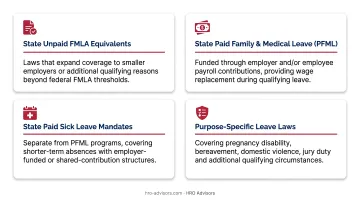
Multistate employers need to track four distinct types of state-level requirements:
- State unpaid FMLA equivalents — laws that expand coverage to smaller employers or additional qualifying reasons
- State paid family and medical leave (PFML) programs — funded through employer and/or employee payroll contributions, providing wage replacement during leave
- State paid sick leave mandates — separate from PFML, covering shorter-term absences
- Purpose-specific leave laws — covering pregnancy disability, bereavement, domestic violence, jury duty, and more
The PFML Expansion
According to NCSL (updated November 2025), 13 states and Washington, D.C. have enacted paid family and medical leave laws. New programs continue launching:
| State | Status |
|---|---|
| Delaware | Benefits live as of January 1, 2026 |
| Minnesota | Benefits begin January 1, 2026; 2026 premium rate is 0.88% |
| Maine | Benefits apply to time out of work on or after May 1, 2026 |
| Washington | Active; 2026 maximum weekly benefit is $1,647 |
The Location-Based Rule
Leave laws apply based on where the employee performs their work — not where the employer is headquartered. A Dallas-based company with a remote employee in California must comply with California's leave laws for that employee.
For federal FMLA purposes, 29 CFR 825.111 specifies that a remote employee's worksite is the office to which they report or from which assignments are made, not their home address. State programs each have their own coverage rules, so verify jurisdiction by jurisdiction.
Local Ordinances Add Another Layer
State law isn't always the final word. Cities and counties layer their own requirements on top — and in some markets, those local rules are stricter than state mandates.
Cities and counties have enacted their own requirements on top of state law:
- San Francisco: Paid Sick Leave Ordinance accrues 1 hour per 30 hours worked; separate Paid Parental Leave Ordinance applies to employers with 20+ employees worldwide
- New York City: Earned Safe and Sick Time Act requires written notice of employee rights in their primary language
- Chicago: Paid Leave and Paid Sick Leave Ordinance applies to Chicago businesses
- Philadelphia: Promoting Healthy Families and Workplaces ordinance covers paid sick leave
If your workforce includes employees in any of these cities, local compliance belongs on your checklist alongside state and federal requirements.
Key Differences Between Federal FMLA and State Leave Laws
Employer Size and Employee Eligibility Thresholds
Federal FMLA's 50-employee threshold excludes a large portion of employers. Many state laws do not:
| State | Employer Threshold |
|---|---|
| California (CFRA) | 5+ employees |
| New York (PFL) | 1+ employees |
| Colorado (FAMLI) | 1+ qualified employee |
| Oregon (Paid Leave) | All employers, regardless of size |
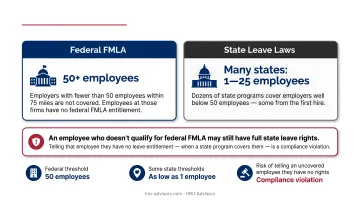
An employee who doesn't qualify for federal FMLA may still have full state leave rights. Telling that employee they have no leave entitlement — when a state program covers them — is a compliance violation.
Leave Duration
While federal FMLA caps at 12 weeks, several states allow more:
- Washington: Up to 16 weeks combined, or 18 weeks when a pregnancy-related serious health condition applies
- Minnesota: Up to 20 weeks combined per benefit year
- Massachusetts: Up to 20 weeks medical leave; up to 26 weeks total combined leave
A multistate employer applying a uniform policy at 12 weeks may be cutting off leave that employees are legally entitled to in certain states.
Paid vs. Unpaid — Wage Replacement Details
Federal FMLA is entirely unpaid. State PFML programs provide wage replacement, typically calculated as a percentage of the employee's average weekly wages up to a state-set cap. Current examples:
- California PFL: ~70–90% of wages, up to $1,765/week
- New Jersey FLI: 85% of average weekly wage, up to $1,119/week in 2026
- Washington PFML: Up to $1,647/week in 2026
These programs are funded through payroll contributions — by employers, employees, or both — with rates and cost-sharing formulas varying by state.
Documentation and Certification Differences
Applying federal FMLA documentation practices in every state is not safe. California's CFRA, for example, uses a state-specific certification form from the Civil Rights Department — and California law restricts what medical information an employer can request, making the standard federal FMLA certification form inappropriate for CFRA leave.
States also differ on several related requirements:
- Recertification frequency and triggers
- Whether second medical opinions are permitted
- What health information employers are allowed to collect
Default to state-issued forms whenever a state leave law applies alongside federal FMLA.
The ADA Overlap
When FMLA and state leave entitlements run out — or when an employee doesn't qualify for either — the Americans with Disabilities Act (ADA) may still require additional unpaid leave as a reasonable accommodation. EEOC guidance confirms employers must consider leave as an accommodation unless it creates undue hardship. This requires an interactive process and a case-by-case analysis.
Common Multistate FMLA Compliance Pitfalls
The "Federal FMLA Default" Trap
Many multistate employers process every leave request through federal FMLA procedures alone. That approach misses state-specific notice requirements, designation letters, more expansive eligibility rules, and paid benefit obligations. The legal exposure is real on all of those fronts.
The Remote Workforce Blind Spot
If HR doesn't actively track where employees are physically working, the company may unknowingly trigger leave obligations in states it hadn't accounted for. A single hire in a new state can create PFML registration requirements, new contribution rates, and posting obligations often within days of the employee's start date.
The Uniform Policy Problem
A single leave policy across all states sounds administratively clean, but it forces you to default to the most employee-favorable standard across every dimension:
- Highest leave duration
- Lowest eligibility threshold
- Most generous wage replacement
- No cost-sharing with employees
That combination typically costs more than any individual state actually requires. Most employers are better served by a federal base policy with state-specific addenda.
Failure to Stay Current
Multiple states launch or expand paid leave programs each year. Contribution rates reset annually, qualifying reasons broaden, and covered family relationships grow. Setting a policy and revisiting it every few years is not a compliance strategy — it's a liability.
Manager Retaliation Risk
Under 29 U.S.C. § 2615, it is unlawful to interfere with, restrain, deny, or discriminate against employees for exercising FMLA rights. Colorado's FAMLI program similarly protects employees from discrimination, retaliation, and interference. A demotion, schedule change, or termination that follows closely after a leave request can trigger a retaliation claim under federal law, state law, or both. Managers must be trained specifically on non-retaliation obligations — not just how to route leave paperwork.
Step-by-Step Compliance Strategy for Multistate Employers
Step 1 — Conduct a Leave Law Audit
Map every state and locality where you have employees. For each jurisdiction, document:
- Employer size threshold
- Employee eligibility criteria
- Leave duration and qualifying reasons
- Whether benefits are paid or unpaid
- Contribution rates and funding mechanism
- Notice and posting requirements
- State-specific forms
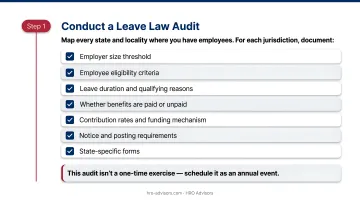
This audit isn't a one-time exercise — schedule it as an annual event.
Step 2 — Update Policies and Employee Handbooks
A single generic leave policy is not enough. Build a federal FMLA base section, then add state-specific addenda for each jurisdiction where you have employees. Each addendum should address what's different — not just repeat the federal rules.
Don't overlook new-hire notice requirements and workplace posting obligations. Massachusetts, for example, requires all employers to display a PFML workplace poster regardless of size.
Step 3 — Align HR, Payroll, and Legal Teams
Most compliance failures trace back to internal misalignment, not ignorance of the law. Each team carries distinct responsibilities:
- Payroll: Apply correct contribution codes and rates for each state's PFML program
- HR: Track triggering events and documentation requirements by jurisdiction
- Legal: Step in for complex scenarios — intermittent leave disputes or overlapping state and federal claims
Step 4 — Use Jurisdiction-Specific Documentation
Use state-issued forms wherever they exist. California's CFRA certification form, New York's PFL forms, Washington's employer reporting tools — these aren't optional alternatives to federal forms. They're the appropriate documents for those jurisdictions, and using them creates a more defensible compliance record.
Step 5 — Build an Ongoing Monitoring System
Designate an HR owner responsible for tracking leave law changes in each state where you have employees. Set up legislative alerts and schedule at least one annual policy review cycle.
States with programs launching in 2026 — Delaware, Minnesota, Maine — are a timely reminder that the landscape shifts constantly. Early awareness gives employers time to adapt; last-minute scrambles rarely do.
How a PEO Can Help Manage Multistate Leave Compliance
For growing businesses expanding into new states, tracking a patchwork of FMLA obligations, PFML contribution rates, local ordinances, and documentation rules can overwhelm internal HR and payroll teams. Miss a filing deadline or misclassify a leave type, and you're looking at back pay, penalties, and potential litigation.
A Professional Employer Organization (PEO) can absorb much of that complexity. PEOs that specialize in multistate compliance typically handle:
- Leave administration and employee notifications across jurisdictions
- PFML contribution tracking and remittance for each state program
- Policy updates triggered by new or amended state laws
- Compliance monitoring to catch regulatory changes before they become violations
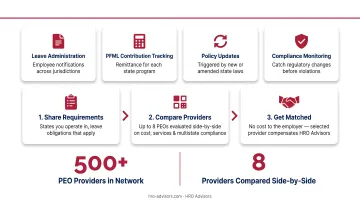
The challenge is finding a PEO with demonstrated expertise in the specific states where you operate — not all providers cover the same jurisdictions equally. HRO Advisors helps businesses solve that problem by matching them to the right PEO from a network of 500+ providers. The process starts by collecting your compliance requirements — which states you operate in, which obligations apply — then compares up to eight PEO providers side-by-side on cost, services, and multistate compliance capabilities.
The service costs nothing to the employer — the selected provider compensates HRO Advisors directly. For businesses managing leave obligations across multiple states, that means getting an expert comparison at no cost, with compliance coverage as a core filter — not an afterthought.
Frequently Asked Questions
Are FMLA rules different in different states?
Yes. Many states have enacted leave laws that expand on federal FMLA — covering smaller employers, adding paid wage replacement, or extending leave duration. Employers must comply with whichever law is most protective of the employee in each jurisdiction.
What medical conditions qualify for FMLA?
Federal FMLA covers "serious health conditions" — illnesses, injuries, or physical/mental conditions requiring inpatient care or continuing provider treatment (29 CFR 825.113). State laws often expand this to additional conditions or family relationships not covered federally.
Does FMLA apply to employers with fewer than 50 employees?
Federal FMLA does not. However, many state leave programs cover much smaller employers — New York and Colorado apply to employers with just one employee, and California's CFRA kicks in at five employees. Smaller multistate businesses cannot assume they have no leave law obligations.
Which state's leave law applies when an employee works remotely in a different state than the employer?
Leave laws generally apply based on where the employee performs their work. A remote employee physically working in California is covered by California's leave laws even if their employer is headquartered elsewhere — so tracking work locations, not just home addresses, matters.
Can an employer use one leave policy for all states?
Possible, but it means adopting the most generous standard across every state — highest duration, lowest eligibility threshold, maximum wage replacement — which can significantly increase costs. Most multistate employers use a federal FMLA base policy supplemented by state-specific addenda.
What happens when federal FMLA and state leave laws conflict?
Federal FMLA sets the floor. Where state law provides greater protections, state law controls — employers must apply whichever provision is more favorable to the employee in each specific instance.