Here's what makes this particularly urgent: the Nonprofit Risk Management Center reports that wrongful employment-practices claims represent more than 90% of claims filed under several nonprofit directors and officers liability programs. A well-built handbook won't eliminate that risk, but it's your first line of defense.
This guide covers what a nonprofit handbook must include, which policies are legally required based on your employee count, how nonprofit handbooks differ from corporate ones, and a practical process for building and maintaining one.
Key Takeaways
- Nonprofits are not exempt from federal and state employment laws — tax-exempt status changes your tax obligations, not your HR obligations
- Handbook content must address nonprofit-specific realities: volunteer roles, conflict of interest policies, and IRS compliance requirements
- Required policies vary significantly by employee headcount — thresholds at 15, 50, and 100 employees each trigger new federal obligations
- A handbook only protects your organization if employees receive it, acknowledge it in writing, and can access it whenever needed
- Annual reviews are essential: laws change, and an outdated handbook can expose your organization to more legal risk than having none
Why Every Nonprofit Needs an Employee Handbook
The Employment Law Misconception
The National Council of Nonprofits states plainly that being exempt from federal income tax does not exempt an organization from state and federal employment laws. This misconception persists — and it's costly when it goes uncorrected.
DOL Fact Sheet #14A explains that FLSA coverage for nonprofits depends on two key criteria:
- The organization has at least $500,000 in annual gross volume from ordinary commercial activities
- Individual employees engage in interstate commerce through calls, mail, or shipments
Many nonprofits meet one or both criteria without realizing it.
State laws add further complexity — lower employee-count thresholds, additional leave requirements, pay transparency rules, and harassment training mandates that vary by jurisdiction.
Three Reasons a Handbook Protects Your Organization
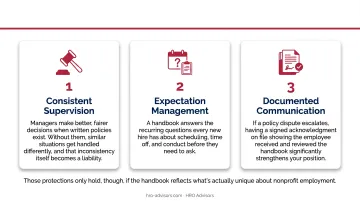
- Consistent supervision — Managers make better, fairer decisions when written policies exist. Without them, similar situations get handled differently, and that inconsistency itself becomes a liability.
- Expectation management — A handbook answers the recurring questions every new hire has about scheduling, time off, and conduct before they need to ask.
- Documented communication — If a policy dispute escalates, having a signed acknowledgment on file showing the employee received and reviewed the handbook significantly strengthens your position.
Those protections only hold, though, if the handbook reflects what's actually unique about nonprofit employment.
What Makes a Nonprofit Handbook Different
A corporate HR handbook and a nonprofit handbook share the same legal scaffolding — but the content diverges in several meaningful ways:
- Mission and values section — Not just culture-building fluff. In nonprofits, reminding employees why their work matters is directly tied to retention
- Conflict of interest policy — Required for IRS compliance and board governance integrity; rarely found in for-profit handbooks
- Volunteer guidelines — Volunteers aren't covered by employment law, but their conduct still reflects on the organization
- Grant-funded role disclaimers — Positions tied to specific grants need language about what happens when funding ends
The volunteer distinction deserves particular attention. The DOL's FLSA advisor confirms that individuals may volunteer for nonprofits when services are offered freely and without expectation of compensation.
The catch: nonprofit employees cannot volunteer to perform the same services they're paid to do. That line must be clearly drawn in your handbook to avoid misclassification exposure.
Nonprofit Employee Handbook Template: What to Include
Think of this section as a working framework — the core sections every nonprofit handbook needs, in the order they typically appear.
Organizational Foundation
Open with your mission, vision, values, and a brief organizational history. This anchors the entire document in purpose. Two legal essentials follow:
- At-will employment statement (if you operate in an at-will state, which covers nearly every US state — Montana is the sole exception)
- Disclaimer that the handbook is not an employment contract — this protects the organization from employees arguing the handbook created implied contractual rights
Employment Basics
This section establishes the structural rules of employment:
- Job classifications — full-time, part-time, temporary, and critically, exempt vs. non-exempt under FLSA
- Standard working hours and attendance expectations
- Remote and hybrid work policies, if applicable
- The onboarding process and new hire documentation requirements
Compensation and Benefits
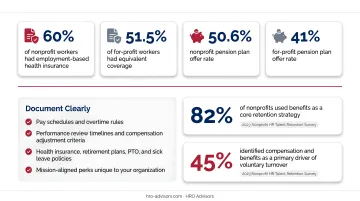
Most nonprofits underestimate what they actually offer. A 2024 Bureau of Labor Statistics analysis found that 60% of nonprofit workers had employment-based health insurance, compared to 51.5% of for-profit workers — and pension plan offer rates of 50.6% in nonprofits versus 41% in for-profits.
Document clearly:
- Pay schedules and overtime rules
- Performance review timelines and how compensation adjustments are determined
- Health insurance, retirement plans, PTO, sick leave policies
- Any mission-aligned perks unique to your organization
The 2023 Nonprofit HR Talent Retention Survey found 82% of nonprofits used benefits as a core retention strategy, and 45% identified compensation and benefits as a primary driver of voluntary turnover. If your benefits are competitive, your handbook is where that case gets made — or lost.
Workplace Policies
Day-to-day operational policies belong here:
- Technology and social media use (particularly important given how public-facing most nonprofits are)
- Expense reimbursement procedures
- Remote work guidelines and expectations
- Confidentiality and nondisclosure expectations around donor data, client information, and organizational financials
- Workplace safety protocols under OSHA
Nonprofit-Specific Policies
Four areas go beyond standard HR policy and reflect the unique legal and operational landscape of nonprofit work:
Conflict of Interest Policy — IRS Form 990 asks directly whether this policy exists. The IRS doesn't require it for tax-exempt status, but operating without one signals weak governance and creates real board-level exposure.
Whistleblower Policy — Federal law bars retaliation against employees who report financial or accounting concerns — and Form 990 asks whether a written policy is in place. New York goes further: nonprofits with 20+ employees and annual revenue over $1 million must adopt one under state law.
Volunteer Guidelines — Define the scope of volunteer roles, behavioral expectations, and the clear boundary between volunteer and employee responsibilities. Volunteers aren't covered by the same employment laws as staff, but this section protects the organization when lines blur.
Grant-Funded Role Disclaimers — Positions tied to a specific grant need language that makes the contingent nature of that employment explicit, including what happens if the funding ends.
Employee Conduct and Grievance
This section is the organization's primary defense against employment claims:
- Code of conduct and behavioral expectations
- Anti-harassment and anti-discrimination policies (federally required at 15+ employees)
- Progressive discipline procedures — including documentation requirements at each stage
- Grievance and complaint process — how employees report concerns and how the organization investigates them
Documented procedures do more than reduce legal risk — employees who see a real, functional complaint process are more likely to raise concerns internally rather than escalating externally.
Required vs. Recommended Policies for Nonprofits
What you must include depends on two factors: where you operate and how many employees you have. State and local laws frequently impose lower thresholds and additional requirements beyond what federal law mandates. Always confirm your specific obligations with an employment attorney who knows your jurisdiction.
Legally Required Policies by Employee Count
The table below covers federal minimums. Your state may require more — and at lower headcounts.
| Threshold | Federal Requirement |
|---|---|
| All employers | OSHA workplace safety compliance; FLSA wage and hour compliance (where covered); tax withholding obligations |
| 10+ employees | OSHA injury and illness recordkeeping (Forms 300, 300A, 301) |
| 15+ employees | ADA accommodations policy; Title VII non-discrimination; anti-harassment/sexual harassment policy; Equal Pay Act compliance (note: the EPA technically covers virtually all employers) |
| 50+ employees | FMLA policy (also requires 50 employees within 75 miles of the work location) |
| 100+ employees | WARN Act — 60 days' advance notice required for qualifying plant closings and mass layoffs |
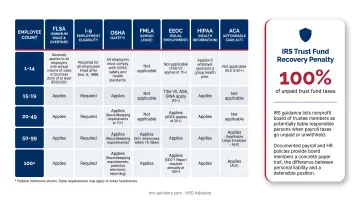
One often-overlooked risk: the IRS Trust Fund Recovery Penalty. IRS guidance explicitly lists members of a board of trustees for nonprofit organizations as potentially liable responsible persons when payroll taxes go unpaid or unwithheld. The penalty equals 100% of unpaid trust fund taxes.
Documented payroll and HR policies give board members a concrete paper trail — evidence that proper processes were in place and followed. That documentation can make the difference between personal liability and a defensible position.
Recommended Nonprofit-Specific Policies
These aren't legally required in most jurisdictions, but they're considered standard practice for well-governed nonprofits:
- Conflict of interest policy — Directly affects IRS scrutiny and board credibility
- Whistleblower protections — Form 990 asks; more than 45 states have related whistleblower laws
- Document retention and destruction policy — Form 990 asks this too; destroying records to obstruct a federal investigation carries Sarbanes-Oxley-related criminal liability
- Social media policy — Reduces reputational risk when staff represent the organization publicly to donors, clients, and the communities you serve
- Volunteer conduct guidelines — Protects the organization even when volunteers aren't covered by employment law
- DEI commitment statement — Now a standard expectation among donors, funders, and prospective employees evaluating nonprofits
How to Build and Implement Your Nonprofit Handbook
Step 1: Audit and Research
Start by reviewing any existing policies — even informal ones. Identify gaps, then research applicable federal and state laws for every location where you have employees. Gather input from department leads, your legal counsel, and any HR staff or advisors. Don't assume your existing practices are compliant simply because they haven't been challenged yet.
Step 2: Draft with Clarity
Write for your actual employees, not for lawyers. Practical guidance:
- Use plain language — avoid phrases that require a law degree to interpret
- Use consistent formatting throughout (headers, bullet points, numbered steps)
- Bold critical clauses like at-will statements and acknowledgment requirements
- Match the tone to your organizational culture — a community health nonprofit and a professional association can have similar legal content and very different voices
- Don't copy-paste generic corporate templates without adapting them to nonprofit realities
Step 3: Get Legal Review
Before the handbook is finalized, a licensed employment attorney familiar with your specific jurisdiction(s) must review it. This is not optional — it's the single most important safeguard against creating policies that inadvertently violate state or local law. The cost of a legal review is a fraction of the cost of a single employment claim.
Step 4: Distribute and Document Acknowledgment
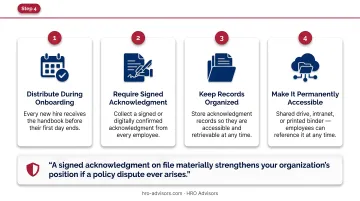
- Distribute the handbook during onboarding — every new hire, before their first day ends
- Require a signed or digitally confirmed acknowledgment from every employee
- Keep acknowledgment records organized and accessible
- Make the handbook permanently accessible — shared drive, intranet, printed binder — so employees can reference it at any time
A signed acknowledgment on file materially strengthens your organization's position if a policy dispute ever arises.
Step 5: Offload the Administrative Work
For most nonprofits — especially smaller organizations without dedicated HR staff — managing handbook compliance, policy updates, payroll, and benefits is a real drain on time that could go toward program delivery.
Working with a PEO (Professional Employer Organization) through a broker like HRO Advisors gives nonprofits access to compliant policy frameworks and enterprise-level benefits that would otherwise be out of reach. HRO Advisors matches nonprofits with PEOs that understand the sector: grant-funded positions, Form 990 compliance, and the specific constraints of mission-driven organizations. The service costs the nonprofit nothing; HRO Advisors is compensated by the selected provider, and their negotiation process is designed to lower total HR costs — clients report savings of up to 40%.
How to Keep Your Nonprofit Handbook Current
A handbook is a living document. Laws change, benefit packages evolve, and your organization grows past thresholds that trigger new compliance requirements.
Brightmine's 2024 Employee Handbook Survey found that 12% of respondents reported handbook mistakes resulted in monetary repercussions — legal fees, settlements, or fines. The same research found less than half of HR professionals feel "very confident" their handbooks reflect current legal requirements.
Recommended review cadence:
- Annual review at minimum — calendar a specific date each year
- Triggered reviews any time a significant law changes (federal or state), your organization crosses a new employee-count threshold, or you add operations in a new state
- Version control — retain historical copies of previous handbook editions; they may be needed for legal reference in disputes involving past employees
Maintaining that cadence requires clear ownership. Designate a specific person to own this process: your HR lead, operations director, or an outside HR advisor.
Before each update, gather input from the people who use the handbook daily:
- Ask employees which policies feel unclear or inconsistently applied
- Check with managers about edge cases that came up since the last review
- Review any HR complaints or disputes that exposed policy gaps
Staff on the ground often catch what leadership miss — and their input makes updates more practical and credible.
Frequently Asked Questions
Do nonprofits need an employee handbook?
No federal law universally mandates a written handbook, but HR and legal professionals strongly recommend one for every employer. It protects the organization in disputes, sets clear expectations, and gives supervisors a consistent framework for treating employees fairly.
What policies are legally required in a nonprofit employee handbook?
It depends on your employee count and state law. Anti-harassment and ADA policies are federally required at 15+ employees; FMLA applies at 50+; and the WARN Act triggers at 100+. State laws often set lower thresholds. Consult an employment attorney to confirm exactly what applies to your organization.
How is a nonprofit employee handbook different from a for-profit one?
Nonprofit handbooks typically include mission and values as a cultural foundation, a conflict of interest policy tied to IRS compliance, whistleblower protections (which Form 990 asks about directly), and volunteer conduct guidelines — none of which commonly appear in standard corporate handbooks.
Should volunteers be covered in a nonprofit employee handbook?
Volunteers are legally distinct from employees and aren't covered by the same employment laws. Even so, nonprofits should either include a dedicated volunteer section in the handbook or maintain a separate volunteer policy document that defines conduct expectations and protects the organization from liability.
How often should a nonprofit update its employee handbook?
At minimum, once a year. Also update immediately when laws change, when the organization grows past a new employee-count compliance threshold (15, 50, or 100 employees are the key federal triggers), or when major internal policies change. Outdated handbooks can create more exposure than no handbook at all.
What happens if a nonprofit doesn't have an employee handbook?
If an employment dispute arises, the organization has no written evidence that policies were communicated or consistently applied. That gap makes defending against claims harder and legal costs considerably higher.