
The real cost of an employee isn't what shows up on their paycheck. It's wages plus employer payroll taxes, benefits contributions, workers' compensation premiums, and the administrative cost of processing payroll itself. Miss any of those, and your budget is off before the first pay period closes.
Two mistakes show up most often: underestimating the true per-employee cost, and choosing a payroll management approach that doesn't fit the business's size or complexity. Both are fixable — but you have to know what you're actually measuring.
This guide breaks down every component of payroll cost, current pricing ranges for different management approaches, the variables that drive costs up or down, and a practical formula for budgeting accurately in 2026.
Key Takeaways
- Total payroll cost per employee typically runs 1.25x–1.4x base salary once taxes, benefits, and admin are factored in
- Full-service payroll software generally costs $40–$100/month base + $6–$12 per employee
- Employee count, payroll frequency, industry type, and multi-state operations drive the widest cost swings
- Outsourcing payroll is often cheaper than in-house management once errors, penalties, and staff time are counted
- NAPEO research shows PEOs deliver a 27.2% ROI — making them one of the highest-return options for reducing payroll costs
What Are Payroll Costs for Small Businesses?
Payroll costs are the total employer expense of compensating workers — not just gross wages, but every dollar a business absorbs on top of each paycheck.
The Core Components
Every small business owner should account for these four categories:
- Gross wages — hourly pay, salaries, piece-rate, commissions, and bonuses
- Employer payroll taxes — FICA (Social Security at 6.2% on wages up to $184,500, plus Medicare at 1.45% with no wage cap), FUTA at 6.0% on the first $7,000 per employee, and state unemployment taxes (SUTA) that vary by state
- Benefits contributions — employer share of health insurance premiums, retirement matching, paid time off accruals, and workers' compensation insurance
- Payroll administration costs — software subscriptions, per-run processing fees, staff time, or outsourced service fees
The 1.25x–1.4x Rule of Thumb
Once all employer-side costs are summed, total payroll cost per employee typically runs 1.25x to 1.4x their base salary. BLS March 2026 data puts private-industry wages at $32.60/hour and benefits at $14.01/hour — a total compensation multiplier of 1.43x wages before administrative overhead.
In practical terms:
| Employee | Base Pay | Estimated Total Cost (1.3x) |
|---|---|---|
| $20/hr full-time (~$41,600/yr) | $41,600 | ~$54,080 |
| $60,000/yr salaried | $60,000 | ~$78,000 |
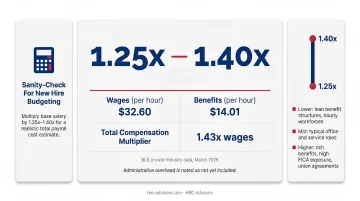
Use this multiplier as a sanity check when budgeting for new hires. That said, the multiplier isn't fixed — industry type can push it considerably higher or lower.
Why Industry Matters
Workers' compensation premiums alone can move the needle on total payroll costs. A Texas insurance-industry rate survey illustrates the spread clearly:
| Industry | Workers' Comp Rate per $100 Payroll |
|---|---|
| Clerical office work | $0.07–$0.26 |
| Retail stores | $0.69–$2.31 |
| Roofing contractors | $4.36–$21.28 |
A construction company with $500,000 in annual payroll could pay $20,000+ more in workers' comp premiums annually than a professional services firm with the same headcount.
What Payroll Services Don't Cover
One common point of confusion: a payroll service provider's monthly fee covers payroll processing — not total payroll costs. Workers' comp insurance premiums, health insurance contributions, and state unemployment insurance are separate expenses.
The service fee handles the calculation, filing, and deposit mechanics. Budget for those underlying costs independently — they're typically where the real variation between businesses appears.
How Much Does Payroll Cost for Small Businesses in 2026?
Payroll service pricing has no fixed number — it scales with headcount, features needed, and how much compliance risk you want to carry yourself. Underbudgeting leads to cash flow gaps; choosing an underpowered system for a growing team leads to compliance errors and IRS penalties.
The three tiers below map to those tradeoffs directly — pick the wrong one and the cost difference shows up in penalties, not just invoices.
| Tier | Monthly Base | Per-Employee Fee | Tax Filing Included |
|---|---|---|---|
| Basic / DIY | $17–$37 | $4–$6 | No (owner-managed) |
| Mid-Range Full-Service | $49–$88 | $6–$6.50 | Yes |
| HR + Payroll / PEO | $150+, or 3%–8% of payroll | $500–$1,500/yr | Yes, plus HR compliance |
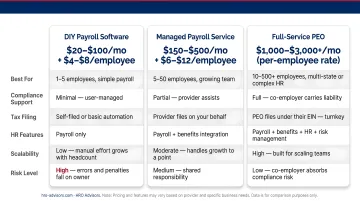
Basic / DIY or Entry-Level Software
Manual payroll or entry-level software. Patriot Software's Basic plan starts at $17/month + $4/worker; its Full Service plan runs $37/month + $5/worker. Square Payroll's full-service tier is $35/month + $6/person. Wage calculations and direct deposit are standard — but the owner handles tax filings.
Best for solo operators or businesses with 1–5 employees who can absorb the time cost of managing compliance manually.
One real risk: basic tiers typically exclude automated tax filing. A missed deposit triggers penalties that escalate fast — 2% for deposits 1–5 days late, up to 15% if unpaid after an IRS notice.
Mid-Range / Full-Service Online Payroll
This tier covers automated federal and state tax filing, W-2/1099 generation, new-hire reporting, and employee self-service. OnPay and Gusto both start at $49/month + $6/person; QuickBooks bundles run around $88/month + $6.50/employee before promotions.
Best fit for businesses with 5–50 employees who want to minimize compliance risk without hiring a dedicated payroll specialist. The platform handles filings — you focus on the business.
High-End / Comprehensive HR + Payroll or PEO
All-in-one HR and payroll platforms start at $150+/month. PEO arrangements run roughly 3%–8% of total payroll, or $500–$1,500 per employee per year. Both include benefits administration, HR compliance, risk management, and access to group health plan pricing that smaller businesses can't typically access on their own.
Right fit for businesses with 10+ employees where benefits costs, multi-state compliance, and talent retention are genuine operational priorities — the kind that show up in turnover rates and recruiting costs when ignored.
Key Factors That Drive Payroll Costs Up or Down
Two businesses with the same headcount can have wildly different payroll costs depending on these variables.
Number of Employees and Payroll Frequency
Most payroll providers charge per-employee fees, so headcount scales cost directly. Payroll frequency matters just as much, especially with per-run pricing models.
A 10-person team running weekly payroll completes roughly 52 runs per year. Bi-weekly cuts that to 26; monthly to 12. With per-run pricing, that difference adds up fast. Providers like OnPay and Square include unlimited pay runs in their monthly fee — worth factoring in if you run payroll frequently.
Industry and Workers' Compensation Rates
Workers' comp premiums are assigned by industry risk classification codes, and the spread is steep. The Texas rate data above shows roofing contractors paying 60x more per $100 of payroll than clerical workers. For construction, manufacturing, and healthcare businesses, this isn't a rounding error — it can represent tens of thousands of dollars annually.
Employee Benefits Package
Health insurance is typically the largest non-wage payroll cost. According to KFF's 2025 Employer Health Benefits Survey, average annual premiums run $9,325 for single coverage and $26,993 for family coverage. Employers cover the majority of that cost.
Add 401(k) matching, bonuses, and supplemental benefits, and employer benefits contributions can add 10%–20% to total payroll costs on top of wages.
Multi-State Operations
Each state has its own withholding rates, unemployment tax wage bases, and local payroll tax rules. The gap between states can be dramatic:
- Washington UI wage base: $78,200
- Florida UI wage base: $7,000
Operating in both means tracking entirely different rate structures, deadlines, and filing requirements. Most payroll providers charge additional fees for multi-state processing — and the compliance complexity scales with every state you add.
Worker Classification
Misclassifying an employee as an independent contractor is one of the most expensive payroll mistakes possible. The IRS is clear: employers may be liable for all employment taxes owed on a misclassified worker, plus penalties and interest.
Under IRS Section 3509, even the more lenient partial liability rates apply — 1.5% of wages for income tax withholding and 20% of the employee FICA share. Intentional misclassification triggers significantly higher rates with no cap on exposure.
In-House vs. Outsourced Payroll: What Actually Costs More?
Most small business owners assume handling payroll internally saves money. Once you account for time, error risk, and software overhead, that assumption rarely holds up.
The Hidden Costs of In-House Payroll
The real cost comparison requires looking at four factors:
- Staff time — The NSBA's 2025 taxation survey found small businesses spend an average of 4.9 hours per month on federal tax administration. Payroll is a significant portion of that time.
- Error risk — IRS failure-to-deposit penalties escalate from 2% to 5%, 10%, and 15% based on how late and how far the IRS has to chase. A single miscalculation can wipe out months of cost savings.
- Software still required — Even "in-house" payroll usually requires payroll software, so the cost gap between DIY and outsourced is smaller than it appears.
- Scalability breaks down — Manual or minimally automated payroll works at 2–3 employees. At 10–20, the error rate climbs and the time cost multiplies.
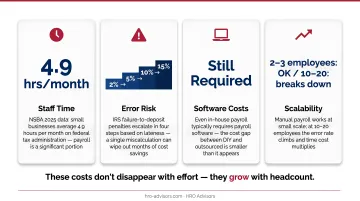
These costs don't disappear with effort — they grow with headcount. That's what makes the alternatives worth a closer look.
The Middle-Ground Options
The choice isn't binary. Three practical models exist:
- Basic software: Reduces time cost, but owner still manages compliance
- Full-service payroll software: Automates tax filing and compliance at $40–$100/month base; the most efficient option for 5–50 employees
- PEO arrangement: Co-employs staff, absorbs compliance liability, and uses group purchasing to reduce per-employee benefits costs. NAPEO research documents a 27.2% ROI from cost savings alone for PEO users
For businesses comparing these models, HRO Advisors offers a free side-by-side evaluation of up to 8 payroll and PEO providers, with no cost or obligation to the business.
How to Estimate Your Payroll Budget and Reduce Costs
Getting your payroll budget right requires two things: an accurate per-employee cost formula and a clear picture of where you're overspending. Here's how to approach both.
The Budgeting Formula
For each employee:
(Gross annual wages) + (Employer FICA: 7.65% of wages) + (FUTA: 6.0% on first $7,000) + (SUTA per your state) + (Benefits contributions) + (Admin/processing costs) = Total annual cost per employee
Multiply by headcount, then apply the 1.25x–1.4x rule as a sanity check. If your multiplier lands outside that range, something is either undercounted or over-budgeted.
How to Reduce Payroll Costs Without Cutting Pay
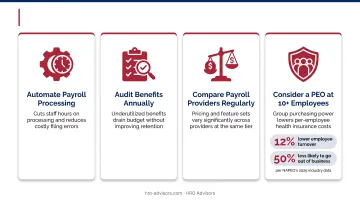
- Automate payroll processing — cuts staff hours on processing and reduces costly filing errors
- Audit your benefits package annually — underutilized benefits drain budget without improving retention
- Compare payroll providers regularly — pricing and feature sets vary significantly across providers at the same tier
- Consider a PEO at 10+ employees — group purchasing power lowers per-employee health insurance costs; PEO users also see 12% lower employee turnover and are 50% less likely to go out of business, per NAPEO's 2025 industry data
Three Fixable Cost Leaks
- Paying for payroll features you don't use — audit your software plan against actual usage
- Running payroll more frequently than legally required — weekly payroll on a per-run pricing model costs significantly more than bi-weekly
- Delaying the switch from manual to automated systems — every month of delay costs staff time and compounds error exposure
What Most Small Business Owners Get Wrong About Payroll Costs
Three mistakes consistently derail payroll budgets — often before the end of Q1.
- Budgeting only for base salary. Hiring someone at $60,000/year puts the real cost closer to $78,000 once you factor in employer taxes, benefits, and admin overhead. Skipping that math creates payroll gaps fast.
- Treating compliance as optional. The IRS failure-to-deposit penalty escalates to 15% — before interest and misclassification liability. One missed deposit can cost more than a full year of payroll software fees.
- Picking the cheapest plan without checking total cost. A $17/month basic plan that excludes tax filing, charges separately for W-2s, and lacks multi-state support can run higher than a $49/month full-service provider. Monthly price and total cost are two different numbers.
Frequently Asked Questions
How much should I pay for payroll services for a small company?
Most small businesses using full-service payroll software pay $40–$100/month base plus $6–$12 per employee. The right spend depends on headcount, payroll frequency, and whether you need automated tax filing — which most businesses with more than a handful of employees do.
What is included in payroll costs beyond employee wages?
The employer's share of FICA taxes (7.65%), FUTA, state unemployment insurance, workers' compensation premiums, benefits contributions, and payroll processing fees all sit on top of gross wages. Together, these add 25%–40% to what any employee actually costs.
Is it cheaper to do payroll in-house or outsource it?
Outsourcing is usually more cost-effective once you account for staff time, software costs, and penalty risk — especially once you exceed 5–10 employees. The time savings alone often justify the cost of a full-service provider.
How do payroll taxes affect total payroll costs?
Beyond the FICA and FUTA taxes covered above, SUTA rates vary significantly by state and employer experience rating. That variability can swing your total payroll tax burden by several percentage points — making state-level compliance one of the harder costs to predict when hiring.
What is the 1.25x–1.4x rule for calculating payroll costs?
It means a $50,000/year employee actually costs the employer $62,500–$70,000 when all employer-side costs are included. Use it as a quick budget check when planning hires.
Can a PEO help a small business reduce payroll costs?
Yes — PEOs co-employ workers and use pooled buying power to reduce benefits costs across their client base. NAPEO documents a 27.2% ROI from PEO cost savings. HRO Advisors offers a free, side-by-side PEO comparison with direct negotiation on your behalf.