
The problem? The market is crowded. Pricing ranges from $199 to $600+ per employee per month on publicly listed plans alone, and providers vary dramatically in how they deliver compliance — some through wholly owned legal entities, others through local partner networks. Pick the wrong one and you've traded one set of risks for another.
This guide covers the 10 best EOR services available today, what sets each apart, how they're priced, and what to look for before signing a contract.
Key Takeaways
- EOR services let companies hire internationally without setting up a local legal entity — the EOR becomes the legal employer.
- Public starting prices range from $199 to $599 per employee per month; enterprise providers like G-P and Rippling require custom quotes.
- Budget-focused teams often choose Remofirst; mid-market companies lean on Deel or Remote.com; enterprise operations typically need G-P.
- The most important evaluation criteria: entity ownership model, pricing transparency, country coverage, compliance depth, and support quality.
- EOR and PEO serve different needs — EORs cover international hiring; PEOs handle domestic co-employment for US-based teams.
What Is an Employer of Record (EOR)?
An EOR is a third-party company that becomes the legal employer of workers on a client's behalf — handling payroll, tax filings, statutory benefits, and employment contracts — while the client retains day-to-day management control. As the U.S. Chamber of Commerce explains, the key structural difference from a PEO is that an EOR legally employs the workforce, while a PEO operates under a co-employment arrangement that requires the client to already have a domestic legal entity.
When companies use an EOR:
- Hiring remote workers in countries where the company has no entity
- Testing a new market before committing to a permanent local setup
- Onboarding contractors who need to be converted to full employees
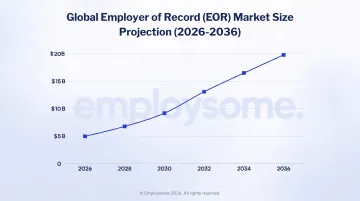
That demand adds up fast. Custom Market Insights projects the global EOR market will reach $6.82 billion in 2025 — a figure that reflects how quickly cross-border hiring has become standard practice, not a workaround.
Top 10 Best Employer of Record Services
These providers were evaluated on compliance reliability, country coverage, pricing transparency, platform quality, and client support.
Deel
Deel is one of the largest global employment platforms by customer count, operating across 150+ countries. It owns entities and its payroll engine in 130+ countries — meaning fewer compliance handoffs than competitors who rely on third-party local partners.
What sets it apart: A free HRIS tier for up to 200 workers, same-day contract generation, AI compliance monitoring, and 120+ software integrations make Deel one of the more complete platforms on the market. G2 and Capterra reviews flag mixed experiences with customer support response times and pricing clarity in certain markets.
| Attribute | Details |
|---|---|
| Best For | Mid-size teams wanting an integrated EOR and contractor management platform |
| Key Features | Global payroll, free contractor management, AI compliance monitoring, same-day contract generation |
| Starting Price | $599/employee/month |
Remote.com
Remote operates exclusively through owned legal entities — no third-party subcontractors — in 100 EOR countries as of mid-2026. That ownership model gives it direct accountability for compliance and stronger IP protection.
What sets it apart: No upfront deposits, no onboarding fees, no setup fees, and transparent FX rates. A 15% discount applies to startups and social-purpose organizations. Contractor management starts free. The owned-entity footprint is smaller than some competitors (90–100 countries versus 150+), and there's no free contractor management tier at scale.
| Attribute | Details |
|---|---|
| Best For | Companies hiring engineers or IP-sensitive roles internationally |
| Key Features | Owned entities in all EOR markets, no hidden FX markups, free HRIS tier, contractor management |
| Starting Price | $599/employee/month (reduced from $699) |
G-P (Globalization Partners)
G-P is widely recognized as a pioneer of the EOR category, with 180+ markets and a wholly-owned entity model that provides consistent compliance accountability across complex jurisdictions. It's the default choice for enterprise teams managing multi-country hiring simultaneously.
What sets it apart: Deep owned-entity compliance network, dedicated account management, and enterprise HRIS/ERP integrations. Pricing is custom-quoted only — no public rates — which makes it less transparent for budget planning. Third-party sources suggest rates run higher than mid-market providers, making G-P less cost-effective for teams with fewer than 10 international hires.
| Attribute | Details |
|---|---|
| Best For | Enterprise organizations hiring across many complex jurisdictions simultaneously |
| Key Features | 180+ wholly-owned entities, enterprise HRIS/ERP integrations, dedicated account management |
| Starting Price | Custom quote only; contact G-P directly |
Rippling
Rippling is the only platform that natively unifies HR, IT, and Finance in a single system, with an international EOR module layered on top of its domestic infrastructure. For US companies already running Rippling for domestic HR and device management, adding international EOR avoids the need to onboard a separate vendor entirely.
What sets it apart: 600+ app integrations, automated device management, and a single source of truth for the entire workforce. International EOR country coverage is narrower than dedicated EOR providers, and the modular pricing structure makes total cost hard to estimate without a sales conversation.
| Attribute | Details |
|---|---|
| Best For | US-based companies already using Rippling for domestic HR and IT |
| Key Features | Unified HR/IT/Finance platform, 600+ integrations, automated onboarding workflows |
| Starting Price | Custom quote; contact Rippling directly |
Oyster HR
Oyster HR covers 180+ countries and differentiates on employee experience — professional development resources, cultural integration tools, and fast onboarding timelines designed for distributed teams.
What sets it apart: Built-in contractor-to-employee conversion, optional People Partner advisory services, and a focus on making the distributed work experience feel cohesive rather than just legally compliant. Pricing starts at $499/month per employee, placing it among the higher-priced standard options. Some country coverage relies on partner entities rather than owned infrastructure.
| Attribute | Details |
|---|---|
| Best For | Remote-first teams prioritizing employee experience and cultural integration |
| Key Features | 180+ country coverage, contractor conversion tool, employee professional development resources |
| Starting Price | $499/employee/month |
Multiplier
Multiplier charges a flat rate per employee per month across 150+ countries — no volume tiers, no regional surcharges, no setup or offboarding fees. For finance teams trying to model headcount costs across multiple markets, predictable pricing has real practical value.
What sets it apart: Flat-rate pricing with immigration and visa processing expertise included. Onboarding timelines are fast. The platform has slightly narrower country coverage than some competitors and fewer HRIS integrations than all-in-one platforms like Rippling or Deel.
| Attribute | Details |
|---|---|
| Best For | Teams wanting predictable costs with no hidden fees or regional surcharges |
| Key Features | Flat-rate pricing in 150+ countries, visa support, contractor of record option |
| Starting Price | $400/employee/month |
Remofirst
Remofirst is among the most affordable EOR options on the market, covering 180+ countries with no minimum employee count, no contract terms, and free contractor management included. A single international hire is financially viable at this price point.
What sets it apart: Entry-level pricing makes EOR accessible to early-stage companies that can't justify $500–$600/month per hire. The tradeoff is heavier reliance on in-country partners rather than owned entities, plus more limited platform polish and support at scale. Remofirst's partner documentation cites 15–20 years of experience and $30B+ in processed payroll across its partner network.
| Attribute | Details |
|---|---|
| Best For | Budget-conscious startups and small teams making their first international hires |
| Key Features | 180+ country coverage, free contractor management, global health insurance add-on, visa support |
| Starting Price | $199/person/month |
Papaya Global
Papaya Global combines EOR services with enterprise-grade payroll analytics and proprietary payment rails — a strong fit for finance teams that need consolidated multi-country payroll visibility alongside the EOR function itself.
What sets it apart: Workforce intelligence dashboards with real-time cost breakdowns by market, automated tax tracking across jurisdictions, and support for 160–180+ countries (confirm current coverage on their live site before purchasing). Papaya uses mid-market FX rates with a processing fee, and costs disclose FX within the platform. Pricing starts at $499/employee/month.
| Attribute | Details |
|---|---|
| Best For | Finance-driven organizations managing payroll across 10+ countries simultaneously |
| Key Features | Multi-country payroll analytics, 160–180+ country coverage, proprietary payment rails, real-time reporting |
| Starting Price | $499/employee/month |
Pebl (formerly Velocity Global)
Velocity Global rebranded as Pebl on September 9, 2025, relaunching as an AI-first EOR platform with coverage across 185+ countries and guidance from 200+ local legal experts. It holds more employment licenses than most competitors and carries ISO/IEC 27001:2022 and SOC 2 certifications.
What sets it apart: An AI compliance assistant operating in 50+ languages and a strong regulatory track record on third-party review platforms. The recent rebrand may introduce some platform transition uncertainty. Verify current pricing directly, as promotional and standard rates differ on official pages.
| Attribute | Details |
|---|---|
| Best For | Teams needing wide country coverage with AI-powered compliance tools |
| Key Features | 185+ country coverage, AI compliance assistant, 200+ local legal experts, ISO/SOC 2 certified |
| Starting Price | $399/month (promotional); $599 standard — verify live |
Safeguard Global
Safeguard Global provides EOR services alongside managed payroll and compliance support across 170+ countries (country count varies by source — confirm on their live site before purchasing). It serves complex, multi-region workforce environments where dedicated account management matters.
What sets it apart: Broad geographic reach and in-country expertise. One important note: Safeguard sold its global enterprise payroll division to Deel effective March 11, 2025 — buyers should verify current service scope in specific regions before committing. Pricing is available via contact form, with a campaign page surfacing $699 as a starting figure.
| Attribute | Details |
|---|---|
| Best For | Organizations managing complex workforce structures across multiple regions |
| Key Features | 170+ country coverage, in-country experts, managed payroll and compliance support |
| Starting Price | Contact provider directly for current pricing |
How We Chose the Best EOR Services
The Five Evaluation Dimensions
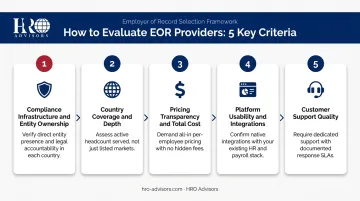
Providers were assessed across five criteria:
- Compliance infrastructure and entity ownership — owned entities vs. third-party partner networks
- Country coverage and depth — breadth and reliability of presence in key hiring markets
- Pricing transparency and total cost of employment — public rates, hidden fees, FX markups, benefit markups
- Platform usability and integration capability — HRIS features, integrations, onboarding workflows
- Customer support quality — responsiveness, dedicated management, escalation paths
A surprisingly common mistake: choosing an EOR based on country count or the lowest headline price, without verifying what's actually behind that coverage.
Why Entity Ownership Matters
Providers that operate through their own licensed entities in each country have direct accountability for local compliance — no intermediary, no handoff risk. Those that rely on in-country partners can still deliver compliant employment, but quality depends on their infrastructure.
This distinction matters most in complex jurisdictions like France, Germany, Brazil, and India, where labor law is strict and enforcement is active.
Understanding Pricing
EOR pricing typically takes one of two forms: a fixed monthly fee per employee or a percentage of total payroll. Publicly listed starting prices from official provider pages run from $199/month (Remofirst) to $599/month (Deel and Remote.com). G-P and Rippling require custom quotes.
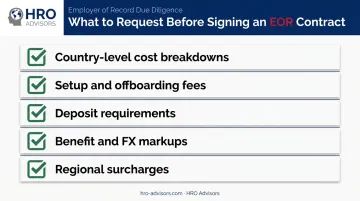
Before signing, always request:
- Country-level cost breakdowns
- Setup and offboarding fees
- Deposit requirements
- Benefit and FX markups
- Any regional surcharges
EOR vs. PEO: A Quick Distinction
Once pricing is clear, it's worth confirming which model you actually need. EOR services are designed for international hiring in markets where your company has no legal entity. PEO (Professional Employer Organization) services co-employ workers alongside an existing domestic entity and are better suited to domestic HR outsourcing. If you're primarily hiring within the US, a PEO may deliver more value than an EOR.
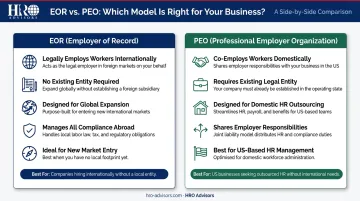
HRO Advisors offers free consultations to help businesses compare PEO and EOR options side-by-side — useful for teams that are unsure which model fits their workforce structure.
Conclusion
The best EOR service isn't the one with the most countries or the lowest sticker price. It's the one whose compliance infrastructure, pricing model, and support capabilities actually align with your hiring markets, team size, and growth trajectory.
Before committing to any provider: confirm entity ownership in your target countries, request transparent country-level pricing (including fees and markups), and assess whether your team size warrants a budget entry-point provider, a mid-market platform, or an enterprise-grade solution.
For businesses navigating the EOR versus PEO decision — or unsure which provider is the right fit — HRO Advisors offers a free consultation that compares providers side-by-side. With access to 500+ HR outsourcing providers and direct negotiation on your behalf, HRO Advisors helps US businesses identify the right partner and secure better rates — at no cost to you.
Call: 866-755-0288 | Email: info@hro-advisors.com
Frequently Asked Questions
How much do employer of record services typically cost?
Publicly listed starting prices range from $199 to $599 per employee per month based on official provider pages. Enterprise providers like G-P and Rippling require custom quotes, which commonly run higher. The two main pricing models are a flat monthly fee per employee or a percentage of gross salary. Costs vary by country, headcount, and compliance complexity.
What is the best HR software for employer of record services?
EOR platforms are distinct from standalone HR software — providers like Deel, Remote.com, and Rippling include built-in HR tools within their EOR product. Some companies pair a dedicated EOR with their existing HRIS via integrations. The right choice depends on whether you need an all-in-one platform or prefer layering EOR onto existing systems.
What is the difference between an EOR and a PEO?
An EOR becomes the legal employer of workers in countries where the client has no entity, managing payroll and compliance entirely. A PEO co-employs workers alongside an existing domestic entity, sharing employer responsibilities. EOR is built for global expansion; PEO is designed for domestic HR outsourcing.
When should a business use an EOR instead of setting up a local entity?
EOR is generally the better choice when entering a new market for the first time, when headcount in a single country is small, or when testing market viability before committing to a permanent setup. Entity establishment can take months and carries significant administrative overhead. EOR provides a faster, lower-commitment path to compliant employment.
Do EOR services handle compliance in multiple countries?
Yes. Global EOR providers manage local labor law compliance, payroll tax filings, statutory benefits, and employment contracts across all countries they cover. Quality varies depending on whether the provider uses owned entities or third-party in-country partners.
What should I look for when choosing an EOR provider?
Prioritize these criteria when evaluating providers:
- Entity model: owned entities vs. third-party in-country partners
- Pricing transparency: all fees and markups disclosed upfront
- Country coverage: confirmed presence in your specific target markets
- Compliance depth: local labor law, tax filings, and statutory benefits
- Support scalability: capacity to grow with your headcount
Verify each point directly with the provider before committing.