That shift is backed by numbers. The CDC reports that employers can yield $3 to $15 for every $1 invested in workplace health promotion programs. Meanwhile, KFF's 2025 Employer Health Benefits Survey shows that 83% of large firms already offer at least one wellness program—smoking cessation, weight management, or lifestyle coaching—compared to just 56% of small firms. The gap is real, and it's costing smaller employers more in claims and turnover than they realize.
This article identifies the top group health insurers with the strongest wellness benefits, explains how to evaluate them, and covers what employers often miss when selecting a group health plan.
Key Takeaways
- UnitedHealthcare, Aetna, Cigna, Humana, and BCBS/Anthem each offer dedicated wellness platforms beyond basic coverage
- Wellness programs vary significantly: some focus on biometrics and physical health, others add behavioral, financial, and maternity support
- The right insurer depends on your workforce profile, geographic footprint, and wellness priorities — premium cost is only one factor
- Small and mid-size businesses can access large-group pricing and carrier tiers through PEO arrangements
- Compare participation incentives, digital tools, and behavioral health coverage — not just plan type and network
What Group Health Insurance and Wellness Benefits Actually Cover
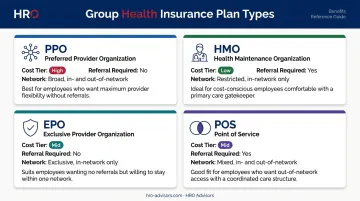
Group health insurance covers employees (and eligible dependents) under a single employer-sponsored policy, with premiums split between employer and employee. Plan structures vary by network flexibility and cost-sharing design:
- PPO (Preferred Provider Organization) — broadest network access, higher premiums
- HMO (Health Maintenance Organization) — lower cost, requires referrals and in-network care
- EPO (Exclusive Provider Organization) — mid-range cost, no referrals but network-restricted
- POS (Point of Service) — hybrid model combining HMO and PPO features
The scale of employer-sponsored coverage is significant. According to the U.S. Census Bureau's 2024 coverage report, 63.2% of adults ages 19 to 64 had employment-based health coverage in 2024, making it the dominant channel for working-age Americans.
Wellness benefits sit at the front of the cost curve—they address health risks before they become claims. When employees use preventive screenings, health coaching, and mental health resources, employers see fewer hospitalizations, lower absenteeism, and measurable productivity gains over time.
That ROI is what shapes this review. The insurers below were selected based on the depth and variety of their wellness programs alongside their group health plan capabilities. Businesses working through a PEO can frequently access these plans at group rates that aren't available in the direct small-group market.
Top Group Health Insurers with Strong Wellness Benefits
Choosing the right group health insurer means more than comparing premiums. For employers focused on workforce health and retention, the depth of built-in wellness programming matters just as much as coverage. Each insurer below was evaluated across four dimensions: wellness programming depth, group plan quality, employer support resources, and overall market presence.
UnitedHealthcare
UnitedHealthcare is the largest health insurer in the US by premium volume, holding $269.45 billion in direct written premiums and 16.05% market share per NAIC's 2024 data. It offers group health plans for employers of all sizes across PPO, HMO, and EPO structures.
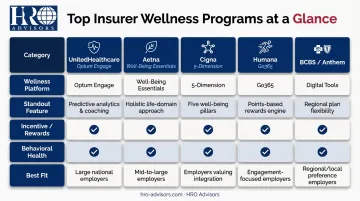
UHC's wellness platform, formerly Rally Health and now rebranded as Optum Engage as of 2026, centers on rewarding employees for measurable health behaviors. Employees can earn up to $1,000 for activities including step tracking, active minutes, health surveys, and biometric screenings. The platform also includes One Pass Select for fitness access, Real Appeal for weight management, and Quit For Life for tobacco cessation.
| Feature | Details |
|---|---|
| Key Wellness Programs | Optum Engage (step/activity tracking, biometric screenings, health assessments), One Pass Select, Real Appeal, Quit For Life |
| Standout Feature | Rewards system offering up to $1,000 for verified healthy activities—tied directly to the health plan |
| Best Suited For | Mid-to-large employers wanting a tech-driven, incentive-based wellness platform with broad plan type options |
Aetna (CVS Health)
Aetna is a top-five US health insurer now operating under CVS Health, ranking #2 by NAIC premium volume with $121.24 billion in direct written premiums in 2024. Its group health plans give employers access to CVS retail health resources alongside core coverage.
Aetna's Well-Being Essentials program is its primary employer wellness offering. Its standout feature is the Culture of Well-Being diagnostic tool, which evaluates a company's programs across six dimensions of well-being and produces a strategic roadmap with a dedicated consultant.
Employers also receive lifestyle coaching options and a well-being allowance. Aetna's behavioral health network spans 257,219 behavioral health providers and 89,196 EAP providers nationwide.
| Feature | Details |
|---|---|
| Key Wellness Programs | Well-Being Essentials, Culture of Well-Being diagnostic, lifestyle coaching, EAP, women's health resources |
| Standout Feature | Six-dimension wellness gap analysis with a dedicated consultant and strategic roadmap |
| Best Suited For | Employers wanting a consultative, data-driven wellness strategy with coaching support and behavioral health depth |
Cigna Healthcare
Cigna serves employers across multiple industries with a focus on whole-person health. It ranks #8 nationally by NAIC premium volume with $41.92 billion in direct written premiums in 2024, primarily serving commercial employer groups.
Cigna's wellness framework addresses five dimensions: physical, emotional, environmental, financial, and social. Employers with 51 to 2,999 eligible employees are paired with a Health Engagement Consultant, a dedicated resource that tailors the wellness program to the specific culture and workforce of each employer. Additional tools include Cigna Health Matters, health assessments, the Healthy Rewards Program, and an EAP providing access to licensed clinicians and work/life resources.
| Feature | Details |
|---|---|
| Key Wellness Programs | Five-dimension wellness model, Health Engagement Consultants, Healthy Rewards, Cigna Health Matters, EAP |
| Standout Feature | Dedicated Engagement Consultant for accounts with 51–2,999 employees, customizing the wellness approach to each employer |
| Best Suited For | Employers prioritizing a holistic wellness strategy that includes financial and environmental dimensions alongside physical health |
Humana
Humana ranks #4 nationally by NAIC premium volume with $110.55 billion in direct written premiums in 2024. It serves both employer groups and Medicare members, with a strong emphasis on measurable health outcomes.
Humana's Go365 platform drives engagement through healthy actions and a rewards system. Members earn points for completing health activities and redeem them for gift cards. The platform incorporates biometric screenings, health assessments, and device connectivity. Employers can access Go365's resource hub, which includes instructional materials and tools for planning and promoting worksite wellness initiatives internally.
| Feature | Details |
|---|---|
| Key Wellness Programs | Go365 (biometric screenings, health assessments, rewards, device connectivity), employer engagement resource hub |
| Standout Feature | Employer-facing resource hub providing tools to actively manage and promote wellness initiatives at the worksite |
| Best Suited For | Employers wanting a structured, outcomes-based wellness program with biometric data integration and measurable health benchmarks |
Blue Cross Blue Shield / Anthem (Elevance Health)
BCBS covers 1 in 3 Americans through its affiliated plans, with access to 97% of US hospitals and 83% of physicians nationwide. Anthem (now Elevance Health) is one of the largest BCBS-affiliated group insurers, ranking #5 nationally with $108.18 billion in direct written premiums in 2024.
BCBS offers Blue365, a discount and wellness platform with mental health and mindfulness resources through partners like eMindful, plus a personalized wellness-plan tool. Anthem adds a 24/7 NurseLine, Future Moms healthy pregnancy coaching, and a comprehensive behavioral health EAP covering confidential counseling, depression, anxiety, substance use, and stress management.
Together, these offerings give multi-state employers strong coverage across mental, emotional, and prenatal wellness.
| Feature | Details |
|---|---|
| Key Wellness Programs | Blue365 (discounts, mental health), Anthem EAP (behavioral health, stress, anxiety, substance use), Future Moms, 24/7 NurseLine |
| Standout Feature | Integrated behavioral health and maternity support alongside traditional wellness tools—covering mental, emotional, and prenatal wellness comprehensively |
| Best Suited For | Employers with multi-state workforces needing broad network access and particularly strong mental health and maternity wellness coverage |
How to Evaluate Group Health Insurers (And What Employers Get Wrong)
The Evaluation Framework
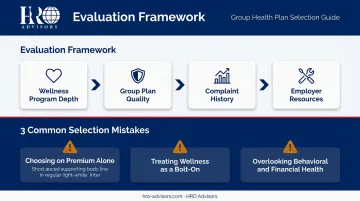
When comparing group health insurers for wellness program quality, assess across four dimensions:
- Wellness program depth — digital tools, coaching options, program variety, and whether behavioral/financial health are included
- Group health plan quality — network breadth, plan types (PPO, HMO, EPO), and employer support infrastructure
- Complaint history — NAIC's Consumer Insurance Search lets employers look up complaint and financial data by insurer; NCQA Health Plan Ratings and J.D. Power's 2024 Commercial Member Health Plan Study (which measured satisfaction across 29,188 members in 147 health plans) are also useful benchmarks
- Employer resources — onboarding tools, engagement consultants, reporting capabilities, and integration between the wellness platform and the health plan Knowing what to measure matters—but employers still make predictable mistakes when it's time to choose.
Common Selection Mistakes
Three mistakes consistently drive poor outcomes:
- Choosing on premium cost alone. KFF reports 2025 employer family premiums average $26,993, with workers contributing $6,850. The real number to watch is total claims spend—low premiums without strong preventive care programs often push it higher over time.
- Treating wellness as a bolt-on. When the wellness platform doesn't connect to the health plan, participation drops and behavior rarely changes. Look for insurers where completing wellness activities links directly to rewards or care navigation.
- Overlooking behavioral and financial health. Physical health programs alone miss major drivers of absenteeism and productivity loss. Cigna's five-dimension model and Aetna's six-dimension diagnostic reflect what the data shows: physical health is only part of the picture.
Also factor in market presence and financial stability. NAIC premium volume gives a quick read on network depth—larger, established insurers typically carry broader provider networks and more negotiating leverage with health systems.
Frequently Asked Questions
Who are the big 5 health insurance companies?
By NAIC 2024 accident and health direct written premiums, the five largest US insurers are UnitedHealth Group ($269.45B), CVS Health/Aetna ($121.24B), Centene ($113.19B), Humana ($110.55B), and Elevance Health/Anthem ($108.18B). Note that market share reflects premium volume and network scale—not wellness program quality for employer groups.
What are the best corporate wellness programs?
The strongest insurer-based programs are UHC's Optum Engage, Aetna's Well-Being Essentials, Cigna's five-dimension wellness platform, Humana's Go365, and Anthem's behavioral health EAP suite. The best choice depends on which health dimensions—physical, mental, financial—your workforce most needs.
What wellness benefits should I look for in a group health plan?
Prioritize plans with a dedicated digital wellness platform, behavioral and mental health support (EAP and coaching), preventive care integration (biometric screenings, health assessments), and measurable outcome tracking. A wellness program integrated directly into the health plan drives far higher participation than a standalone add-on.
Can small businesses access the same wellness programs as large corporations?
Not easily through the direct market. Small businesses typically face higher costs and limited plan options on their own. Through a Professional Employer Organization (PEO), employees are pooled across many companies, unlocking access to large-group health plans—including the wellness suites described above—that small employers can't access independently.
How do wellness programs help reduce group health insurance costs?
The CDC estimates employers can yield $3 to $15 for every $1 invested in workplace health promotion. Those savings come from increased preventive care use, lower chronic disease risk, reduced absenteeism, and fewer high-cost hospitalizations.
How does a PEO help businesses get better group health insurance with wellness benefits?
PEOs co-employ a business's workforce, pooling employees across multiple companies to negotiate group health insurance rates and benefit packages—including full wellness suites—that small businesses can't access on their own. A PEO broker like HRO Advisors helps businesses compare 3–8 PEO options side-by-side at no cost to the employer.
The Bottom Line
Choosing a group health insurer is no longer just a cost exercise. The wellness benefits built into the plan determine whether employees actually engage with their health—and that engagement is what drives down claims, reduces absenteeism, and helps employers retain talent over time.
Before finalizing a group health plan, evaluate wellness program depth, participation incentives, digital tools, and behavioral health coverage alongside premiums and network size. Reassess annually as your workforce evolves.
For small and mid-size businesses, that evaluation hits a wall quickly. Insurers offer richer terms to larger employee pools, leaving smaller employers with limited options in the direct market. Working with a PEO broker like HRO Advisors gives businesses access to 3–8 vetted PEO partners compared side-by-side, including Fortune 500-level health plans and full wellness benefit suites at rates not available outside group purchasing arrangements.
The comparison process is free and doesn't add to your costs. Reach HRO Advisors at 866-755-0288 or info@hro-advisors.com.